Sf: tidyverse::*_join returns different results depending on the order of the parameters
Example dataset
library(sf)
library(tidyverse)

set.seed(42)

nc_sf <- sf::st_read(system.file("shape/nc.shp", package = "sf"), quiet = TRUE)

nc_df <- data.frame(
  CNTY_ID     = nc_sf$CNTY_ID,
  choosen_one = sample(c(TRUE, FALSE), nrow(nc_sf), replace=TRUE)
)
Problem
This will work:
nc_sf %>%
  left_join(nc_df, by="CNTY_ID") %>%
  ggplot() +
  geom_sf(aes(fill=choosen_one))
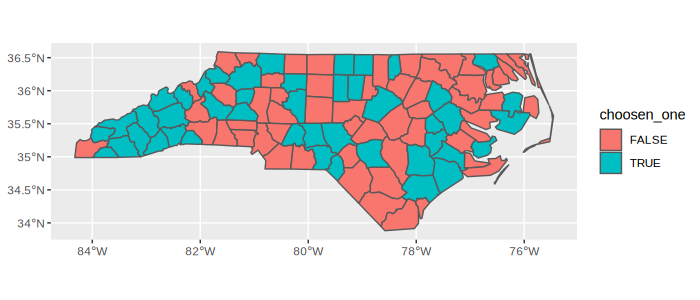
This will not work:
nc_df %>%
  right_join(nc_sf, by="CNTY_ID") %>%
  ggplot() +
  geom_sf(aes(fill=choosen_one))
Gives: Error: stat_sf requires the following missing aesthetics: geometry
Even if I explicitly puts the geometry in the aes, it will not work
nc_df %>%
  right_join(nc_sf, by="CNTY_ID") %>%
  ggplot() +
  geom_sf(aes(geometry=geometry, fill=choosen_one))
Gives: Error in if (type == "point") { : argument is of length zero
Expected behaviour
Is this the expected behavior or there is a bug?
My intuition would expect that left_join(a, b) have the same semantics and should return the same result as right_join(b, a).
Tests
I noticed that the object returned by left_join and right_join are different.
The first command, with lef_join, returns both the sf and data.frame objects. The second command, with right_join, returns only the data.frame object.
I tested a couple of function calls, changing the order of the parameters and also using the base merge function.
left_join(nc_sf, nc_df, by="CNTY_ID") %>% class # works, returning `sf` and `data.frame`
right_join(nc_sf, nc_df, by="CNTY_ID") %>% class # works, returning `sf` and `data.frame`
left_join(nc_df, nc_sf, by="CNTY_ID") %>% class # does not work, returning only the `data.frame`
right_join(nc_df, nc_sf, by="CNTY_ID") %>% class # does not work, returning only the `data.frame`
merge(nc_sf, nc_df, by="CNTY_ID") %>% class # works, returning `sf` and `data.frame`
merge(nc_df, nc_sf, by="CNTY_ID") %>% class # does not work, returning only the `data.frame`
Conclusion
Merge/join functions will work only if the sf object is the first parameter of the function call, no matter if it is a left join or right join.
System Environment
Library versions:
> library(sf)
Linking to GEOS 3.8.0, GDAL 3.0.4, PROJ 6.3.1
> library(tidyverse)
── Attaching packages ─────────────────────────────────────── tidyverse 1.3.0 ──
✔ ggplot2 3.3.0     ✔ purrr   0.3.4
✔ tibble  3.0.1     ✔ dplyr   0.8.5
✔ tidyr   1.0.2     ✔ stringr 1.4.0
✔ readr   1.3.1     ✔ forcats 0.5.0
── Conflicts ────────────────────────────────────────── tidyverse_conflicts() ──
✖ dplyr::filter() masks stats::filter()
✖ dplyr::lag()    masks stats::lag()
>
 gabrielmagno
All 2 comments
This simply can't work because of how S3 classes work in general in R. Method dispatch is based only on the first argument and consequently:
- if you call
left_join(sf_object, data_frame_object)a method forsfobjects is dispatched (that is defined in _sf_ package), that treatssfobject properly and returnssfobject; - if you call
right_join(data_frame_object, sf_object)a method fordata.frameobjects is dispatched (that is regular _dplyr_right_join) that doesn't care at all aboutsf_objectis somewhat special and returns regular data frame (to be precise atibble).
 tzoltak
on 12 May 2020
tzoltak
on 12 May 2020
@tzoltak that's true, but not complete — in dplyr, we certainly could choose to implement double dispatch so that left_join(x, y) and right_join(y, x) return the same type of thing, but we deliberately chose not to.
We did this partly because getting all the details requires a complicated algorithm (so it's much harder to explain than returning the same type as the left-hand side), and partly because it's not obvious what you should get if you (say) join a sf and a data table, or a data table and a grouped df, or ...
 hadley
on 20 May 2020
hadley
on 20 May 2020
Related issues
 happyshows
·
3Comments
happyshows
·
3Comments
 angela-li
·
4Comments
angela-li
·
4Comments
 adrfantini
·
4Comments
adrfantini
·
4Comments
 kendonB
·
4Comments
kendonB
·
4Comments
 dkyleward
·
4Comments
dkyleward
·
4Comments
Most helpful comment
This simply can't work because of how S3 classes work in general in R. Method dispatch is based only on the first argument and consequently:
left_join(sf_object, data_frame_object)a method forsfobjects is dispatched (that is defined in _sf_ package), that treatssfobject properly and returnssfobject;right_join(data_frame_object, sf_object)a method fordata.frameobjects is dispatched (that is regular _dplyr_right_join) that doesn't care at all aboutsf_objectis somewhat special and returns regular data frame (to be precise atibble).