Sf: Odd behavior of st_intersection when using multipolygons
I'm finding that the order in which I contruct a MULTIPOLYGON affects the behavior of st_intersection.
When I construct the multipolygon using st_multipolygon(list(list(square_out), list(square_small))) the behavior is as expected but when I use st_multipolygon(list(list(square_out, square_small))) I end up with only the first element (square_out) getting intersected. Is this expected behavior?
See below:
library(sf); library(mapview); library(tidyverse)
#> Linking to GEOS 3.6.1, GDAL 2.2.3, PROJ 4.9.3
square <- cbind(c(0,0, 1, 1, 0), c(0, 1, 1, 0, 0))
square_out <- square + 1
square_small <- square*0.5


poly_1 <- st_multipolygon(list(list(square))) %>%
  st_sfc() %>%
  st_sf()
poly_2a <- st_multipolygon(list(list(square_out), list(square_small))) %>%
  st_sfc() %>%
  st_sf()
poly_2b <- st_multipolygon(list(list(square_out, square_small))) %>%
  st_sfc() %>%
  st_sf()

plot1 <- poly_1 %>%
  ggplot() +
  geom_sf(fill = "blue", alpha = 0.4) +
  geom_sf(data = poly_2a, fill = "red", alpha = 0.4) +
  theme_bw()

plot2 <- poly_1 %>%
  ggplot() +
  geom_sf(fill = "blue", alpha = 0.4) +
  geom_sf(data = poly_2b, fill = "red", alpha = 0.4) +
  theme_bw()

# Both appear to be legitimate:
cowplot::plot_grid(plot1, plot2, nrow = 1)

st_intersection(poly_2a, poly_1) # works
#> Simple feature collection with 1 feature and 0 fields
#> geometry type:  GEOMETRYCOLLECTION
#> dimension:      XY
#> bbox:           xmin: 0 ymin: 0 xmax: 1 ymax: 1
#> epsg (SRID):    NA
#> proj4string:    NA
#>                         geometry
#> 1 GEOMETRYCOLLECTION (POINT (...
st_intersection(poly_2b, poly_1) # fails
#> Simple feature collection with 1 feature and 0 fields
#> geometry type:  POINT
#> dimension:      XY
#> bbox:           xmin: 1 ymin: 1 xmax: 1 ymax: 1
#> epsg (SRID):    NA
#> proj4string:    NA
#>      geometry
#> 1 POINT (1 1)
Created on 2018-12-10 by the reprex package (v0.2.1.9000)
 kendonB
All 4 comments
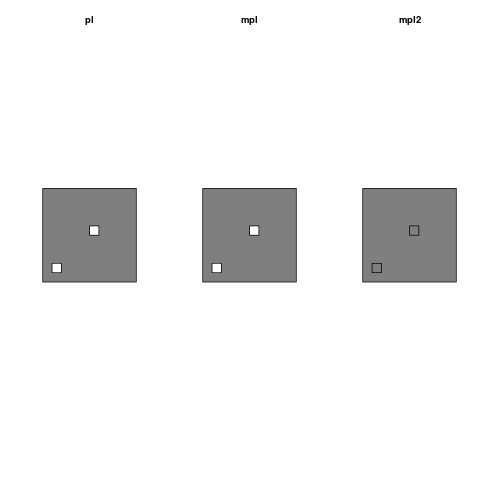
Sorry if I'm missing something obvious or I'm just plain wrong, but it looks to me like poly_2b is an invalid geometry. For instance, on my system, sf::st_is_valid(poly_2b) returns FALSE. If my understanding is correct, this is because the second polygon in poly_2b is actually defined to be a hole inside the first polygon. In other words, when you create a st_polygon with multiple polygons in the input list (which AFAIK is what you're doing with poly_2b), the first polygon should be the "outer border" and the subsequent polygons should define the "borders of the holes" inside the first polygons (apologies - I don't know the correct terminology). But here, the hole (i.e. the second polygon) in poly_2b is located outside the "border polygon (i.e. the first polygon).
Here's some code that might help with understanding how st_polygon and st_multipolygon interpret input arguments. In the plots below, the "holes" are in coloured in white and the "filled in geometries" are coloured in "grey".
# load package
library(sf)

# create raw polygon coordinate data
outer <- matrix(c(0,0,10,0,10,10,0,10,0,0),ncol=2, byrow=TRUE)
hole1 <- matrix(c(1,1,1,2,2,2,2,1,1,1),ncol=2, byrow=TRUE)
hole2 <- matrix(c(5,5,5,6,6,6,6,5,5,5),ncol=2, byrow=TRUE)

# create polygon with two holes
pl <- st_polygon(list(outer, hole1, hole2))

# create a multipolygon that contains one polygon with two holes
mpl <- st_multipolygon(list(list(outer, hole1, hole2)))

# create a multipolygon that contains three polygons, each with no holes
mpl2 <- st_multipolygon(list(list(outer), list(hole1), list(hole2)))

# plot the geometries to visually compare
par(mfrow = c(1, 3))
plot(pl, col = "grey50", main = "pl")
plot(mpl, col = "grey50", main = "mpl")
plot(mpl2, col = "grey50", main = "mpl2")
 jeffreyhanson
on 10 Dec 2018
jeffreyhanson
on 10 Dec 2018
Fantastic - I get it!
kendonB
on 10 Dec 2018
@jeffreyhanson Should st_multipolygon check this sort of validity at construction? Or is that too burdensome?
kendonB
on 10 Dec 2018
I don't know. Perhaps others with more experience in how long sf::st_is_valid takes to run might be able to answer? But I feel like being able to create and store invalid geometries is very helpful when working with "real world data" that so very often contains invalid geometries that first need to be fixed prior to analysis, so I wouldn't want functions like st_multipolygon to throw an error and refuse to create invalid geometries.
jeffreyhanson
on 10 Dec 2018
Related issues
kendonB
·
3Comments
kendonB
·
3Comments
 RemkoDuursma
·
4Comments
RemkoDuursma
·
4Comments
 angela-li
·
4Comments
angela-li
·
4Comments
 faridcher
·
4Comments
faridcher
·
4Comments
Most helpful comment
I don't know. Perhaps others with more experience in how long
sf::st_is_validtakes to run might be able to answer? But I feel like being able to create and store invalid geometries is very helpful when working with "real world data" that so very often contains invalid geometries that first need to be fixed prior to analysis, so I wouldn't want functions likest_multipolygonto throw an error and refuse to create invalid geometries.