Currently st_intersection(x, y) intersects all geometries in x with all geometries in y. Would it be possible to have an option that can be vectorized to compute intersections between pairs of x and y?
Background for this is that I have a very large sf object and want to check for overlapping polygons. I am first using st_intersect to figure out which polygons have intersections, and want to take the output from that to make pairs of sf objects that I use as the parameters for st_intersection. Right now, I am combining st_intersection with map from purrr, but this has proven to be very computationally demanding.
Any insight would be greatly appreciated!
 yixinsun1216
All 30 comments
Can you provide a reproducible example? I have no idea what you mean by 'very large' but I routinely use st_intersection on layers of all feature types with 200k+ rows and 30+ columns. I have found computing time to be generally acceptable (<10-15 minutes usually).
 tim-salabim
on 30 Nov 2017
tim-salabim
on 30 Nov 2017
... and do give your sessionInfo()!
 edzer
on 30 Nov 2017
edzer
on 30 Nov 2017
Sorry here's the sessionInfo
> sessionInfo()
R version 3.3.2 (2016-10-31)
Platform: x86_64-w64-mingw32/x64 (64-bit)
Running under: Windows >= 8 x64 (build 9200)
locale:
[1] LC_COLLATE=English_United States.1252 LC_CTYPE=English_United States.1252 LC_MONETARY=English_United States.1252
[4] LC_NUMERIC=C LC_TIME=English_United States.1252
attached base packages:
[1] stats graphics grDevices utils datasets methods base
other attached packages:
[1] sf_0.5-6
loaded via a namespace (and not attached):
[1] magrittr_1.5 class_7.3-14 DBI_0.7 tools_3.3.2 units_0.4-6 Rcpp_0.12.14 udunits2_0.13
[8] grid_3.3.2 e1071_1.6-8 texreg_1.36.23 classInt_0.1-24
I can't share the proprietary dataset, but it is has ~500,000 multipolygons/polygons that I want to intersect with itself. Below is an example of how I am currently doing pairwise intersection using 4 simple polygons
library(dplyr)
library(sf)
library(purrr)
# creating the polygons
df1 <-
list(matrix(c(2,4,4,1,2, 2,3,5,4,2), ncol = 2),
matrix(c(5,4,2,5, 2,3,2,2), ncol = 2)) %>%
map(function(x) st_polygon(list(x))) %>%
st_sfc
df2 <-
list(matrix(c(5, 3, 2, 5, 2, 3, 2, 2), ncol = 2),
matrix(c(2, 3, 3, 2, 2, 3, 3, 5, 4, 3), ncol = 2)) %>%
map(function(x) st_polygon(list(x))) %>%
st_sfc
# Output
> st_intersection(df1, df2)
Geometry set for 3 features
geometry type: POLYGON
dimension: XY
bbox: xmin: 2 ymin: 2 xmax: 5 ymax: 4.666667
epsg (SRID): NA
proj4string: NA
POLYGON ((3.5 2.75, 2 2, 3 3, 3.5 2.75))
POLYGON ((2 2, 3.5 2.75, 5 2, 2 2))
POLYGON ((2.5 4.5, 3 4.66666666666667, 3 3, 2 3...
# What I would like to do for pairwise intersection
> map2(df1, df2, st_intersection)
[[1]]
POLYGON ((3.5 2.75, 2 2, 3 3, 3.5 2.75))
[[2]]
GEOMETRYCOLLECTION EMPTY
I meant the sessionInfo() after loading sf.
edzer
on 30 Nov 2017
I edited the last post to reflect the sessionInfo
yixinsun1216
on 30 Nov 2017
Is it right that the st_intersection takes about 20 times as long as st_intersects?
edzer
on 30 Nov 2017
When I run it on the whole dataset, st_intersect takes about 10 min while st_intersection takes more than a day
yixinsun1216
on 30 Nov 2017
How much RAM does the machine have?
edzer
on 30 Nov 2017
16 gb. At this point I'm ok letting it just run on my computer overnight - but wanted to take a shot in the dark at seeing if it can be vectorized using st_intersection!
yixinsun1216
on 30 Nov 2017
I think your own solution map is the way to go, now.
edzer
on 3 Dec 2017
Here's an approach that uses data.table. I have no idea whether this is actually any faster than your solution using map2, but I would appreciate and be very interested in getting feedback how it performs in your case. We are still learning how to data.table with sf so any experiences with real-world cases are valuable.
library(dplyr)
library(sf)
library(mapview)
library(data.table)
nc = read_sf(system.file("gpkg/nc.gpkg", package="sf"))
sfc1 = st_geometry(nc)
sfc2 = st_jitter(st_geometry(nc), amount = 0.05)
mapview(list(sfc1, sfc2))
dt = data.table(ID = seq_along(sfc1),
geom1 = sfc1,
geom2 = sfc2)
dt[, int := list(st_intersection(geom1, geom2)), by = "ID"]
mapview(sfc1[56]) +
mapview(sfc2[56], col.regions = "green") +
mapview(dt$int[56], col.regions = "red")
Hi @edzer @tim-salabim,
continuing the Twitter discussion here.
Runtime
sf: 1.61 days (points, poly) and 1.63 days (poly, points) on a 2.1 GHz Debian 9 system.
ArcGIS : < 1 min
QGIS: Quit QGIS2 due to being unresponsive after 2h, QGIS3 unchecked yet
Reprex
library(sf)
files <- download.file("http://www.geoinf.uni-jena.de/~bi28yuv/st_intersection_reprex/files.zip", "files.zip")
unzip("files.zip")
points <- st_read("points.shp")
polygons <- st_read("poly.shp")
time <- Sys.time()
out <- st_intersection(points, polygons)
time <- Sys.time() - time
print(time)
 pat-s
on 27 Feb 2018
pat-s
on 27 Feb 2018
Seems like you're trying to rasterize polygons, for which st_intersection might not be the most efficient approach. Maybe try fasterize?
edzer
on 27 Feb 2018
Yes and no.
First, I want to have a point feature to use it for spatial prediction with information from all predictors.That's why I am doing the st_intersection; I essentially just want to extract the polygon information to the points. And for that, st_intersection should be the right tool?
This point feature is gridded because later I'll transform it into a raster with 200x200m so that I have a spatial prediction map.
pat-s
on 27 Feb 2018
st_join(points, polygons[1:10, ]) takes about 45 seconds compared to about 6 minutes for st_intersection(points, polygons[1:10, ]). Obviously this ratio may increase or decrease for the whole set. But I think it's worth a try.
tim-salabim
on 27 Feb 2018
The MULTIPOLYGONs are soil types or something like that, and largely overlap. Since the spatial index works from bounding boxes, polygons with mostly overlapping bounding boxes are not efficiently indexed (Tim's example of waterways). Casting object polygons to POLYGON and using that as first argument seems to speed up things quite dramatically:
> p <- polygons %>% st_cast("POLYGON")
Warning message:
In st_cast.sf(., "POLYGON") :
repeating attributes for all sub-geometries for which they may not be constant
> system.time(out <- st_intersection(p, points[sample(nrow(points),500),]))
user system elapsed
3.094 0.000 3.094
Warning message:
attribute variables are assumed to be spatially constant throughout all geometries
> system.time(out <- st_intersection(polygons, points[sample(nrow(points),500),]))
user system elapsed
64.804 0.003 64.808
Warning message:
attribute variables are assumed to be spatially constant throughout all geometries
And the combination of both runs in less than a minute for the whole set, just like ArcGIS:
library(sf)

# files <- download.file("http://www.geoinf.uni-jena.de/~bi28yuv/st_intersection_reprex/files.zip", "files.zip")
# unzip("files.zip")

points <- st_read("points.shp")
polygons <- st_read("poly.shp") %>% st_cast("POLYGON")

system.time({
  tst = st_join(points, polygons)
})

   user  system elapsed
 32.698   0.012  32.708

head(tst)
Simple feature collection with 6 features and 2 fields
geometry type:  POINT
dimension:      XY
bbox:           xmin: 532900 ymin: 4702500 xmax: 533500 ymax: 4702700
epsg (SRID):    32630
proj4string:    +proj=utm +zone=30 +datum=WGS84 +units=m +no_defs
  OBJECTID COD_LITOLO               geometry
1        1         01 POINT (533100 4702500)
2        2         08 POINT (533300 4702500)
3        3         01 POINT (533500 4702500)
4        4         01 POINT (532900 4702700)
5        5         01 POINT (533100 4702700)
6        6         08 POINT (533300 4702700)
I think we know what ArcGIS is doing in case of point-polygon intersection - use binary predicates to get intersection ids and join attributes based on these ids.
tim-salabim
on 27 Feb 2018
Awesome!
So lesson learned: Convert MULTIPOLYGON to POLYGON and use st_join in favor of st_intersection if both features overlap (?).
If the runtime difference is that crucial and the outcome is equivalent, maybe a note in the help file for st_intersection would be helpful for users?
pat-s
on 27 Feb 2018
I usually use st_join when dealing with point-polygon intersections where geometries don't change. For poly-poly or poly-line etc. it depends on the intended outcome (i.e. if the intersected geometries are needed - st_intersection- or if we merely want to know which intersections exist - st_intersects). The latter is much faster and is used by default in st_join.
tim-salabim
on 27 Feb 2018
Good to know. Could be worth a blog post. Guess I'm not the first and last facing such a problem.
Especially because point-poly intersections are quite common and other users from apps like ArcGIS are used to the "intersection" keyword and therefore are naturally directed to st_intersection instead of st_join.
The st_cast("POLYGON") is nice to additionally speed it up but there should be more awareness of when to use which function (st_join/st_intersection).
This could be reached by a blog post + a note in the help file (or even a warning if a point-poly operation is detected).
I'm sure Edzer will find a good solution :smile:
pat-s
on 27 Feb 2018
How to return the output of st_bbox(st_geometry(polygons)[[1]]) as an sfg object, so that lapply() could create a picture of the overlapping envelopes - to make plainer why using precise small envelopes matters for point-in polygon? A side point, is Rcpp::checkUserInterrupt() feasible in geos.cpp? I don't think we did it in rgeos to avoid housekeeping costs.
 rsbivand
on 27 Feb 2018
rsbivand
on 27 Feb 2018
@rsbivand you can get a sfc with st_as_sfc(st_bbox(polygons[1, ])).
Rcpp::checkUserInterrupt() would be great (I cannot count the times I had to kill the process).
tim-salabim
on 27 Feb 2018
Check geos.cpp: R_CheckUserInterrupt() is in practically every (outer) loop.
edzer
on 27 Feb 2018
@edzer forgot about CAPI. @tim-salabim no progress - need an sf or sfc containing all the bbox-derived POLYGON objects. I get to:
library(sf)
mp <- st_read("poly.shp")
o <- lapply(1:nrow(mp), function(i) st_as_sfc(st_bbox(mp[i,])))
but cannot create a single sfc out of n single entity sfc's. Then I want to show how much overlaps for the input gerrymandered case and demonstrate why spatial indexing obviously breaks down when most of the points could be in most of the polygons when indexed by envelope/bbox. The was an idea of a blog or similar, so I thought it would be easy.
rsbivand
on 28 Feb 2018
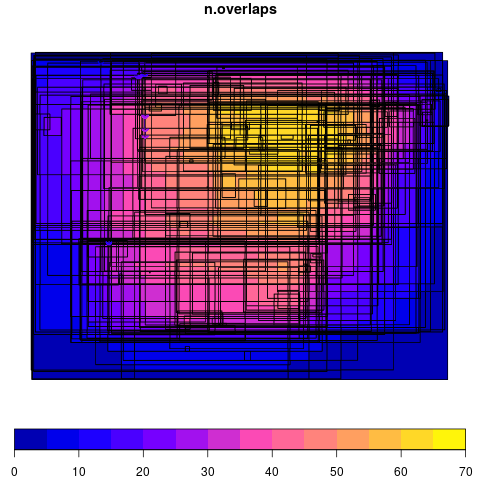
Then:
x = do.call(c, o)
i = st_intersection(st_sf(x))
plot(i["n.overlaps"])
edzer
on 28 Feb 2018
This simplification allows you to do
o <- lapply(st_geometry(mp), function(x) st_as_sfc(st_bbox(x)))
Thanks, my mistake was "rbind" not "c" in do.call(). In sp/rgeos, the median bbox overlaps for multipolygons was 47, for polygons was 3. I haven't got to the area proportions being searched multiple times, but the figure as it is shows the root of the problem when doing point in polygon with envelopes overlapping each other.
rsbivand
on 28 Feb 2018
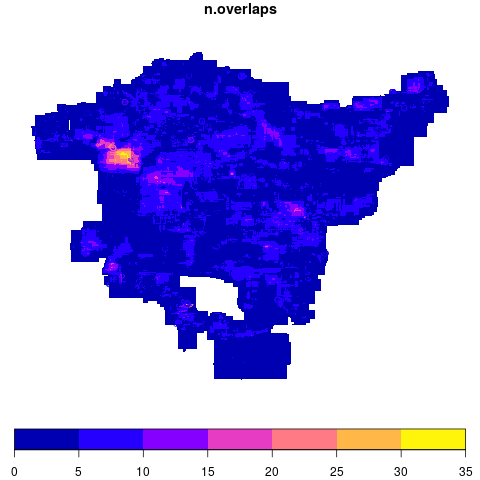
Right. For POLYGONs:
p <- st_cast(mp, "POLYGON")
op <- lapply(1:nrow(p), function(i) st_as_sfc(st_bbox(p[i,])))
xp = do.call(c, op)
i = st_intersection(st_sf(xp))
plot(i["n.overlaps"], border = NA)
edzer
on 28 Feb 2018
Thanks @rsbivand and @edzer for this very graphic insight into this problem. I think an rspatial blog post about this would be great, as it seems to be a rather common application for users.
tim-salabim
on 28 Feb 2018
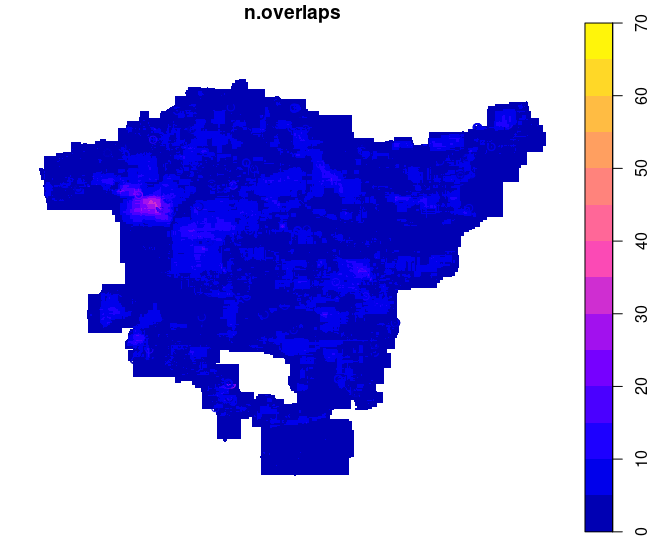
Right, my image of the same matches. With the same class intervals as the multipolygon case it is:
rsbivand
on 28 Feb 2018
Related issues
rsbivand
·
25Comments
rsbivand
·
24Comments
 RCura
·
27Comments
RCura
·
27Comments
 buxinator
·
25Comments
buxinator
·
25Comments
 WWolf
·
25Comments
WWolf
·
25Comments
Most helpful comment
And the combination of both runs in less than a minute for the whole set, just like ArcGIS:
I think we know what ArcGIS is doing in case of point-polygon intersection - use binary predicates to get intersection ids and join attributes based on these ids.