Serenity: LibRegex: Couple parser syntax issues
From google.com:
Browser(24): [PARSER] Error: Unexpected token Plus. Expected: Char
Browser(24): [PARSER] Error: Unexpected token Slash. Expected: Char
Browser(24): Throwing JavaScript Error: SyntaxError, RegExp compile error: 'Error during parsing of regular expression:
    ^[\w+/_-]+[=]{0,2}$
        ^---- Invalid character class type referenced.
'
Browser(24):   <anonymous>
Browser(24):   (global execution context)
JQuery <1.6.3
Browser(24): [PARSER] Error: Unexpected token HyphenMinus. Expected: RightParen
Browser(24): Throwing JavaScript Error: SyntaxError, RegExp compile error: 'Error during parsing of regular expression:
    ^(?:[^<]*(<[\w\W]+>)[^>]*$|#([\w\-]*)$)
                                     ^---- ( ) imbalance.
'
Browser(24):   <anonymous>
Browser(24):   <anonymous>
Browser(24):   (global execution context)
 Lubrsi
All 11 comments
I have more:
> /{/
Error during parsing of regular expression:
    {
    ^---- Invalid regular expression.
> /\//
Error during parsing of regular expression:
    \/
     ^---- Invalid character class type referenced.
 linusg
on 28 Nov 2020
linusg
on 28 Nov 2020
 bcoles
on 28 Nov 2020
bcoles
on 28 Nov 2020
/^[\w+/_-]+[=]{0,2}$/
Not sure what's going on, I'll get back to you on this :P
/^(?:[^<]*(<[\w\W]+>)[^>]*$|#([\w\-]*)$)/
That's interesting, \- in character classes is only allowed in unicode mode for whatever reason, though the parser does switch to it in some scenarios...:thinking:
/{/
This is not valid (as per the spec): Atom > PatternCharacter > "SourceCharacter but not SyntaxCharacter"
https://www.ecma-international.org/ecma-262/#prod-Atom
https://www.ecma-international.org/ecma-262/#prod-SyntaxCharacter
/\//
I guess that has been forgotten...oops
 alimpfard
on 28 Nov 2020
alimpfard
on 28 Nov 2020
I might be reading the spec wrong, but.../\// isn't allowed in non-unicode mode?
here's what I can see:
(https://www.ecma-international.org/ecma-262/#sec-regexpinitialize)
If F contains "u", let BMP be false; else let BMP be true.
If __BMP is true__, then
Let pText be the sequence of code points resulting from interpreting each of the 16-bit elements of P as a Unicode BMP code point. UTF-16 decoding is not applied to the elements.
Parse pText using the grammars in 21.2.1. The goal symbol for the parse is __Pattern[~U, ~N]__. If the result of parsing contains a GroupName, reparse with the goal symbol __Pattern[~U, +N]__ and use this result instead. Throw a SyntaxError exception if pText did not conform to the grammar, if any elements of pText were not matched by the parse, or if any Early Error conditions exist.
Seems like not passing 'u' as a flag makes /\// invalid (at least, as far as the spec is concerned)
alimpfard
on 28 Nov 2020
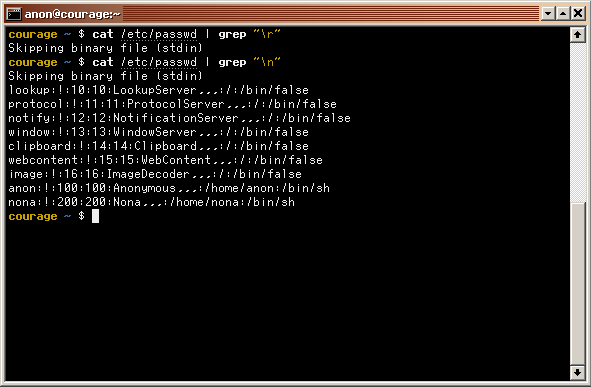
@bcoles what exactly is wrong with the \r and \n cases? the first looks for carriage returns (and there are none in that file), the second looks for newlines, and there _are_ newlines (note that \n in double-quoted strings is a shell escape - replaced with a newline).
alimpfard
on 28 Nov 2020
@bcoles what exactly is wrong with the
\rand\ncases? the first looks for carriage returns (and there are none in that file), the second looks for newlines, and there _are_ newlines (note that\nin double-quoted strings is a shell escape - replaced with a newline).
grep states it skipped the binary file stdin in both scenarios. Clearly stdin was not skipped given that the output for both scenarios differs. Also stdin is not a binary file.
bcoles
on 28 Nov 2020
/\//isn't allowed in non-unicode mode?
Actually, any unrecognised escape is allowed in non-unicode mode, I'm just really bad at reading specs apparently.
alimpfard
on 28 Nov 2020
@alimpfard wait I don't think this fixed ^[\w+/_-]+[=]{0,2}$
 awesomekling
on 28 Nov 2020
awesomekling
on 28 Nov 2020
It seems to parse okay though?
alimpfard
on 28 Nov 2020
heck, that's part of the test suite now :/
alimpfard
on 28 Nov 2020
Oh whoops, my bad! I didn't compile before testing, duh 😇
awesomekling
on 28 Nov 2020
Related issues
 danboid
·
5Comments
danboid
·
5Comments
 nibblebits
·
4Comments
nibblebits
·
4Comments
 xTibor
·
5Comments
danboid
·
6Comments
linusg
·
3Comments
xTibor
·
5Comments
danboid
·
6Comments
linusg
·
3Comments
Most helpful comment
Oh whoops, my bad! I didn't compile before testing, duh 😇