Sdk: HttpClient leaks on Darwin (iOS/macOS)
Dart program:
import 'dart:io';

Future<void> main() async {
  HttpClient client = HttpClient();
  final req = await client.getUrl(Uri.parse('https://google.com'));
  final HttpClientResponse resp = await req.close();

  await for (final bytes in resp) {
    print('Got some bytes ${bytes.length}');
  }
  client.close();
  print('done');
}
Leaks a bunch of stuff all seems to be rooted in SecCertificate:
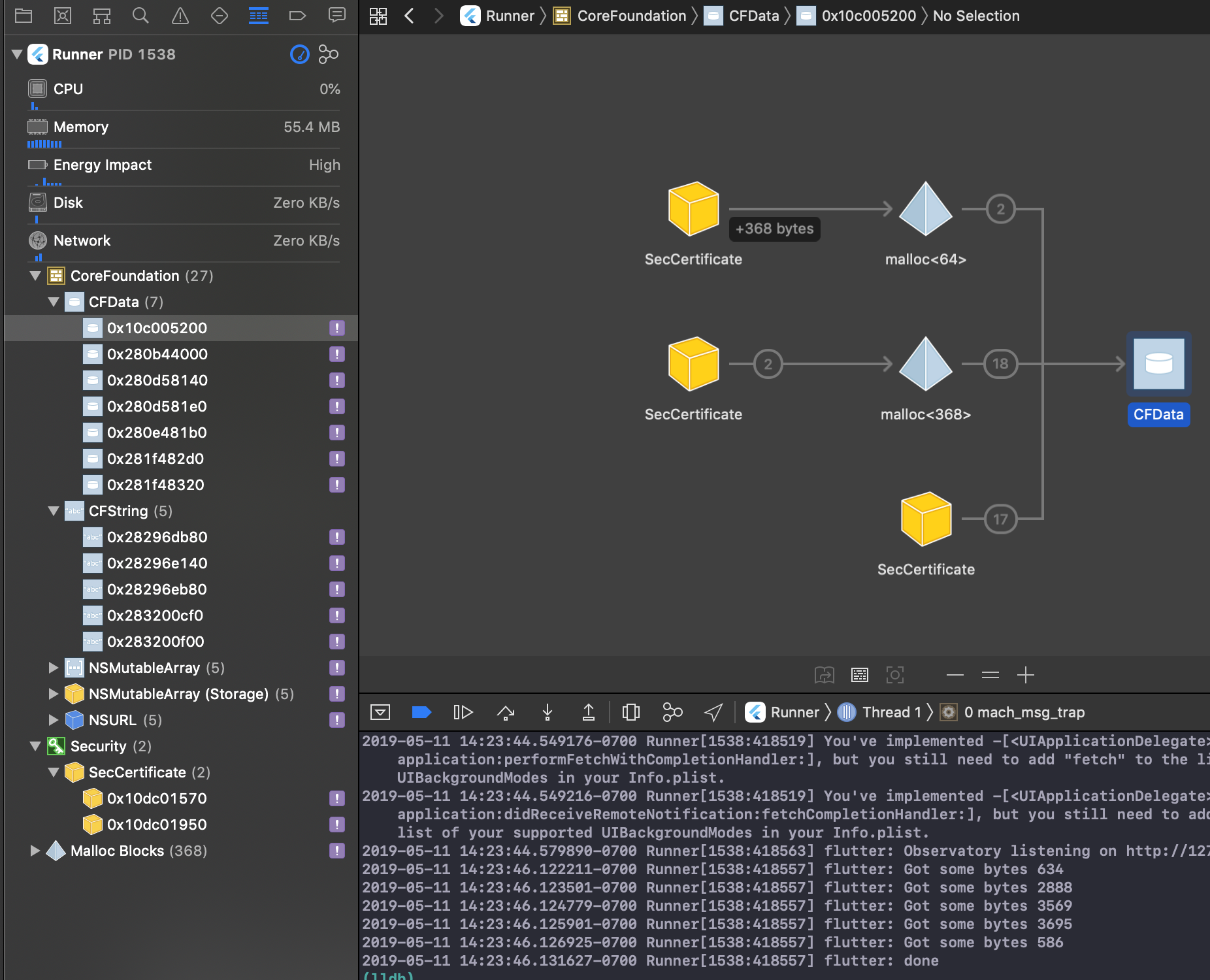
It gets particularly bad if you end up downloading a bunch of things over HTTPS. Noticed this while working on https://github.com/flutter/flutter/issues/32143, and would see hundreds of these floating around in memory dumps as I scroll back and forth in a gridview with 100+ network images.
 dnfield
All 13 comments
/cc @bkonyi since you seem like you might know about https://github.com/dart-lang/sdk/blame/master/runtime/bin/security_context_macos.cc based on the blame in it
dnfield
on 11 May 2019
I'll assign this to myself for now just so I don't forget. Not sure what the exact issue is, but I wouldn't be surprised if there's leaks.
 bkonyi
on 14 May 2019
bkonyi
on 14 May 2019
Opened https://dart-review.googlesource.com/c/sdk/+/102560 - there's still some leaks in open SSL for this but they're smaller now (some random malloc blocks that trace back to OPENSSL_malloc).
dnfield
on 15 May 2019
The remaining leaks all seem to be related to a call to status = SSL_do_handshake(ssl_); and likely affect platforms other than Darwin.
Not clear to me at this point if there's something Dart needs to do to free resources after that call, or if there's a leak in Boring SSL.
dnfield
on 15 May 2019
Example backtrace of a malloc block that isn't freed after making an SSL connection:
0 malloc_zone_malloc
1 malloc
2 OPENSSL_malloc
3 ASN1_OBJECT_new
4 c2i_ASN1_OBJECT
5 asn1_ex_c2i
6 asn1_d2i_ex_primitive
7 asn1_item_exd2i
8 asn1_template_noexp_d2i
9 asn1_template_ex_d2i
10 asn1_item_ex_d2i
11 asn1_template_noexp_d2i
12 asn1_template_ex_d2i
13 asn1_item_ex_d2i
14 asn1_template_noexp_d2i
15 asn1_template_ex_d2i
16 asn1_item_ex_d2i
17 ASN1_item_ex_d2i
18 ASN1_item_d2i
19 d2i_X509
20 X509_parse_from_buffer
21 bssl:ssl_crypto_x509_session_cache_objects(ssl_sesison_st*)
22 bssl:do_read_server_certificate(bssl::SSL_HANDSHAKE*)
23 bssl::ssl_client_handshake(bssl:SSL_HANDSHAKE*)
24 bssl::ssl_run_handshake(bssl:SSL_HANDSHAKE*, bool*)
25 SSL_do_handshake
26 dart::bin::SSLFilter::Handshake()
27 dart::bin::Builtin_SecureSocket_Handshake(_Dart_NativeArguments*)
...
This seems like a leak in Boring SSL - did verify that we're calling SSL_free after all of this. Someone from Boring SSL is looking at it now.
dnfield
on 16 May 2019
FYI, this is likely the same as https://github.com/flutter/flutter/issues/20409
bkonyi
on 22 May 2019
Someone with more knowledge of boring SSL than I says this isn't reproducing in Boring SSL and is probably a problem with the way Dart holds it.
It's not obvious to me what's wrong right now, but I'll try to poke at it a little more when I have time.
dnfield
on 7 Jun 2019
From what I can tell, all our calls to SSL_new are paired with an SSL_free, and even after the SSL_free we're leaking. I'm not sure what else I can do here - it would really help probably sit with someone from BSSL or more familiar with BSSL on this.
For what it's worth, I am able to reproduce this on a local macOS VM build without using Flutter now.
dnfield
on 7 Jun 2019
I'm not actively working on this and not sure when I'll get back to it. A lot of the leak has been cleaned up but there's still something in there.
dnfield
on 5 Oct 2019
Also, if it's not clear, the program in the first comment creates the leak without any Flutter dependencies - running it through dart will create the leak, which can be observed by attaching Xcode.
dnfield
on 5 Oct 2019
Here's what it looks like now:
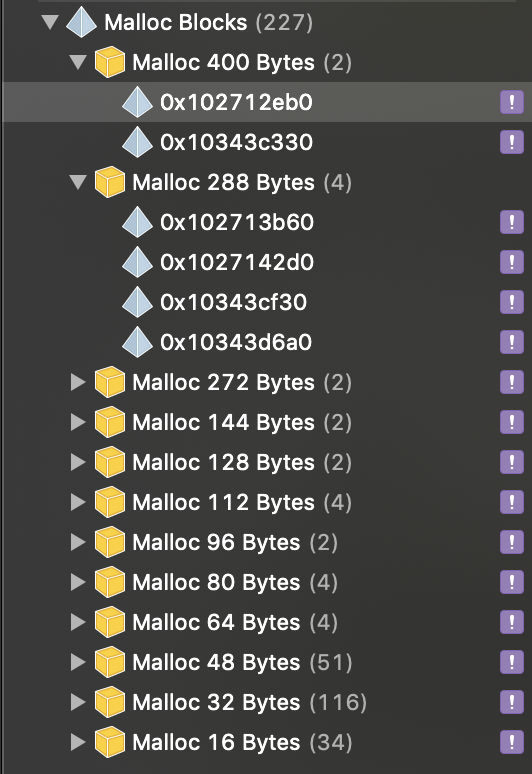
We leak (2* 400) + (4 * 288) + (2 * 272) + (2 * 144) + (2 * 128) + (2 * 112) + (2 * 96) + (4 * 80) + (4 * 64) + (51 * 48) + (32 * 116) + (34 * 16) = about 11kb. It doesn't seem to matter how many clients or requests we make.
dnfield
on 5 Oct 2019
/cc @zichangg
 mkustermann
on 19 May 2020
mkustermann
on 19 May 2020
Related issues
 DartBot
·
3Comments
DartBot
·
3Comments
DartBot
·
3Comments
DartBot
·
3Comments
 Hixie
·
3Comments
Hixie
·
3Comments
 brooth
·
3Comments
DartBot
·
3Comments
brooth
·
3Comments
DartBot
·
3Comments