Scylla: Can Alternator correctly handle HTTP requests that include the "Expect: 100-continue" HTTP request header?
Installation details
Scylla version (or git commit hash): 4.0.0-0.20200601.d95aa77b6
Cluster size: 1
OS (RHEL/CentOS/Ubuntu/AWS AMI): Centos
When I use Dynamo SDK to send a request to Scylla Alternator, if I send the request directly to Alternator, I will get a delay of more than 1s. If I send it to apisix first, and then apisix forwards it to Alternator, I can get a normal ms level. delay.
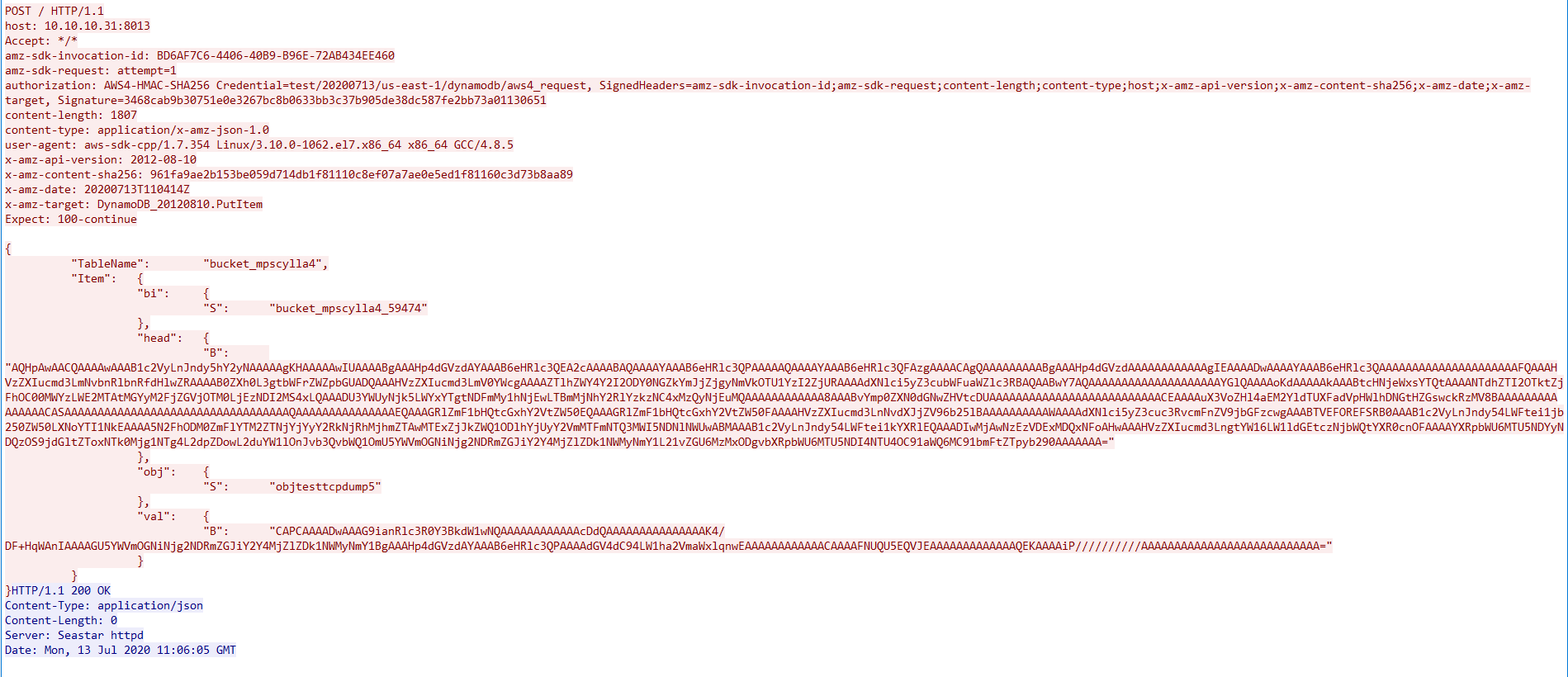
After tcpdump debug, I found that the delay of 1s comes from the stage of establishing TCP connection and sending request data. The Alternator delay monitoring in the Scylla monitor also verifies this. The delay of the Alternator processing PutItem and GetItem operations is still ms level, but the dynamo SDK client gets a delay of about 1s.
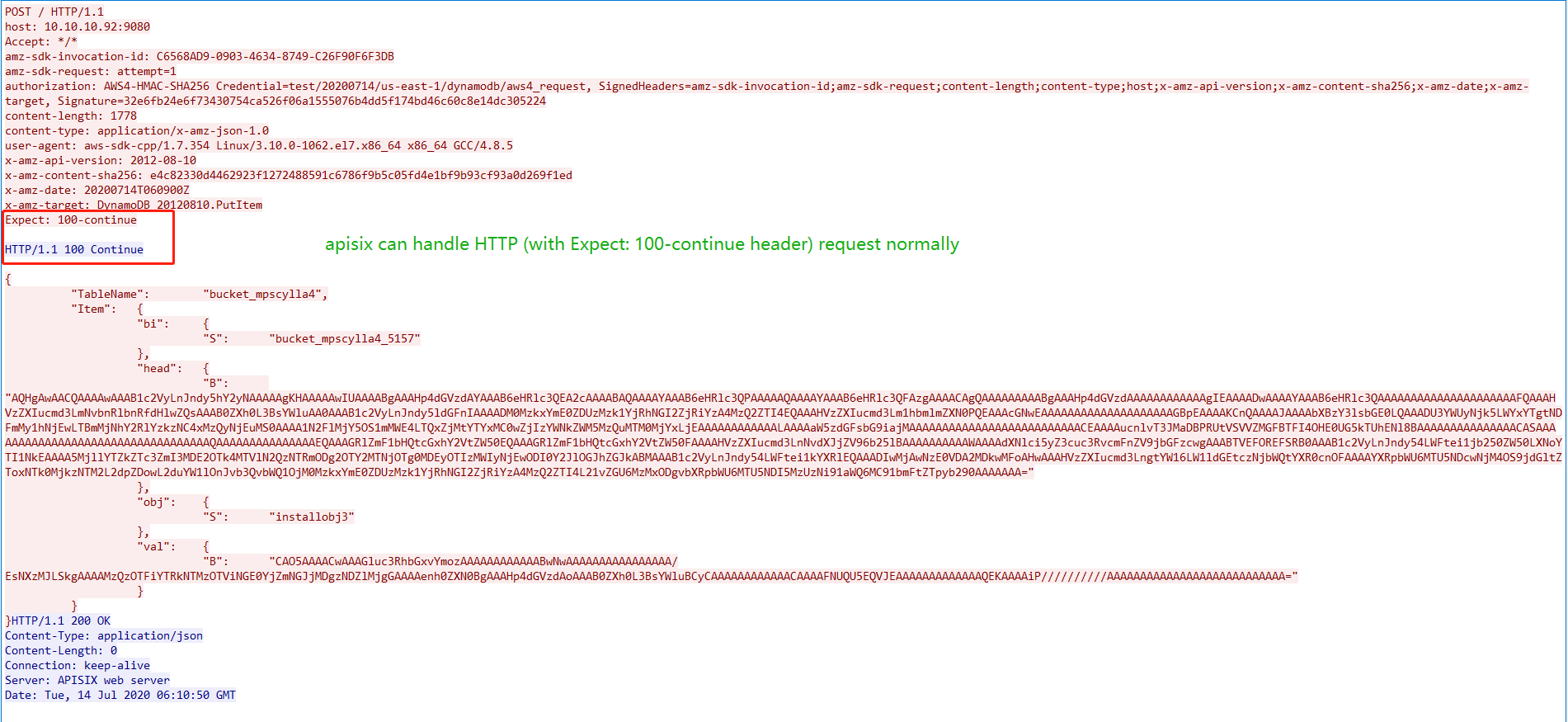
After apisix, you can get a normal delay, because apisix can normally handle HTTP requests with the "Expect: 100-continue" header, and the requests forwarded to the Alternator no longer have the "Expect: 100-continue" header.
Attached below are some screenshots of my debug process.
I’m not sure if my guess is correct, I need your help to verify
HTTP request sent directly to ScyllaAlternator
The client gets a delay of about 1s

HTTP request is forwarded to ScyllaAlternator via apisix routing
The client gets a normal ms-level delay

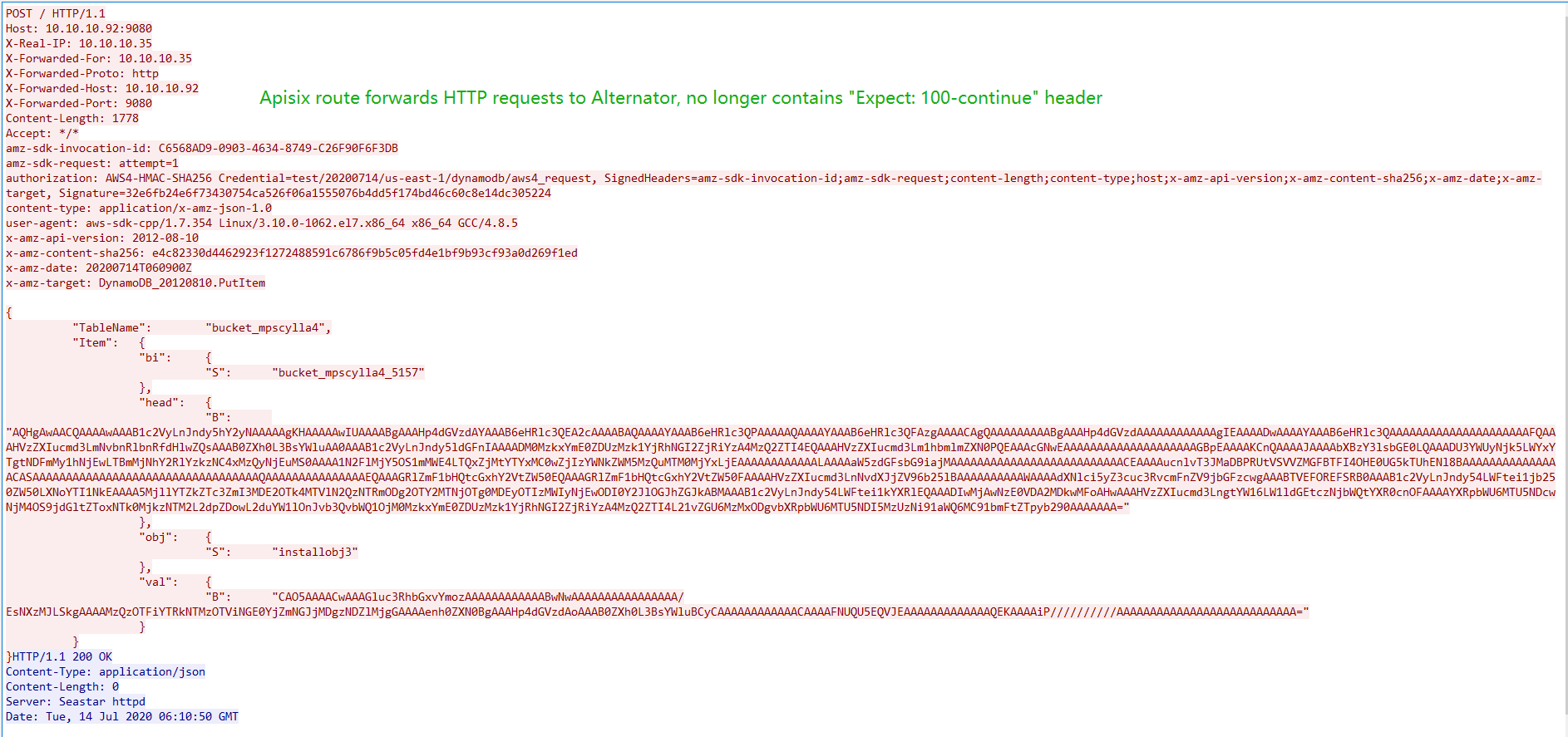
ps: Dynamo SDK client(10.10.10.35), apisix(10.10.10.92), Scylla(10.10.10.31)
 Felix-zhoux
All 9 comments
Nice detective work!
I haven't seen these 1 second delays in anu of my tests (what is this "Dynamo SDK" - which language is it?), but you are right - the "Expect: 100-continue" is a part of the HTTP 1.1 RFC (see https://tools.ietf.org/html/rfc7231#section-5.1.1) and Seastar's HTTP server is missing support for it :-( I will have to add it.
 nyh
on 15 Jul 2020
nyh
on 15 Jul 2020
I haven't seen these 1 second delays in anu of my tests (what is this "Dynamo SDK" - which language is it?)
aws-cpp-sdk-dynamodb (Sorry, that's my spoken language. -_-!)
Felix-zhoux
on 15 Jul 2020
By the way, AWS C++ SDK documentation mentions a quite easy workaround (source: https://docs.aws.amazon.com/sdk-for-cpp/v1/developer-guide/client-config.html):
disableExpectHeader
- Applicable only for CURL HTTP clients. By default, CURL adds an “Expect: 100-Continue” header in an HTTP request to avoid sending the HTTP payload in situations where the server responds with an error immediately after receiving the header. This behavior can save a round-trip and is useful in situations where the payload is small and network latency is relevant. The variable’s default setting is false. If set to true, CURL is instructed to send both the HTTP request header and body payload together.
 psarna
on 15 Jul 2020
psarna
on 15 Jul 2020
This will need to be fixed in the Seastar library, where the HTTP server code that we use lives. I opened an issue there: https://github.com/scylladb/seastar/issues/768
nyh
on 15 Jul 2020
I haven't seen these 1 second delays in anu of my tests (what is this "Dynamo SDK" - which language is it?)
aws-cpp-sdk-dynamodb (Sorry, that's my spoken language. -_-!)
My question was about the programming language of that SDK (C++? Java? Python? Go?), not your spoken language :-)
So the answer is C++. Thanks. Surprisingly, I think that's the only language that we haven't experimented with - we test heavily with the Python SDK, and experimented less heavily with the Java, Go, and Node.JS SDKs. So it's good that you are testing it.
nyh
on 15 Jul 2020
@nyh please evaluate for backport. It doesn't look like a regression, but if it makes alternator unusable, it's a major bug.
 avikivity
on 9 Aug 2020
avikivity
on 9 Aug 2020
Yes, it does make Alternator unusable for users of a specific driver (a C++ one) which appears to use this HTTP feature. However, I'm not sure how to backport. I guess that instead of putting a new version of Seastar in the branches, I should backport the specific Seastar patch to the branch-specific-seastar we have? So I should basically follow the instructions for that in the maintainers.md?
nyh
on 10 Aug 2020
I suppose we need an instructions.md that tells you to follow the instructions.
avikivity
on 10 Aug 2020
Backported the Seastar patch to the Seastar branch of Scylla 4.2, 4.1 and 4.0
nyh
on 11 Aug 2020
Related issues
 tzach
·
3Comments
tzach
·
3Comments
 pdziepak
·
6Comments
pdziepak
·
6Comments
 LouayKamel
·
6Comments
LouayKamel
·
6Comments
 amoskong
·
6Comments
tzach
·
7Comments
amoskong
·
6Comments
tzach
·
7Comments