Scratch-vm: The queueing of questions works differently from 2.0
Steps to Reproduce
- Drag 3 'ask
and wait' blocks to the workspace. Put 'answer' or 'timer' in the text field. - Click on all 3
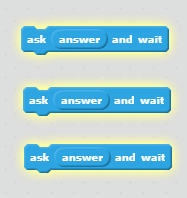
Behavior in 2.0: The question is nothing, then your first answer, then your second answer
Behavior in 3.0: The question is nothing all 3 times
If you use timer, 3.0 uses time when you started the block, 2.0 uses time when it ran.
You can also do this across sprites (if 2 sprites want to ask questions at the same time)
Operating System and Browser
Windows 10 Chrome
 fsih
fsih
All 7 comments
I'll work on this.
I think I see the problem. Basically, whenever multiple question blocks are run at the same time, they get put on the queue. The queue stores the stingified question text.
Problem is, it stores the stringified text _at the time it was called_. Instead, we should store the argument to the block on the queue, and only cast it to string at the last minute.
I'll make a repo, and once I have this issue fixed, I'll make a pull request.
The relevant file is https://github.com/LLK/scratch-vm/blob/develop/src/blocks/scratch3_sensing.js, with the relevant code being around line 70 or so.
 Clark-E
on 7 Mar 2018
Clark-E
on 7 Mar 2018
It turns out, we'd need to make somewhat major changes to make this work. Maybe we could make the ask block yield if a question is being asked?
Clark-E
on 20 Mar 2018
Good repro project for this: https://scratch.mit.edu/projects/227391651
 corihudson
on 4 Jun 2018
corihudson
on 4 Jun 2018
From what I can tell, this issue (both the original example and my repro project with the timer block) stems from differences in how 3.0 and 2.0 (and 1.4, which shares 2.0 behavior) queues up evaluation for ask and wait blocks. In 3.0, when two ask blocks are queued in different threads they immediately evaluate their inputs before waiting (relevant: execute.js lines 336-347, scratch3_sensing.js lines 138-147). In 2.0 and 1.x, ask and wait blocks appear to wait before evaluating their inputs.
corihudson
on 5 Jun 2018
Relevant lines in llk/scratch-flash:
- https://github.com/LLK/scratch-flash/blob/develop/src/primitives/SensingPrims.as#L201-L222 (ask block implementation)
- https://github.com/LLK/scratch-flash/blob/a4d01c9e9e5293c5b17e7a1940b3a60d2f8762d2/src/interpreter/Interpreter.as#L107 (doYield implementation)
- https://github.com/LLK/scratch-flash/blob/a4d01c9e9e5293c5b17e7a1940b3a60d2f8762d2/src/interpreter/Interpreter.as#L255-L298 (lines related to yielding threads)
corihudson
on 11 Jun 2018
I think this might be related to tmickel's comments at https://github.com/LLK/scratch-vm/issues/591
He mentions that the issue has come up before, in repeat blocks and in wait blocks (and potentially here now). We have always worked around the problem to avoid refactor, but the "underlying problem" is, currently in Scratch 3.0, input blocks are resolved and then the resulting value is passed to the parent block (no parent block code runs until the inputs are already evaluated). For instance, the issue with https://github.com/LLK/scratch-vm/pull/593/files was that wait was called every tick with a different args.DURATION. This could be solved by letting the parent block decide when its input blocks are evaluated, which would be a large VM change. From Tim:
...
"in the Scratch 2.0 interpreter, handling this was simplified because block implementations do "their own deciding" about when their inputs are evaluated. It's possible that the nicest solution could be to refactor the 3.0 interpreter to work similarly, it's a different abstraction (in 3.0 thus far, to the block implementation inputs are "ready-to-go" and evaluated at the start).
...
"could be worth trying :) also might have performance benefits. the original reason for this way was having a good API for Scratch extensions (which maybe shouldn't have to evaluate their own inputs) and have the default blocks use the same API. But maybe something could satisfy everything..."
(More relevant discussion in the linked issue)
fsih
on 15 Aug 2018
Tough problem :) Another option for this particular case could be to create some kind of lock around all blocks of one type, so that you never enter into an ask-and-wait block until others complete (instead of enqueueing the ask blocks in Scratch3SensingBlocks).
 tmickel
on 15 Aug 2018
tmickel
on 15 Aug 2018
Related issues
 rasmushaglund
·
4Comments
rasmushaglund
·
4Comments
 kchadha
·
6Comments
kchadha
·
6Comments
 CatsAreFluffy
·
6Comments
CatsAreFluffy
·
6Comments
 Micircle
·
5Comments
Micircle
·
5Comments
 cwillisf
·
4Comments
cwillisf
·
4Comments