Versions
Sarama Version: 1.20.1 release
Kafka Version: N/A
Go Version: 1.12.1
using Sarama commit 03a43f93cd29dc549e6d9b11892795c206f9c38c
Problem Description
Using Sarama to test the "liveliness" of a Kafka server, and calling NewSyncProducer in a new goroutine every second, it was noted that the application was slowly leaking memory.
Looking at the memory profiler, the memory was allocated by "go-metrics". The go-metrics commit used was 3113b8401b8a98917cde58f8bbd42a1b1c03b1fd
This issue was discussed in #897 and marked as resolved but it may not be the case.
The issue was noted when:
- using
nilas configuration withNewSyncProducer - using a
NewConfig()when callingNewSyncProducer
The code which triggered the issue looked like
    var endpoints []string
       ...
    producer, err := sarama.NewSyncProducer(endpoints, nil)
    if err != nil {
           ....
    }
    defer producer.Close()

    message := &sarama.ProducerMessage{
        Topic: "the-topic",
        Value: sarama.StringEncoder(...),
    }

    _, _, err = producer.SendMessage(message)
       ...
A work around was to reuse Sarama configuration objects when re-connecting to the same destination (I only noticed the option to disable metrics when looking to report this issue).
 thomas-mangin
All 14 comments
I meet the same problem.
 xiezhenye
on 8 Apr 2019
xiezhenye
on 8 Apr 2019
@bai There is a real issue with go-metrics and Sarama use of it. My old colleagues also reported the same issue. What are our options here?
 varun06
on 3 May 2019
varun06
on 3 May 2019
If you'd ask me, I don't find Sarama's metrics useful and have no production workloads that rely on it in any way, preferring prometheus or custom integrations instead. Also, go-metrics seems abandoned (or on life support, depending on what your threshold of "abandoned" is) with last commit made in October last year.
In fact, it seems that you already raised this issue a month ago. Do you happen to have any data on usage of Sarama's metrics?
I'd better not provide functionality at all, rather than provide something that doesn't work for a majority of users and impacts production workloads.
 bai
on 4 May 2019
bai
on 4 May 2019
Yeah, I also think that we should announce and remove this functionality. It is maintenance nightmare and not very good. How do we do that @bai?
As far as usage, I was trying to get some broker/consumer related metrics from sarama, but they are not good at all. You get an amalgamation bunch metric type and then you have to turn them into their particular metric type(count, gauge etc) on call site. So more unnecessary complexity.
varun06
on 5 May 2019
I have historically managed to completely avoid breaking changes to the API (thus the fact we're still on v1 with semantic versioning). If this is worth ripping out, then perhaps it's finally time for a v2, and we can roll in a bunch of the things I'd collected in https://github.com/Shopify/sarama/wiki/Ideas-that-will-break-backwards-compatibility at the same time?
 eapache
on 6 May 2019
eapache
on 6 May 2019
I agree.
varun06
on 6 May 2019
Will be nice if will be a way to disable the metrics from sarama configuration.
Meanwhile resolved this problem by writing mine metrics registry. Because default one is keeping all metrics in memory.
When you create a Sarama configuration it is used by default:
c.MetricRegistry = metrics.NewRegistry() under which is used StandardRegistry.
Solution is to have a empty one:
var (
    EMPTY = make(map[string]map[string]interface{})
)

type EmptyRegistry struct {
}

func NewEmptyRegistry() metrics.Registry {
    return &EmptyRegistry{}
}
func (r *EmptyRegistry) Each(f func(string, interface{})) {
}
func (r *EmptyRegistry) Get(name string) interface{} {
    return metrics.NilMeter{}
}
func (r *EmptyRegistry) GetOrRegister(name string, i interface{}) interface{} {
    str := fmt.Sprintf("%s", i)
    if strings.Contains(str, "metrics.Meter") {
        return metrics.NilMeter{}
    }
    if strings.Contains(str, "metrics.Histogram") {
        return metrics.NilHistogram{}
    }
    if strings.Contains(str, "metrics.Counter") {
        return metrics.NilCounter{}
    }
    if strings.Contains(str, "metrics.Gauge") {
        return metrics.NilGauge{}
    }
    if strings.Contains(str, "metrics.GaugeFloat64") {
        return metrics.NilGaugeFloat64{}
    }
    if strings.Contains(str, "metrics.EWMA") {
        return metrics.NilEWMA{}
    }
    if strings.Contains(str, "metrics.Healthcheck") {
        return metrics.NilHealthcheck{}
    }
    return metrics.NilMeter{}
}
func (r *EmptyRegistry) Register(name string, i interface{}) error {
    return nil
}
func (r *EmptyRegistry) RunHealthchecks() {
}
 nicolaenicora
on 7 May 2019
nicolaenicora
on 7 May 2019
I met this trouble too. I am using the latest version package.
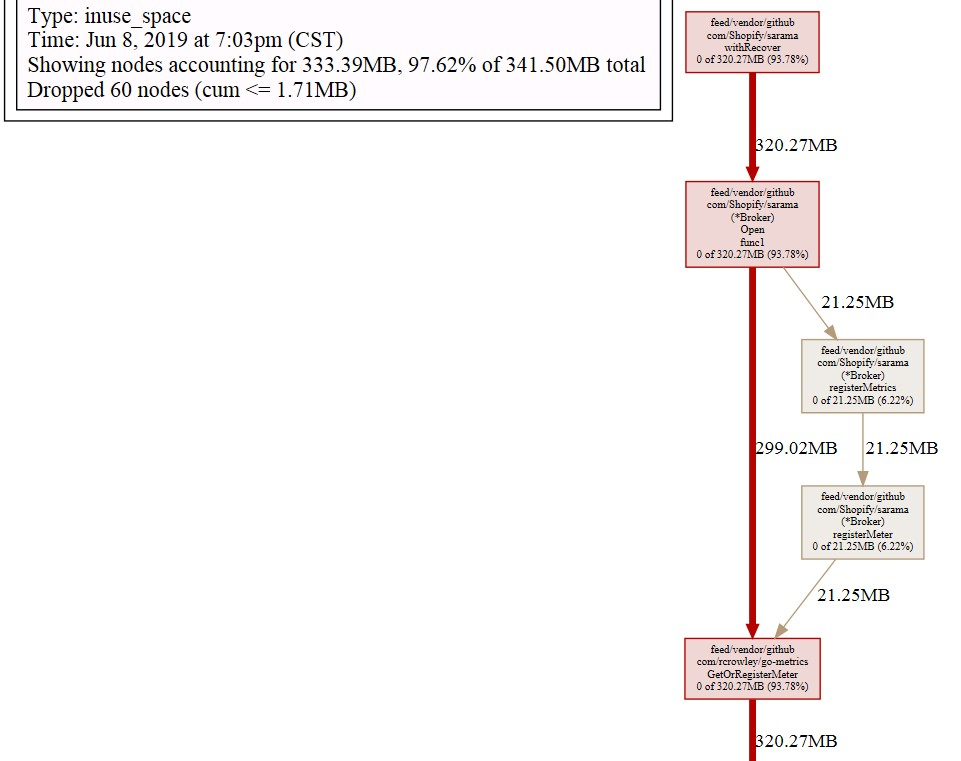
my code :
`func StartTickDeal() {
defer func() {
if perr := recover(); perr != nil {
log.Errorf("startTickDeal panic, errinfo:%v", perr)
}
go StartTickDeal()
}()
broker := strings.Join(config.DbConfig.KafkaSet.Host, ",")
topic := config.Conf.Messagekafka.Topic
snsTopic := config.Conf.Messagekafka.SnsTopic
for range time.Tick(2 * time.Second) {
go consumer(broker, topic)
}
}
func consumer(broker, topic string) {
var wg sync.WaitGroup
c, err := sarama.NewConsumer(strings.Split(broker, ","), nil)
if err != nil {
log.Errorf("Failed to start consumer: %s", err)
return
}
defer c.Close()
closeCh := make(chan int, 2)
go func() {
time.Sleep(2 * time.Second)
close(closeCh)
}()
partitionList, err := c.Partitions(topic)
if err != nil {
log.Errorf("Failed to get the list of partitions: %v", err)
return
}
for _, v := range partitionList {
pc, err := c.ConsumePartition(topic, v, sarama.OffsetNewest)
if err != nil {
log.Errorf("Failed to start consumer for partition %d: %s\n", v, err)
continue
}
wg.Add(1)
go func(pc sarama.PartitionConsumer) {
defer wg.Done()
defer pc.AsyncClose()
var i int
for {
select {
case msg := <-pc.Messages():
i++
log.Tracef("Partition:%d, Offset:%d, Key:%s, Value:%s\n", msg.Partition, msg.Offset, string(msg.Key), string(msg.Value))
deal(msg.Value)
if i > 1000 {
closeCh <- 1
}
case <-closeCh:
return
}
}
}(pc)
}
wg.Wait()
}`
 luzhuqun
on 18 Jun 2019
luzhuqun
on 18 Jun 2019
@ToughK Are you also seeing the issue with using metrics from Sarama or without it?
varun06
on 19 Jun 2019
@ToughK Are you also seeing the issue with using metrics from Sarama or without it?
Using metrics from Sarama. There is no memory leak problem when not using metrics.
 ToughK
on 19 Jun 2019
ToughK
on 19 Jun 2019
Yeah, it's a known problem, it's because the library used to expose these metrics keeps the metrics in memory.
varun06
on 19 Jun 2019
wondering if we could introduce something like this: https://github.com/Shopify/sarama/issues/1321#issuecomment-489973313 without breaking the API, and tell people the feature was removed?
 d1egoaz
on 22 Aug 2019
d1egoaz
on 22 Aug 2019
If you do not care about metrics, you can disable them as documented here (this was referenced by @thomas-mangin but probably not that easy to find):
https://github.com/Shopify/sarama/blob/65e4c5f9905926359079cd336942cf8c23fc791e/config.go#L385-L390
If you do care about metrics (probaby does not make much sense if AsyncProducer are short lived) then you can reuse the configuration:
saramaConfig := sarama.NewConfig()
saramaConfig.Producer.Return.Successes = true // Required for SyncProducer
producer, err := sarama.NewSyncProducer(endpoints, saramaConfig)
defer producer.Close()
...
producer, err := sarama.NewSyncProducer(endpoints, saramaConfig)
defer producer.Close()
Or you can unregister the "cluster" metrics once you are done with, the "broker" metrics are unregistered on producer.Close() with:
defer producer.Close()
defer saramaConfig.MetricRegistry.UnregisterAll()
To be precise only the "cluster" meters (e.g. outgoing-byte-rate) are not eventually garbage collected because they are referenced by a global meterArbiter Goroutine started by go-metrics that never stops and we never call Unregister()/Stop() on those 😢.
That being said reusing an AsyncProducer vs creating one for each message or every 1 second (short lived) is a much more efficient approach on your client and on your brokers (similar to opening the connection to a DBMS for each query).
 slaunay
on 29 Oct 2019
slaunay
on 29 Oct 2019
Thank you for taking the time to raise this issue. However, it has not had any activity on it in the past 90 days and will be closed in 30 days if no updates occur.
Please check if the master branch has already resolved the issue since it was raised. If you believe the issue is still valid and you would like input from the maintainers then please comment to ask for it to be reviewed.
![probot-shopify[bot] picture](https://avatars2.githubusercontent.com/in/10530?v=4&s=40) probot-shopify[bot]
on 21 Feb 2020
probot-shopify[bot]
on 21 Feb 2020
Related issues
 shanson7
·
4Comments
shanson7
·
4Comments
 blackfox1983
·
3Comments
blackfox1983
·
3Comments
 jinleileiking
·
4Comments
jinleileiking
·
4Comments
 dynahcatq
·
5Comments
dynahcatq
·
5Comments
 qiuyesuifeng
·
3Comments
qiuyesuifeng
·
3Comments
Most helpful comment
I have historically managed to completely avoid breaking changes to the API (thus the fact we're still on v1 with semantic versioning). If this is worth ripping out, then perhaps it's finally time for a v2, and we can roll in a bunch of the things I'd collected in https://github.com/Shopify/sarama/wiki/Ideas-that-will-break-backwards-compatibility at the same time?