Runtime: Math.Max/Min methods work differently in .Net Core 3 and Net Framework
The Math.Max and Math.Min methods with double arguments work differently in .Net Core 3 and Net Framework:
Math.Max(double.NaN, 0d) returns 0 in .Net Core 3
Math.Max(double.NaN, 0d) returns double.NaN in Net Framework
Environment data
dotnet --info output:
.NET Core SDK (reflecting any global.json):
Version: 3.0.100-preview-010124
Commit: 41a73b60f2
Runtime Environment:
OS Name: Windows
OS Version: 10.0.17763
OS Platform: Windows
RID: win10-x64
Base Path: C:\Program Files\dotnet\sdk3.0.100-preview-010124\
Host (useful for support):
Version: 3.0.0-preview1-26919-02
Commit: 9ea8c26816
.NET Core SDKs installed:
2.1.500 [C:\Program Files\dotnet\sdk]
2.1.600-preview-009426 [C:\Program Files\dotnet\sdk]
2.1.600-preview-009472 [C:\Program Files\dotnet\sdk]
3.0.100-alpha1-009616 [C:\Program Files\dotnet\sdk]
3.0.100-preview-009812 [C:\Program Files\dotnet\sdk]
3.0.100-preview-010124 [C:\Program Files\dotnet\sdk]
.NET Core runtimes installed:
Microsoft.AspNetCore.All 2.1.6 [C:\Program Files\dotnet\shared\Microsoft.AspNetCore.All]
Microsoft.AspNetCore.All 2.1.7 [C:\Program Files\dotnet\shared\Microsoft.AspNetCore.All]
Microsoft.AspNetCore.All 3.0.0-alpha1-10062 [C:\Program Files\dotnet\shared\Microsoft.AspNetCore.All]
Microsoft.AspNetCore.App 2.1.6 [C:\Program Files\dotnet\shared\Microsoft.AspNetCore.App]
Microsoft.AspNetCore.App 2.1.7 [C:\Program Files\dotnet\shared\Microsoft.AspNetCore.App]
Microsoft.AspNetCore.App 3.0.0-alpha1-10062 [C:\Program Files\dotnet\shared\Microsoft.AspNetCore.App]
Microsoft.AspNetCore.App 3.0.0-preview-18579-0056 [C:\Program Files\dotnet\shared\Microsoft.AspNetCore.App]
Microsoft.AspNetCore.App 3.0.0-preview-19067-0383 [C:\Program Files\dotnet\shared\Microsoft.AspNetCore.App]
Microsoft.DesktopUI.App 3.0.0-alpha-26829-8 [C:\Program Files\dotnet\shared\Microsoft.DesktopUI.App]
Microsoft.NETCore.App 2.1.6 [C:\Program Files\dotnet\shared\Microsoft.NETCore.App]
Microsoft.NETCore.App 2.1.7 [C:\Program Files\dotnet\shared\Microsoft.NETCore.App]
Microsoft.NETCore.App 3.0.0-preview-27122-01 [C:\Program Files\dotnet\shared\Microsoft.NETCore.App]
Microsoft.NETCore.App 3.0.0-preview-27316-4 [C:\Program Files\dotnet\shared\Microsoft.NETCore.App]
Microsoft.NETCore.App 3.0.0-preview1-26919-02 [C:\Program Files\dotnet\shared\Microsoft.NETCore.App]
Microsoft.WindowsDesktop.App 3.0.0-alpha-27128-4 [C:\Program Files\dotnet\shared\Microsoft.WindowsDesktop.App]
Microsoft.WindowsDesktop.App 3.0.0-preview-27316-2 [C:\Program Files\dotnet\shared\Microsoft.WindowsDesktop.App]
To install additional .NET Core runtimes or SDKs:
https://aka.ms/dotnet-download
 pavelovcharov
All 11 comments
/cc @tannergooding
 MarcoRossignoli
on 29 Jan 2019
MarcoRossignoli
on 29 Jan 2019
This change was by design in order to ensure that the functions had the appropriate IEEE 754 compliant behavior.
Most IEEE 754 operations indicate that the NaN payload should be preserved. However, minNum and maxNum, in particular, require that the other number be returned if one is NaN.
minNum(x, y)is the canonicalized numberxifx < y,yify < x, the canonicalized number if one operand is a number and the other aquiet NaN. Otherwise it is eitherxory, canonicalized (this means results might differ among implementations). When eitherxoryis asignalingNaN, then the result is according to 6.2.
 tannergooding
on 29 Jan 2019
tannergooding
on 29 Jan 2019
Closing this as "by-design" as this was fixed as part of the IEEE 754 compliance work.
Feel free to leave any additional comments or re-open if you feel this needs further discussion.
tannergooding
on 29 Jan 2019
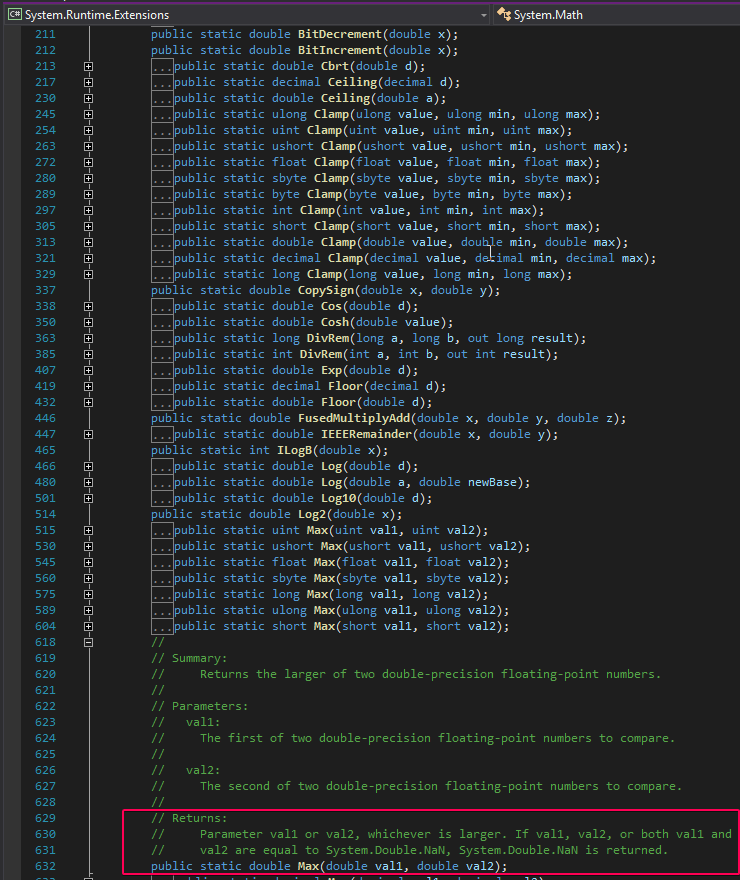
Thank you for the explanation. By the way, the documentaion still says that the double.NaN value is returned in a such cases:
pavelovcharov
on 30 Jan 2019
It would be a huge breaking change in scenarios, when WinForms and WPF controls can be used as is in .Net Core 3 applications. Are you planning to add some sort of a feature toggle to restore the previous behavior?
pavelovcharov
on 30 Jan 2019
By the way, the documentaion still says that the double.NaN value is returned in a such cases
Thanks for catching this. I've logged a bug tracking updating this here: https://github.com/dotnet/dotnet-api-docs/issues/1736
It would be a huge breaking change in scenarios, when WinForms and WPF controls can be used as is in .Net Core 3 applications. Are you planning to add some sort of a feature toggle to restore the previous behavior?
We normally only add a toggle after there has been enough feedback indicating that it is necessary/worthwhile. Do you have some more data on existing WinForms/WPF code that would hit an issue due to this?
tannergooding
on 30 Jan 2019
We faced this issue while porting the DevExpress WPF Controls suite to Net Core 3 - some of our tests failed. Of course, we can modify our code and re-write our tests (in fact, we have already done it). However, in a general case, such differences between Net Core 3 and Net Framework will definitely complicate cross-platform development. If an application or a component was developed under Net Framework and was not specifically modified to work with Net Core 3 (or developers didn't know about such changes), it will work incorrectly in the compatibility Net Core 3 mode.
I would highly appreciate if you share a full list of such differences (incompatibilities) between Net Core and Net Framework so we can take them into account while porting our components.
pavelovcharov
on 31 Jan 2019
I would highly appreciate if you share a full list of such differences (incompatibilities) between Net Core and Net Framework so we can take them into account while porting our components.
I found other "incompatibilities" or different defaults between netfx/netcoreapp I wonder if could be useful have an official doc with diff(organized for namespace/class/member), maybe in a matter of months could be complete.
/cc @jkotas @danmosemsft @stephentoub
MarcoRossignoli
on 31 Jan 2019
I believe that it would be very helpful for developers
pavelovcharov
on 31 Jan 2019
I think it would be best to have such differences here: https://github.com/dotnet/platform-compat ... @terrajobst thoughts?
 karelz
on 22 Feb 2019
karelz
on 22 Feb 2019
This was reverted due to the WPF scenario and it now preserves the NaN once again. We will likely be adding new overloads that don't preserve the NaN in the future.
Closing since this also means we don't have anything that needs to be documented.
tannergooding
on 29 May 2019
Related issues
 yahorsi
·
3Comments
yahorsi
·
3Comments
 Timovzl
·
3Comments
Timovzl
·
3Comments
 jkotas
·
3Comments
jkotas
·
3Comments
 noahfalk
·
3Comments
noahfalk
·
3Comments
 jchannon
·
3Comments
jchannon
·
3Comments
Most helpful comment
We faced this issue while porting the DevExpress WPF Controls suite to Net Core 3 - some of our tests failed. Of course, we can modify our code and re-write our tests (in fact, we have already done it). However, in a general case, such differences between Net Core 3 and Net Framework will definitely complicate cross-platform development. If an application or a component was developed under Net Framework and was not specifically modified to work with Net Core 3 (or developers didn't know about such changes), it will work incorrectly in the compatibility Net Core 3 mode.
I would highly appreciate if you share a full list of such differences (incompatibilities) between Net Core and Net Framework so we can take them into account while porting our components.