Roundcubemail: 401 error (feature?) breaks website monitoring
Today I updated roundcube to 1.4.0. After updating my website monitor returns the website is unauthorized/unreachable because of the 401. I'm using updown.io and phpservermonitor to monitor roundcube. I found out that the 401 isn't an error, it's a feature (#6800)?
It would be great to have the possibility to change this behaviour in an easy and safe way. Also it would be great to have this (a little bit unusual behaviour) documented somewhere.
 Pantos
All 9 comments
The same happens when you have the roundcube virtual machine behind haproxy, as in my case. I solved it by passing layer 7 monitoring, where it didn't work, to layer 4.
I also manipulated the roundcube code and it worked in layer 7, but I would expect a more elegant solution. An accessible function that does it or an available plugin.
 fabianbur
on 10 Nov 2019
fabianbur
on 10 Nov 2019
Try this plugin (save as plugins/unauthcode/unauthcode.php and enable the plugin in config):
<?php
class unauthcode extends rcube_plugin
{
    function init()
    {
        $this->add_hook('unauthenticated', function($args) {
            $args['http_code'] = 200;
            return $args;
        });
    }
}
 alecpl
on 11 Nov 2019
alecpl
on 11 Nov 2019
@alecpl Where does that "feature" atually come from? I also think it's a rather unexpected behavior that the bare login page returns a 401 status code. I'd also tend to make this behavior optional by config and go back to regular 200 responses.
 thomascube
on 11 Nov 2019
thomascube
on 11 Nov 2019
It comes from #5663. So, the request was indeed for "failed login attempts" only. So, maybe we should make it return 401 only on failed logins.
alecpl
on 11 Nov 2019
With regards to the many feedbacks in this and related tickets, we should indeed revert to the default 200 response for the regular login page. For failed login attempts, a 401 response may make sense.
thomascube
on 11 Nov 2019
Fixed.
alecpl
on 11 Nov 2019
Thank you
How sensible your words!
With regards to the many feedbacks in this and related tickets, we should indeed revert to the default 200 response for the regular login page. For failed login attempts, a 401 response may make sense.
fabianbur
on 11 Nov 2019
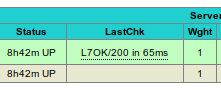
I applied commit 29e7c16 and it worked excellent.
Roundcube 1.4 can now be used in Haproxy, no problem.
I had updated to version 4.1 rc1 since its launch. The truth is that I never thought it would take almost a year to get the stable version, I thought it would be a maximum of one month. But I could contribute by reporting some incidents and others that also affected me, this was the one that took the longest to attend, but in the end it was done in an impeccable way.
Thanks Aleksander Machniak and Thomas Brüderli. We owe you this excellent software.
Sorry for English, my language is Spanish.
fabianbur
on 13 Nov 2019
Per https://tools.ietf.org/html/rfc7235#section-3.1 HTTP 401 has a very specific meaning which does not apply to Roundcube's authentication flow. HTTP 401 means that the browser should use HTTP authentication in order to proceed, which most configurations of Roundcube won't use.
RFC 7235: "The server generating a 401 response MUST send a WWW-Authenticate header field (Section 4.1) containing at least one challenge applicable to the target resource."
Because it doesn't do this, Roundcube is not conforming to the HTTP spec.
Perhaps HTTP 403 would be a more appropriate response for authentication failures.
 mas90
on 22 Nov 2019
mas90
on 22 Nov 2019
Related issues
 serg65535
·
5Comments
serg65535
·
5Comments
 HLeithner
·
6Comments
HLeithner
·
6Comments
 rcubetrac
·
6Comments
rcubetrac
·
6Comments
 CRtEurope
·
7Comments
CRtEurope
·
7Comments
 Rotzbua
·
5Comments
Rotzbua
·
5Comments
Most helpful comment
Per https://tools.ietf.org/html/rfc7235#section-3.1 HTTP 401 has a very specific meaning which does not apply to Roundcube's authentication flow. HTTP 401 means that the browser should use HTTP authentication in order to proceed, which most configurations of Roundcube won't use.
RFC 7235: "The server generating a 401 response MUST send a WWW-Authenticate header field (Section 4.1) containing at least one challenge applicable to the target resource."
Because it doesn't do this, Roundcube is not conforming to the HTTP spec.
Perhaps HTTP 403 would be a more appropriate response for authentication failures.