Roslyn: "Inline temporary variable" breaks code for 'out' parameter
Version Used: Visual Studio 2019 version 16.1
static void GetPath()
{
    DirectoryInfo root = null;
    var files = GetAllMarkdownFiles(@"C:\\temp", out root);

    string fullPath = Path.Combine(root.FullName, @"..\\file.txt");
}

private static object GetAllMarkdownFiles(string inputDirectory, out DirectoryInfo rootDirectory)
{
    throw new NotImplementedException();
}
Put your cursor in root in the first line of the GetPath() method, then select “Inline temporary variable” from the light bulb menu.
Expected Behavior: Code that works at run time.
Actual Behavior: It generates:
static void GetPath()
{
   DirectoryInfo root = null;
   var files = GetAllMarkdownFiles(@"C:\\temp", out root);

   string fullPath = Path.Combine(((DirectoryInfo)null).FullName, @"..\\file.txt");
}
((DirectoryInfo)null).FullName does not work.
 gewarren
All 2 comments
Thanks @gewarren.
Inline temporary variable takes the variable's assigned value, plugs it in to every usage (edit: using fancy logic to make sure things still bind correctly), and flags any additional writes as conflicts. Note the red border around "root" on the second line of the diff window here (and the "X Conflict(s) detected." message):
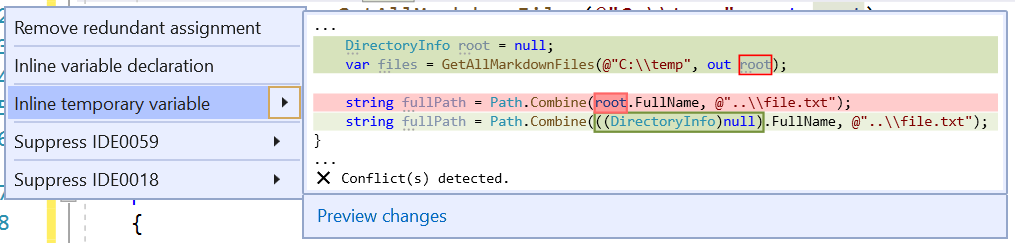
This is sometimes useful, but probably not in this case. The more recent out <type> name argument syntax is generally preferred in this situation, and we do offer to "inline variable declaration" here to convert to that syntax. Without making more fundamental changes to inline temporary variable, I'd propose we simply choose not to offer the refactoring if we recognize this pattern.
 dpoeschl
on 26 Jun 2019
dpoeschl
on 26 Jun 2019
Perhaps 'inline temporary varable' should be renamed to 'replace variable with initializer value' to better indicate what is going on?
 CyrusNajmabadi
on 26 Jun 2019
CyrusNajmabadi
on 26 Jun 2019
Related issues
 JesperTreetop
·
3Comments
JesperTreetop
·
3Comments
 binki
·
3Comments
binki
·
3Comments
 marler8997
·
3Comments
marler8997
·
3Comments
 AdamSpeight2008
·
3Comments
AdamSpeight2008
·
3Comments
 MadsTorgersen
·
3Comments
MadsTorgersen
·
3Comments
Most helpful comment
Perhaps 'inline temporary varable' should be renamed to 'replace variable with initializer value' to better indicate what is going on?