Roslyn: Nullable warning on `default(T) == null`
Version Used:
3.1.0-beta1-19172-05+edd2de88fb3e84a097fb30b4070e0f219f624e40
Repro:
This program
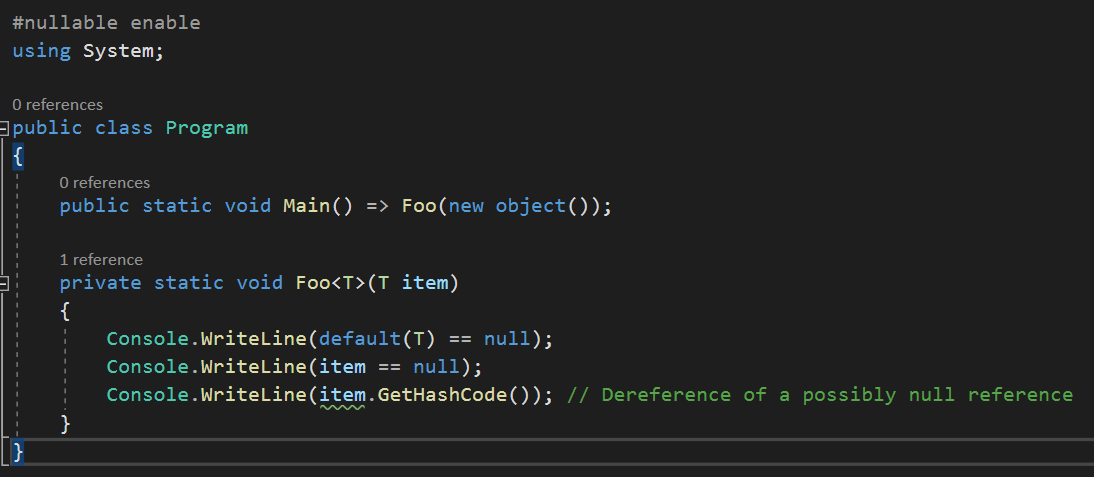
```C#
nullable enable
using System;
public class Program
{
public static void Main() => Foo(new object());
private static void Foo<T>(T item)
{
    Console.WriteLine(default(T) == null);
    Console.WriteLine(item == null);
    Console.WriteLine(item.GetHashCode());
}
}
```
produces two warnings:
default(T): "A default expression introduces a null value when 'T' is a non-nullable reference type. "item.GetHashCode(): "Possible dereference of a null reference."
Several questions:
- Why does
default(T) == nullwarn, and why is that more warn-worthy thanitem == null? Is that a bug? - If it's by design, is the appropriate action here to just
!away the warning? - It's confusing to me that the warning on
default(T)saysTis a "non-nullable reference type", but then trying to dereferenceitem, which is of typeT, says it's a "possible dereference of a null reference". Are those messages correct?
cc: @gafter, @jaredpar, @dotnet/nullablefc
 stephentoub
All 5 comments
The warning is on default(T). If T ends up being a non-nullable reference type, this would introduce a null value of a type T which isn't supposed to have null values.
The diagnostic isn't telling you that T is a non-nullable reference type. It says "when T is a non-nullable reference type".
Having said that, this is an idiom for testing whether or not T is a reference type (or nullable value type?) and probably does not deserve a diagnostic.
 gafter
on 4 Apr 2019
gafter
on 4 Apr 2019
Thanks for the explanation. So the difference from the item == null case is that this case ends up potentially introducing a null where as that case just tests for one.
stephentoub
on 4 Apr 2019
Yes, that is exactly right. But I agree with you that we should be able to see that we are immediately testing and then discarding that value, so no harm arises.
gafter
on 5 Apr 2019
I'm seeing a lot of this and am excited to see that you're planning to remove the warning!
 jnm2
on 27 Oct 2019
jnm2
on 27 Oct 2019
This no longer repro's as of 16.5p3. I think this was fixed by Chuck's tracking of [MaybeNull]T state in an earlier 16.5 preview.
I'll go ahead and close. Thanks
 jcouv
on 29 Jan 2020
jcouv
on 29 Jan 2020
Related issues
 orthoxerox
·
3Comments
orthoxerox
·
3Comments
 NikChao
·
3Comments
NikChao
·
3Comments
 SolalPirelli
·
3Comments
SolalPirelli
·
3Comments
 JesperTreetop
·
3Comments
JesperTreetop
·
3Comments
 AdamSpeight2008
·
3Comments
AdamSpeight2008
·
3Comments
Most helpful comment
The warning is on
default(T). IfTends up being a non-nullable reference type, this would introduce anullvalue of a typeTwhich isn't supposed to havenullvalues.The diagnostic isn't telling you that
Tis a non-nullable reference type. It says "whenTis a non-nullable reference type".Having said that, this is an idiom for testing whether or not
Tis a reference type (or nullable value type?) and probably does not deserve a diagnostic.