Roslyn: C# new preprocessor directives "#pragma exception before"
2.1.403:
Steps to Reproduce:
New implementation
Expected Behavior:
#pragma exeception before
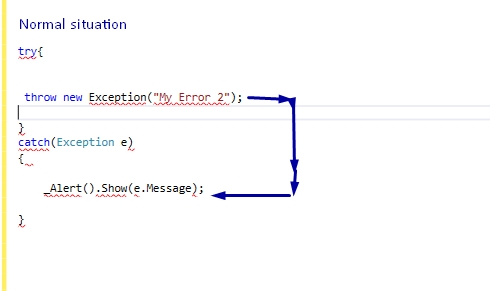
This is the normal situation that we all know today, I did a treatment with an alert ja and when I give an exception within a delegate that execption of a warning in Visual Studio the #pragma would be to disable this warning that Visual Studio and continue the Code because it is an exception that has already been handled.
Sugestion:
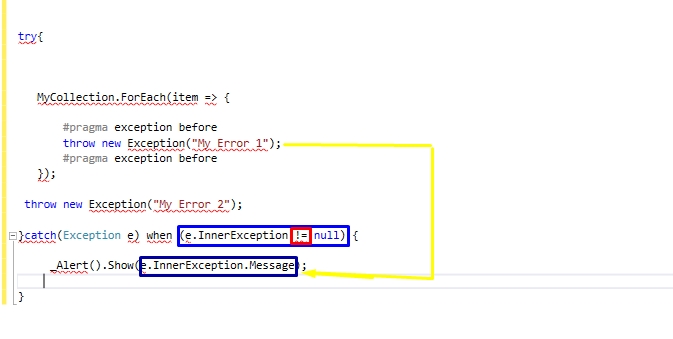
Reference:
 srburton
All 13 comments
Why aren't the existing options offered by VS for controlling when the exception dialog is shown sufficient for you?
Also, does the behavior improve if you use foreach instead of ForEach?
 svick
on 22 Oct 2018
svick
on 22 Oct 2018
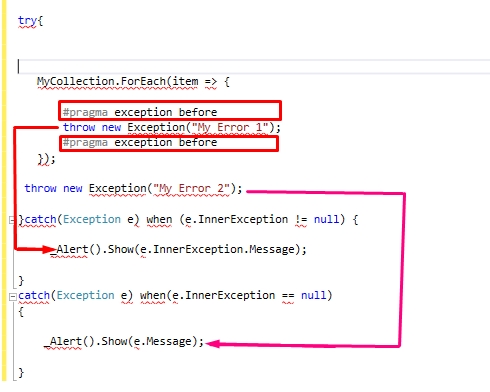
Example:
srburton
on 22 Oct 2018
This issue lacks enogh information to be actionable.
 CyrusNajmabadi
on 22 Oct 2018
CyrusNajmabadi
on 22 Oct 2018
@CyrusNajmabadi
Do you have any models that I can follow to publish something more complete here?
srburton
on 23 Oct 2018
@svick
No, because with settings in the VS gets on the machine on the user and when shared the project will start to give numerous errors on the machine of another programmer, with these #pragma gets more declarative that there has an exception that burst in the first try/cath Previous, this functionality would be very useful for lambdas.
srburton
on 23 Oct 2018
No, because with settings in the VS gets on the machine on the user and when shared the project will start to give numerous errors on the machine of another programmer,
Why is that a problem? How debuggers work is entirely up to the individual. If i choose to use windbg, i want to have control over that experience. If someone else wants to use a debugger present in their IDE, that is up to them.
CyrusNajmabadi
on 23 Oct 2018
would be to disable this warning that Visual Studio and continue the Code because it is an exception that has already been handled.
You can just use a boolean for this:
c#
try
{
    // ...
}
catch (Exception e)
{
    if (!shown)
    {
        shown = true;
        _alert().Show(e.Message);
    }
}
Now you'll only ever report that exception handler once.
CyrusNajmabadi
on 23 Oct 2018
@CyrusNajmabadi
Good if you want to do with activators like Boolean that gets a dirty and great code all right just got another point of view that would be very useful a #pragma to disable exception of a specific snippet of my code, do not want to disable my entire project.
srburton
on 23 Oct 2018
Good if you want to do with activators like Boolean
I'm having trouble understanding what you're trying to say here.
It sounds like you think this is a good solution. If so... great! It doesn't look like we need language changes for this.
that would be very useful a #pragma to disable exception of a specific snippet of my code
What does it mean to "disable exception"? Do you mean: the exception won't be thrown? Or do you mean: the debugger won't report the exception?
CyrusNajmabadi
on 23 Oct 2018
I'm using a translation tool, the debugger will not report the exception in that specific code block.
srburton
on 23 Oct 2018
I'm using a translation tool, the debugger will not report the exception in that specific code block.
I don't understand your response. You stated:
that would be very useful a #pragma to disable exception
I'm tryin got understand what you mean by 'disable exception' Can you clarify? Note: if this is hard to explain here, you can go to gitter.im/roslyn and we can discuss things there. But right now, it's not actually clear what you're asking for.
CyrusNajmabadi
on 23 Oct 2018
the debugger will not report the exception in that specific code block.
srburton
on 23 Oct 2018
Ok. So it sounds like this is purely a tooling request, and is unrelated to making changes to the language or adding pragmas.
For example, WinDbg gives a lot of control over exceptions:
https://docs.microsoft.com/en-us/windows-hardware/drivers/debugger/controlling-exceptions-and-events#span-idcontrollingexceptionsandeventsfromthedebuggerspanspan-idcontrollingexceptionsandeventsfromthedebuggerspancontrolling-exceptions-and-events-from-the-debugger
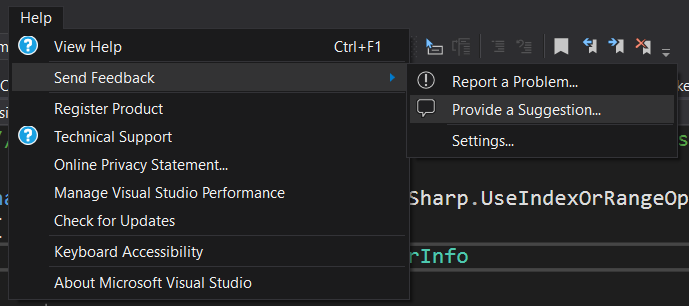
If you'd like the VS debugger to have support for some sort of "don't actually pause for exceptions within this block" i recommend you file a VSFeedback item here:
CyrusNajmabadi
on 23 Oct 2018
Related issues
 NikChao
·
3Comments
NikChao
·
3Comments
 glennblock
·
3Comments
glennblock
·
3Comments
 AdamSpeight2008
·
3Comments
AdamSpeight2008
·
3Comments
 joshua-mng
·
3Comments
joshua-mng
·
3Comments
 DavidArno
·
3Comments
DavidArno
·
3Comments