Respec: Single letter variables don't get converted to var
What happened (e.g., it crashed)?:
If you have: Let |p| be new Promise...
But what I was expecting?:
It should convert |p| to <var>p</var>.
Similarly, if you have: Let |p:Promise| be newly created Promise.
 marcoscaceres
All 8 comments
The issue is with the regex for inline variables:
https://github.com/w3c/respec/blob/1121be0cdb5244b12a6462993b64cc6f59ba77b8/src/core/inlines.js#L140
Changing it to "\\B\\|\\w[\\s\\w]*(?:\\s*\\:\\s*\\w+)?\\|\\B" fixed the issue for me (i.e remove word character matching \\w in the middle), and also passes the tests in inlines-spec.js.
But I don't really know RegEx, so @sidvishnoi what was the reason to match another word character?
 Swapnilr1
on 29 Mar 2019
Swapnilr1
on 29 Mar 2019
New regex by @Swapnilr1 looks good to me. But I'll see if there are some other use cases and if we can simplify it.
 sidvishnoi
on 29 Mar 2019
sidvishnoi
on 29 Mar 2019
Played with the regex a bit. Found these cases:

and this regex to solve both #2208 and #2184
/\B\|\w[\w\s]*(?:\s*\:.+)?\|\B/
A slightly faster regex would be if we specify allowed characters (and not just .)
/\B\|\w[\w\s]*(?:\s*\:[\w\s&;<>]+)?\|\B/
@sidvishnoi There is an issue with
/\B\|\w[\w\s]*(?:\s*\:.+)?\|\B/
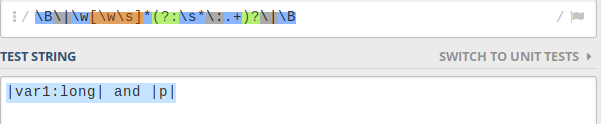
means that var1 becomes the name and long| and |p becomes the type.
The alternative
/\B\|\w[\w\s]*(?:\s*\:[\w\s&;<>]+)?\|\B/
does not cause this error - but I think I am better off seeing a regular expressions reference rather than just trying out strings. Don't want to introduce another bug while fixing this - so need some time.
Swapnilr1
on 31 Mar 2019
Yes, I was concerned about over-matching (See https://github.com/w3c/respec/issues/2184#issuecomment-476075781)
We need to stop the regex search at first |, and not go any further.
The second one works because neither of [\w\s&;<>] includes |, but .+ will match |, causing over-matching.
sidvishnoi
on 31 Mar 2019
Yes, l understood why the first one overmatches, but that was only after I found a case where it overmatches. Specifying allowed characters is a safe approach.
Does [\w\s&;<>] cover all allowed characters? I have encountered &;<> for the first time as valid characters in variable types :open_mouth: so I don't have much of an idea on what is allowed and what is not.
Swapnilr1
on 31 Mar 2019
@Swapnilr1 here is a comprehensive list of types:
https://heycam.github.io/webidl/#idl-types
See the more complex ones, like union, annotated, etc...
marcoscaceres
on 2 Apr 2019
(note we don't need to process the types yet... we will do that eventually).
marcoscaceres
on 2 Apr 2019
Related issues
 deniak
·
5Comments
deniak
·
5Comments
 saschanaz
·
6Comments
marcoscaceres
·
5Comments
sidvishnoi
·
4Comments
saschanaz
·
3Comments
saschanaz
·
6Comments
marcoscaceres
·
5Comments
sidvishnoi
·
4Comments
saschanaz
·
3Comments