Reactor-core: Ignoring the next context swiching with the same thread
First, we all need to agree on the following fact:
We use shcedulers with a single thread iff we want to ensure that there is no _race condition_ by ensuring a _mutual exclusion_.
If you disagree, then let's talk about that first before you keep reading because I may not fully understand the purpose of shcedulers with a single thread.
Something is missing
The synchorinize mechanizm in java allow us to obtain the same _synchronization object_ again if
we already obtained it earlier and we didn't free it between the last time we obtained it until the this time. I would like to see the same behavior when using shcedulers with a single thread.
Impact without the suggested mechanizm in reactor lib
We can't _lock_ multiple methods which are invoked by a stream - one by one.
I must implement the _lock_ mechanizm using a semaphore.
Steps to reproduce
Function<Integer, Mono<Integer>> function = realThreadId -> Mono.just(1)
        .publishOn(Schedulers.single())
        .doOnNext(__ -> {
            System.out.println("(1) the thread which is here is: " + realThreadId);
            try {
                Thread.sleep(1000);
            } catch (InterruptedException e) {
                e.printStackTrace();
            }
        })
        .publishOn(Schedulers.single())
        .doOnNext(__ -> System.out.println("(2) the thread which is here is: " + realThreadId));

Flux.just(1, 2)
        .flatMap(realThreadId ->
                Mono.just(realThreadId)
                        .subscribeOn(Schedulers.elastic())
                        .flatMap(function),2)
        .subscribe();

Thread.sleep(1000 * 1000);
Expected behavior
(1) the thread which is here is: 1
(1) the thread which is here is: 1
(2) the thread which is here is: 2
(2) the thread which is here is: 2
Actual behavior
(1) the thread which is here is: 1
(1) the thread which is here is: 2
(2) the thread which is here is: 1
(2) the thread which is here is: 2
Reactor Core version
3.2.0.BUILD-SNAPSHOT
JVM version (e.g. java -version)
1.8
 stavalfi
All 5 comments
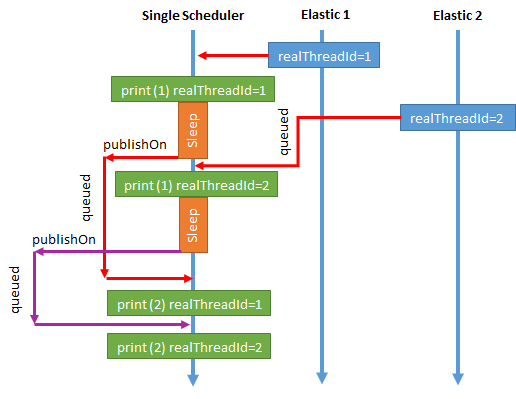
Schedulers.single() uses a single thread to execute work, however, you used the Schedulers.elastic() which can have many threads to feed into the single-threaded scheduler. The actual behavior is the correct behavior. If you removed the second publishOn, you'd get the expected output.
This flow diagram should better explain what's happening:
 akarnokd
on 12 May 2018
akarnokd
on 12 May 2018
Hi @akarnokd and thanks for your fast response.
Could you please explain the following:
you used the
Schedulers.elastic()which can have many threads to feed into the single-threaded scheduler
Also, due to the fact that I didn't encounter any formal material about how schedulers works I would like to ask you to explain what the image, you provided, describers.
stavalfi
on 14 May 2018
@stavalfi I think your original assumption that Schedulers.single() is a mechanism for mutex is wrong. It is more akin to an Executors.newSingleThreadExecutor() where you'd submit one task per value emitted by the upstream Flux. So the second publishOn is not re-entrant.
To explain the diagram, reading from the elastic1 and elastic2 blue boxes:
- elastic1 publishes
realThreadId = 1 singleprints the first message for1, and blocks (sleep)- elastic2 tries to publish
realThreadId = 2tosingle, but is blocked - at the end of the sleep,
singledoesn't continue with imperative code but uses a secondpublishOn. Since it is not re-entrant, that scheduling frees up the thread for the blockedelastic2 - elastic2 finally manages to publish
2, which prints the first message for2and blocks again - at the end of that sleep, second
publishOnof2is scheduled, but that frees up the thread to process the publishOn of1that had previously been scheduled - second message for
1is printed - second message for
2is printed
 simonbasle
on 14 May 2018
simonbasle
on 14 May 2018
Thanks for the description @simonbasle .
Do you mean that we shouldn't use mutex at all? If yes, then I will have a blocking mechanism inside reactor operators which is something we all trying to avoid. If no, then how do I "implement" such a mechanism using reactor operators; is it depends on the particular situation or there is a general way to do it?
stavalfi
on 18 May 2018
Mutex is by definition blocking: the excluded task is blocked until the task that has the mutex releases it. So it is a bad fit for a reactive toolkit.
However, if you can represent tasks as a Flux<TaskDescription> of some sort, you'll benefit from the fact that the reactive streams specification forbids concurrent onNext. That way, and by executing each task using a concatMap, you can obtain a guarantee that no 2 task will conflict (provided they are "submitted" in that original sequence).
simonbasle
on 18 May 2018
Related issues
 nnanda2016
·
4Comments
nnanda2016
·
4Comments
 BerlinAdam87
·
3Comments
BerlinAdam87
·
3Comments
 cquludajun
·
5Comments
cquludajun
·
5Comments
 Jamalarm
·
5Comments
Jamalarm
·
5Comments
 a-voloshyn
·
5Comments
a-voloshyn
·
5Comments