React-testing-library: Fix build for React next
Not sure exactly how/when this happened, but the build is failing: https://travis-ci.org/github/testing-library/react-testing-library/builds/703268660
Help welcome!
 kentcdodds
All 33 comments
This looks like a problem with the cleanup in the flushing queued microtasks step in some Node environments..
I've tried to reproduce it on my local env with no luck, I'll try to reproduce it today and then see what's the specific problem.
 MatanBobi
on 30 Jun 2020
MatanBobi
on 30 Jun 2020
Is this an intermittent failure where the first build (before it was rerun with Travis cron) just happened to fail by chance? Or could it be that a dependency updated in a way that changes this behavior?
 nickmccurdy
on 30 Jun 2020
nickmccurdy
on 30 Jun 2020
I don't think is something regarding to a dependency update. As I see from the log, it happens only on some versions of node.
 marcosvega91
on 30 Jun 2020
marcosvega91
on 30 Jun 2020
@nickmccurdy
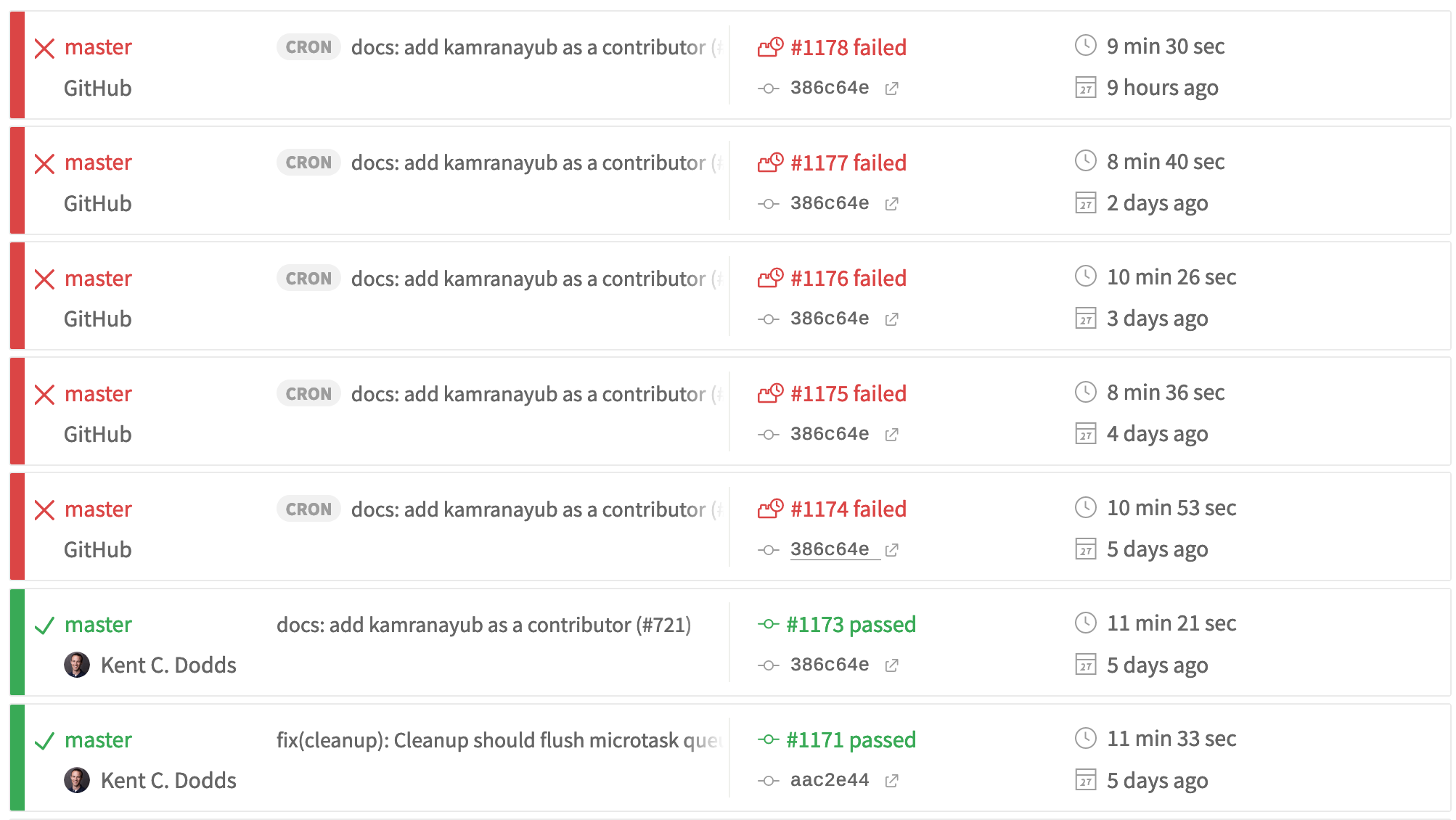
It looks like it started happening quite around the area of pushing the cleanup of queued microstasks and it always fails on the same node version: 12, 14 and current.
It's weird that the initial merge did pass and so did one after that with the same commit as all others who failed..
MatanBobi
on 30 Jun 2020
Just updating that I tried to reproduce this issue with both of the node versions that failed: 12.18.1, 14.4.0 on my local env but all of the tests passed.
MatanBobi
on 30 Jun 2020
The fact that #1171 passed (which introduced the microtask change) is interesting 🤔
kentcdodds
on 30 Jun 2020
The tests are failing for react@next and react-dom@next. Make sure you reproduce the CI environment by doing npm install react@next react-dom@next which is executed in these builds (https://travis-ci.org/github/testing-library/react-testing-library/jobs/703268662#L234)
 eps1lon
on 1 Jul 2020
eps1lon
on 1 Jul 2020
good point, you're right, now the issue is reproducible
marcosvega91
on 1 Jul 2020
The tests are failing for
react@nextandreact-dom@next. Make sure you reproduce the CI environment by doingnpm install react@next react-dom@nextwhich is executed in these builds (https://travis-ci.org/github/testing-library/react-testing-library/jobs/703268662#L234)
That's a good point, it also explains why it happens only in CRON since only there we use react@next and react-dom@next. As @marcosvega91 stated, the issue reproduced now.
I'll dig into it today.
MatanBobi
on 1 Jul 2020
Ah yeah, that explains why it's failing for the cron job 😅 Thanks @eps1lon! I forgot we do that.
kentcdodds
on 1 Jul 2020
Perhaps we should add react@next to the build matrix for all builds rather than just cron builds so we can tell immediately if a new feature is failing on the current next release. Travis also shows multiple jobs in a build side by side, so for example we'd know if a PR failed on @next but not @latest. FWIW I think this would be more similar to Zeit/Vercel Next's usage of GitHub actions for react@next testing.
nickmccurdy
on 1 Jul 2020
Nah, I don't want to prevent a release because our tests don't work with an unreleased version of react.
kentcdodds
on 1 Jul 2020
Good point, we should be able to work around that by adding the @next job as an allowed failure so we can still see the build status without preventing an automated release.
nickmccurdy
on 1 Jul 2020
That sounds fine to me
kentcdodds
on 1 Jul 2020
Updating what I found until now:
It looks like in react@latest our useEffect return callback is being called before we get to await flush() in our cleanup, that way the setImmediate is being registered as expected before the enqueueTask within flushMicroTasks.
In react@next, that's not the behavior. our useEffect return callback is being called after we get to await flush(), that's why the setImmediate is being registered after the enqueueTask so we're not waiting for it.
This looks like a change in the unmount behavior, I'm trying to find the root cause in react.
MatanBobi
on 2 Jul 2020
Ok, I found the change..
It looks like react@next inside commitUnmount calls enqueuePendingPassiveHookEffectUnmount which dispatches the flushPassiveEffects within a scheduleCallback:
    scheduleCallback(NormalPriority, function () {
      flushPassiveEffects();
      return null;
    });
This actually makes the flushPassiveEffects calling our useEffect's destroy function be a different one caused by an internal event in react's event system which triggers commitBeforeMutationEffects, so this isn't a sync operation like it used to.
In react@latest, inside commitUnmount they run a task with priority within the commit phase that just calls the destroy hooks:
var priorityLevel = renderPriorityLevel > NormalPriority ? NormalPriority : renderPriorityLevel;
runWithPriority$1(priorityLevel, function () {
  var effect = firstEffect;
 do {
     var _destroy = effect.destroy;
         if (_destroy !== undefined) {
            safelyCallDestroy(current, _destroy);
          }
          effect = effect.next;
  } while (effect !== firstEffect);
});
runWithPriority is basically sync operation within react@latest.
All of this happens within the ReactDOM.unmountComponentAtNode(container) we do in the cleanup.
In react@next when we call unmountComponentAtNode they schedule a callback to flushPassiveEffects which happens later on, after we setImmediate to flush all microtasks.
Any ideas on how to try and fix this would be great :)
MatanBobi
on 2 Jul 2020
I think we can do something like this for react@next, this will ensure we schedule a callback after react schedule a callback to run the destroy hooks..
The test passes but it seems pretty shady to me, let me know what you think:
import {
  unstable_scheduleCallback as scheduleCallback,
  unstable_NormalPriority as normalPriority,
} from 'scheduler'

function cleanup() {
  mountedContainers.forEach(cleanupAtContainer)
  // flush microtask queue after unmounting in case
  // unmount sequence generates new microtasks
  return {
    then(resolve) {
      scheduleCallback(normalPriority, async () => {
        await flush()
        resolve()
      })
    }
  }
}
Interesting! Could we put that logic within flush itself?
kentcdodds
on 3 Jul 2020
@kentcdodds Yeah, just tried this one and it's also working:
export default function flushMicroTasks() {
  return {
    then(resolve) {
      if (getIsUsingFakeTimers()) {
        // without this, a test using fake timers would never get microtasks
        // actually flushed. I spent several days on this... Really hard to
        // reproduce the problem, so there's no test for it. But it works!
        jest.advanceTimersByTime(0)
        resolve()
      } else {
        scheduleCallback(normalPriority, () => {
          enqueueTask(() => {
            resolve()
          })
        })
      }
    },
  }
}
Sweet. Will that work for all versions of react we support? If not, can we make it?
kentcdodds
on 3 Jul 2020
This solution works with react@latest and [email protected] but in [email protected] the scheduleCallback signature was different and the first argument is the callback not the priority.
I guess we're still supporting 16.8 so we might need to think of a way to polyfill it for 16.8 and lower.
Should I work on a PR for this one?
MatanBobi
on 3 Jul 2020
Yes please. Thanks!
kentcdodds
on 3 Jul 2020
A few questions I bumped into and would like to see what you all think:
Since I'm not installing the scheduler package and counting on react to install it, I get:
'scheduler' should be listed in the project's dependencies. Run 'npm i -S scheduler' to add it
This might mean we will need to add it as a peer dependency for this fix (I did this in https://github.com/MatanBobi/react-testing-library/tree/bugs/726-React-next-fails-build).
The second problem I encountered was that the scheduler package isn't being added to version 16.5 and below, so this means we will need to polyfill the whole package for these versions.
For version 16.6-16.8 we can just polyfill the function (since the function signature has changed starting from 16.9).
Would love your inputs to see how I can push this forward :)
MatanBobi
on 4 Jul 2020
We'll probably need something similar to our act-compat.js
I'm thinking we could add it to this code:
+ const globalObj = typeof window === 'undefined' ? global : window

+ let Scheduler = globalObj.Scheduler

  try {
    // read require off the module object to get around the bundlers.
    // we don't want them to detect a require and bundle a Node polyfill.
    const requireString = `require${Math.random()}`.slice(0, 7)
    const nodeRequire = module && module[requireString]
    // assuming we're in node, let's try to get node's
    // version of setImmediate, bypassing fake timers if any.
+   Scheduler = nodeRequire.call(module, 'scheduler')
    enqueueTask = nodeRequire.call(module, 'timers').setImmediate
  } catch (_err) {
    // ...
  }

+ const scheduleCallback = Scheduler ? (Scheduler.scheduleCallback || Scheduler.unstable_scheduleCallback) : (_, cb) => cb()
+ const NormalPriority = Scheduler ? (Scheduler.NormalPriority || Scheduler.unstable_NormalPriority) : null
I believe that should work.
kentcdodds
on 4 Jul 2020
Oh, and I guess if there is no scheduler we should fallback to a function that does nothing but call the callback it's given. Should work fine.
kentcdodds
on 4 Jul 2020
Updated my code above to account for this
kentcdodds
on 4 Jul 2020
Didn't know we have act-compat :) Thanks for that @kentcdodds!
Based on the example you showed, I just need to add a specific case for React 16.8 where unstable_scheduleCallback was there but accepts different arguments (callback as the first argument and options as the second).
I'll do something like we do in act-compat and create the PR.
Thanks for the help!
MatanBobi
on 4 Jul 2020
:tada: This issue has been resolved in version 10.4.4 :tada:
The release is available on:
npm package (@latest dist-tag)- GitHub release
Your semantic-release bot :package::rocket:
kentcdodds
on 5 Jul 2020
Is this ready to be closed?
nickmccurdy
on 6 Jul 2020
Yep! Weird it wasn't automatically closed 🤔
kentcdodds
on 6 Jul 2020
I think it's because #726 was only mentioned normally, but you need to prefix it with something like fix/fixes/resolve/resolves to have it be automatically closed.
nickmccurdy
on 6 Jul 2020
That's probably on me, sorry.
I saw that the PR wasn't linked automatically and didn't understand why. Thanks @nickmccurdy!
MatanBobi
on 6 Jul 2020
No worries, just wanted to give the tip
nickmccurdy
on 6 Jul 2020
Related issues
 jalvarado91
·
3Comments
jalvarado91
·
3Comments
 albert-olive
·
3Comments
albert-olive
·
3Comments
 kangweichan
·
3Comments
kangweichan
·
3Comments
 joshvillahermosa
·
3Comments
joshvillahermosa
·
3Comments
 mezei
·
3Comments
mezei
·
3Comments
Most helpful comment
Yes please. Thanks!