React-native-iap: What is the correct way of restoring Auto-Renewable Subscriptions?
Version of react-native-iap
2.4.1
Version of react-native
0.59.3
Platforms you faced the error (IOS or Android or both?)
IOS
Expected behavior
Restore available auto-renewable subscriptions
Actual behavior
Restore auto-renewable subscriptions in different devices.
Tested environment (Emulator? Real Device?)
iPhone 6s Plus
Steps to reproduce the behavior
call and priny the results of await RNIap.getAvailablePurchases() and await RNIap.getPurchaseHistory() methods orderly
After purchasing auto-renewable subscriptions I want to restore purchased subscriptions in different devices. As mentioned in Deprecated Readme (iOS Purchasing process right way)
Non-consumable products can be restored via getPurchaseHistory function
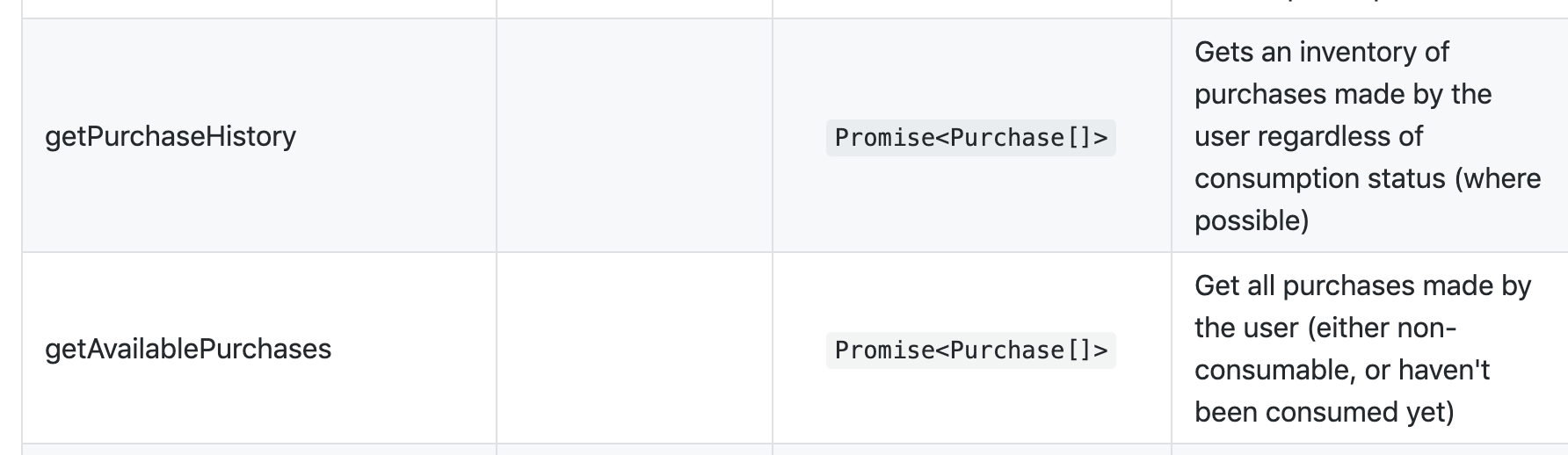
but in documentation getAvailablePurchases() is used to restore purchases. In my tests, the result of RNIap.getAvailablePurchases() and RNIap.getPurchaseHistory() has different items and sizes.
I am very confused which one is the restored items. Which method should be used? Which one is the latest valid restored subscription?
Thank you.
 Myerden
All 6 comments
Have you went through this?
 hyochan
on 17 Jun 2019
hyochan
on 17 Jun 2019
Yes, when I call getAvailablePurchases() 9 elements returns but when I call getPurchaseHistory() 2 elements returns. But the bottom images shows that restoring should be done with getAvailablePurchases(). As you can see non-consumable products mentioned in either with getAvailablePurchases() and getPurchaseHistory(). Which one is correct?


 Myerden
on 17 Jun 2019
Myerden
on 17 Jun 2019
Also I can not understand how these methods returns different items while calling the same action?
/**
* Gets an invetory of purchases made by the user regardless of consumption status
* @returns {Promise<Purchase[]>}
*/
export const getPurchaseHistory = () => Platform.select({
ios: async() => {
checkNativeiOSAvailable();
return RNIapIos.getAvailableItems();
},
//...
})();
/**
* Get all purchases made by the user (either non-consumable, or haven't been consumed yet)
* @returns {Promise<Purchase[]>}
*/
export const getAvailablePurchases = () => Platform.select({
ios: async() => {
checkNativeiOSAvailable();
return RNIapIos.getAvailableItems();
},
//...
})();
as you can see two methods returns RNIapIos.getAvailableItems();
RCT_EXPORT_METHOD(getAvailableItems:(RCTPromiseResolveBlock)resolve
reject:(RCTPromiseRejectBlock)reject) {
[self addPromiseForKey:@"availableItems" resolve:resolve reject:reject];
[[SKPaymentQueue defaultQueue] restoreCompletedTransactions];
}
As I know restoreCompletedTransactions restores the purchases. So these two methods restoring the purchases. Where am I wrong?
Myerden
on 18 Jun 2019
Did you follow #275?
hyochan
on 18 Jun 2019
Yes. I did my restoring process as @andrewzey solution.
const availablePurchases = await RNIap.getAvailablePurchases();
    const sortedAvailablePurchases = availablePurchases.sort(
      (a, b) => b.transactionDate - a.transactionDate
    );
    const latestAvailableReceipt = sortedAvailablePurchases[0].transactionReceipt;
Now it is working correctly in my tests.
Thank you
Myerden
on 18 Jun 2019
Thanks for coming back. I'll close this for now.
hyochan
on 18 Jun 2019
Related issues
 iutin
·
4Comments
iutin
·
4Comments
 bakedbean
·
5Comments
bakedbean
·
5Comments
 summonerriftofficial
·
4Comments
summonerriftofficial
·
4Comments
 lc3t35
·
4Comments
lc3t35
·
4Comments
 HamzaIkram2727
·
3Comments
HamzaIkram2727
·
3Comments
Most helpful comment
Yes. I did my restoring process as @andrewzey solution.
Now it is working correctly in my tests.
Thank you