The vendor bundling example doesn't appear to work as intended. I pulled and ran it and although everything server-rendered fine the output bundles look far too small—React + React DOM can't be 6kb total. Also the client-side code just doesn't run—the click-handler in the example doesn't appear to do anything.
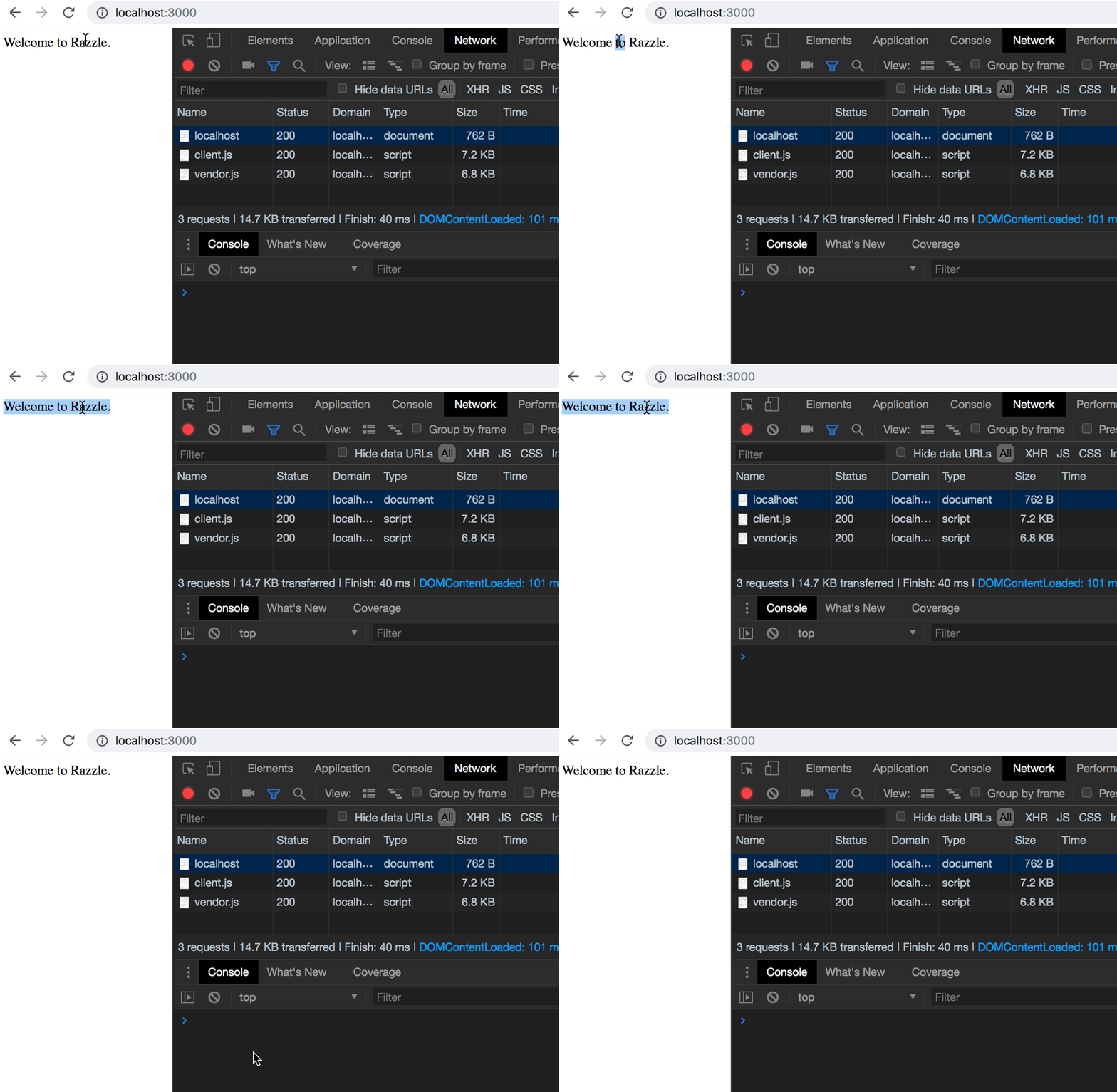
I reproduced this in my own Razzle project too by copying the same config over. I'm not sure exactly what's going on because I'm far from a webpack expert but I know webpack 4 made a lot of changes to commons chunks etc, so is it possible that broke this?
Also probably unrelated to this but the example code in the README doesn't match the project code (and appear to not even build correctly)
 oliverjam
All 16 comments
Same here, doesn't work.
 ghost
on 26 Sep 2018
ghost
on 26 Sep 2018
Hola! So here's the deal, between open source and my day job and life and what not, I have a lot to manage, so I use a GitHub bot to automate a few things here and there. This particular GitHub bot is going to mark this as stale because it has not had recent activity for a while. It will be closed if no further activity occurs in a few days. Do not take this personally--seriously--this is a completely automated action. If this is a mistake, just make a comment, DM me, send a carrier pidgeon, or a smoke signal.
![stale[bot] picture](https://avatars.githubusercontent.com/in/1724?v=4&s=40) stale[bot]
on 2 Dec 2018
stale[bot]
on 2 Dec 2018
Vendor bundling is pretty important, so would be good to get this fixed. I might have some time to look at it in the next few weeks
oliverjam
on 2 Dec 2018
Hi, this example still doesn't work. I can't figure it out why. Vendor bundle doesn't include any react code, same with other libs. Please, can somebody help me with this? Thanks
ghost
on 18 Jan 2019
Review the documentation on splitChunks and vendor bundling. That should help you out.
 mschipperheyn
on 1 Feb 2019
mschipperheyn
on 1 Feb 2019
Scratch that. Tried a number of things and couldn't get splitChunks to work. Don't have time to continue on this right now.
mschipperheyn
on 1 Feb 2019
Any updates on this? I really need to get vendor splitting to work as after code splitting with react-loadable, the main bundle size is still 1mb after gzip 😭
 atomic-tang
on 25 Mar 2019
atomic-tang
on 25 Mar 2019
Okay I am not sure if this solves it but I got vendor splitting to work using cacheGroups instead.
For the with-vendor-bundle example, I did the following:
config.optimization = {
...config.optimization,
splitChunks: {
cacheGroups: {
chunks: 'all',
name: 'vendor',
test: 'vendor',
}
}
}
This thread from stackoverflow helped me.
atomic-tang
on 26 Mar 2019
Followed Webpack site: split chunks example
optimization: {
splitChunks: {
cacheGroups: {
vendor: {
test: /[\\/]node_modules[\\/](react|react-dom)[\\/]/,
name: 'vendor',
chunks: 'all',
}
}
}
}
This worked for me. I can see vendor.chunks.js correctly served.
And we do not even need this part in the example (still work when comment it out), not sure how we deal with razzle/polyfills though
config.entry.vendor = [
require.resolve('razzle/polyfills'),
require.resolve('react'),
require.resolve('react-dom'),
// ... add any other vendor packages with require.resolve('xxx')
];
If @jaredpalmer can help confirm this is the right way, I can submit PR to update the example
 6thfdwp
on 28 Mar 2019
6thfdwp
on 28 Mar 2019
@6thfdwp I can confirm your solution worked for me as well. Thanks for sharing it.
To include razzle/polyfills in your example, I think you should be able to just do this:
vendor: {
test: /[\\/]node_modules[\\/](razzle|react|react-dom)[\\/]/,
name: 'vendor',
chunks: 'all',
}
The way in the docs seems to explicitly state each module to include in the vendor, whereas using test will match based on the directory structure in node_modules. Both ways will work, just different use cases.
Edit: It seems that disables splitting the vendor bundle into chunks, which isn't ideal for production builds (see here). So it will work, but will increase the vendor bundle filesize and prevent it from being chunked up which may not be ideal.
 scraton
on 28 Mar 2019
scraton
on 28 Mar 2019
In order to support vendor bundle splitting in production, it seems you need to use webpack's ManifestPlugin, since razzle's assets-webpack-plugin doesn't seem to report them. I came up with this solution:
// Some additional imports:
const ManifestPlugin = require('webpack-manifest-plugin');
const { extname } = require('path');
// Replace the existing AsetsWebpackPlugin with ManifestPlugin:
config.plugins = config.plugins.map((plugin) => {
if (plugin.constructor.name === 'AssetsWebpackPlugin') {
return new ManifestPlugin({
fileName: '../assets.json',
writeToFileEmit: true,
generate: (seed, files) => (
files.filter(file => !file.isAsset).reduce((manifest, { name, path }) => {
// Group files by extension in the manifest
const ext = extname(path).substr(1);
manifest[ext] = manifest[ext] || [];
manifest[ext].push(path);
return manifest;
}, seed)
),
});
}
return plugin;
});
// Do vendor splitting:
config.entry.vendor = [
require.resolve('razzle/polyfills'),
require.resolve('react'),
require.resolve('react-dom'),
];
config.optimization = {
splitChunks: {
chunks: 'all',
name: dev ? 'vendor' : false,
},
};
You need to specify a name for the splitChunks config in dev, otherwise it will endlessly recompile for some reason.
Then you can import all the assets in your app like so:
${assets.css ? assets.css.reduce((styles, asset) => `${styles}<link rel="stylesheet" ref="${asset}">`, '') : ''}
${assets.js.reduce((scripts, asset) => `${scripts}<script src="${asset}" defer></script>`, '')}
Perhaps Razzle should migrate to using the ManifestPlugin? I saw it mentioned here, so this may be a good reason to do it.
scraton
on 28 Mar 2019
@scraton Thanks for sharing and explanation.
So what you suggested here will produce more chunks, while the Webpack site example using
test: /[\\/]node_modules[\\/](react|react-dom)[\\/]/,
name: 'vendor',
will always give one chunk vendor.chunks.js as I saw it, include all packages passing the test, react, react-dom etc.
Is this also the reason why the with-vendor-example not working? I am not sure if I understand this correctly, any explanation will be appreciated, Thanks!
6thfdwp
on 31 Mar 2019
I gave it another try to no avail. Using splitChunks leads to endless reloads and no matter what I do, no vendor.js is generated. Tried various .env vars RAZZLE_DEV_BUNDLE_PATH, RAZZLE_BUNDLE_PATH but the manifest always contains a vendor key that contains the standard bundle url
mschipperheyn
on 4 Apr 2019
Well, got it done. No idea, why I didn't before. Here's my working config.
If anyone has any suggestions to optimize this, I'd love to hear it.
if (target === 'web') {

    newConfig.output.filename = dev
        ? 'static/js/[name].js'
        : 'static/js/[name].[hash:8].js';

    newConfig.optimization = {
        ...newConfig.optimization,
        splitChunks: {
            cacheGroups: {
                // Chunk splitting optimiztion
                dte: {
                    test: /[\\/]node_modules[\\/](luxon|@date-io\/luxon)[\\/]/,
                    name: 'dte',
                    reuseExistingChunk: true,
                    priority: -30,
                },
                redux: {
                    test: /[\\/]node_modules[\\/](redux|react-redux)[\\/]/,
                    name: 'redux',
                    reuseExistingChunk: true,
                },
                graphql: {
                    test: /[\\/]node_modules[\\/](graphql|react-apollo|apollo-cache-inmemory|apollo-client|apollo-link|apollo-link-context|apollo-link-http|apollo-link-ws|apollo-utilities)[\\/]/,
                    name: 'apollo',
                    reuseExistingChunk: true,
                },
                form: {
                    test: /[\\/]node_modules[\\/](yup|react-final-form|final-form)[\\/]/,
                    name: 'form',
                    reuseExistingChunk: true,
                    priority: -30,
                },
                vendor: {
                    test: /[\\/]node_modules[\\/](react|react-dom|@lingui|react-router|react-router-dom)[\\/]/,
                    name: 'vendor',
                    reuseExistingChunk: true,
                },
                default: {
                    minChunks: 2,
                    priority: -20,
                    reuseExistingChunk: true,
                },
            },
        },
    };
}
@mschipperheyn Could you please send a PR ?
 revskill10
on 16 Apr 2019
revskill10
on 16 Apr 2019
Should be fixed in dev but not using vendors but chunkGroups config
 fivethreeo
on 9 Sep 2020
fivethreeo
on 9 Sep 2020
Related issues
 mhuggins
·
3Comments
mhuggins
·
3Comments
 piersolenski
·
4Comments
piersolenski
·
4Comments
 pseudo-su
·
3Comments
pseudo-su
·
3Comments
 corydeppen
·
3Comments
corydeppen
·
3Comments
 MaxGoh
·
4Comments
MaxGoh
·
4Comments
Most helpful comment
Well, got it done. No idea, why I didn't before. Here's my working config.
If anyone has any suggestions to optimize this, I'd love to hear it.