Rasa: Refactor Agent / Processor / TrackerStore
The Problem
- the
Agentclass is big and hard to maintain - new types of models are hard to implement (e.g. the response selector)
Goals
- Make it easy to implement different / new types of models without having to squeeze it into the existing code
- De-couple our classes to make Rasa Open Source more modular and easier adapt to change
Agent:
- separate model loading logic from class
- separate training from agent class
- remove duplicate code between
Agent/Processor
TrackerStore: Separate it from the model specific domain (theTrackerStoreshould not know of the model domain)- make this not breaking with the existing Rasa Open Source models
Implementation Proposal
- This is about adding a layer before the actual model implementations. So we would e.g. have to adapt our
Processorclass to theModelinterface but could use this then as before
UML Diagrams:
Class hierarchy
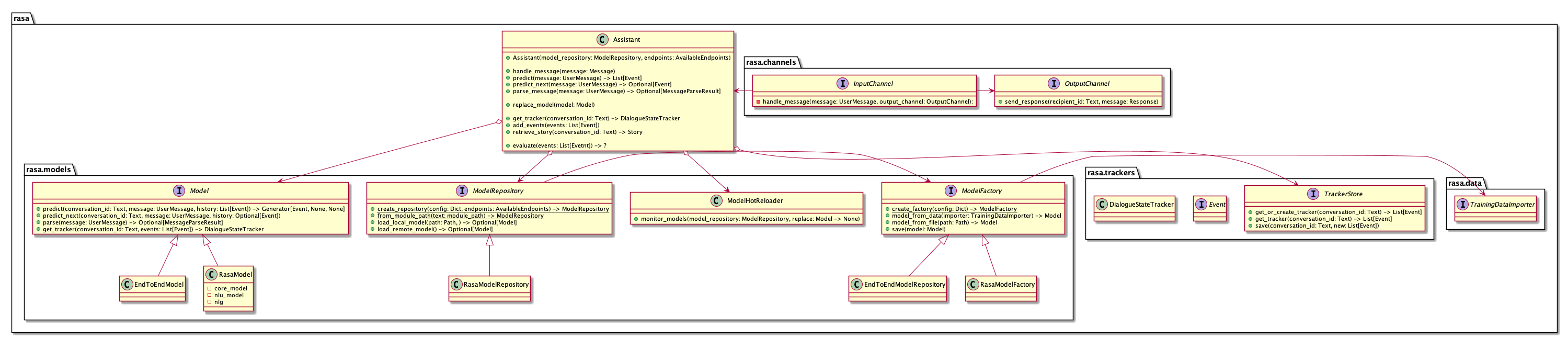
Running a training
This UML diagram how the workflow is when running rasa train
It shows how
- a model is trained using a
TrainingDataImporter - the
ModelFactoryis selected based on a default value / config

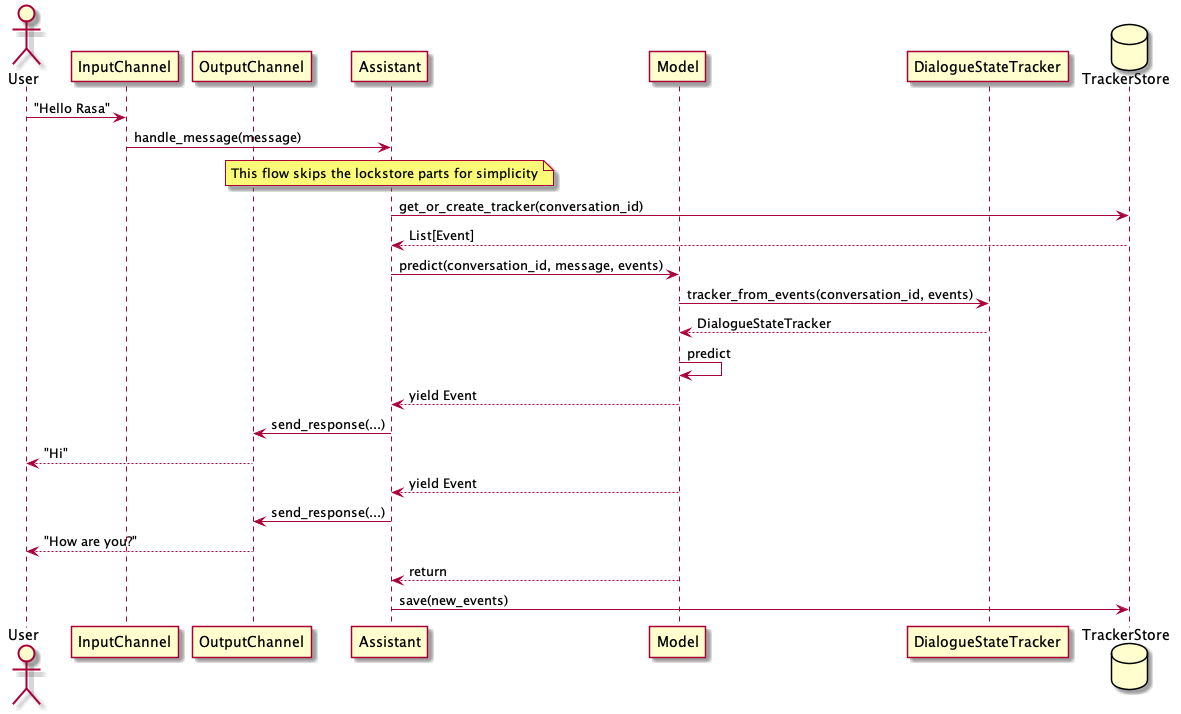
Inference Mode / Interacting with a running Rasa server
It shows how
- the interaction works with the changed
TrackerStore(returns a list of events instead of a DialogueStateTracker - getting response from a model which is behind a
Modelinterface
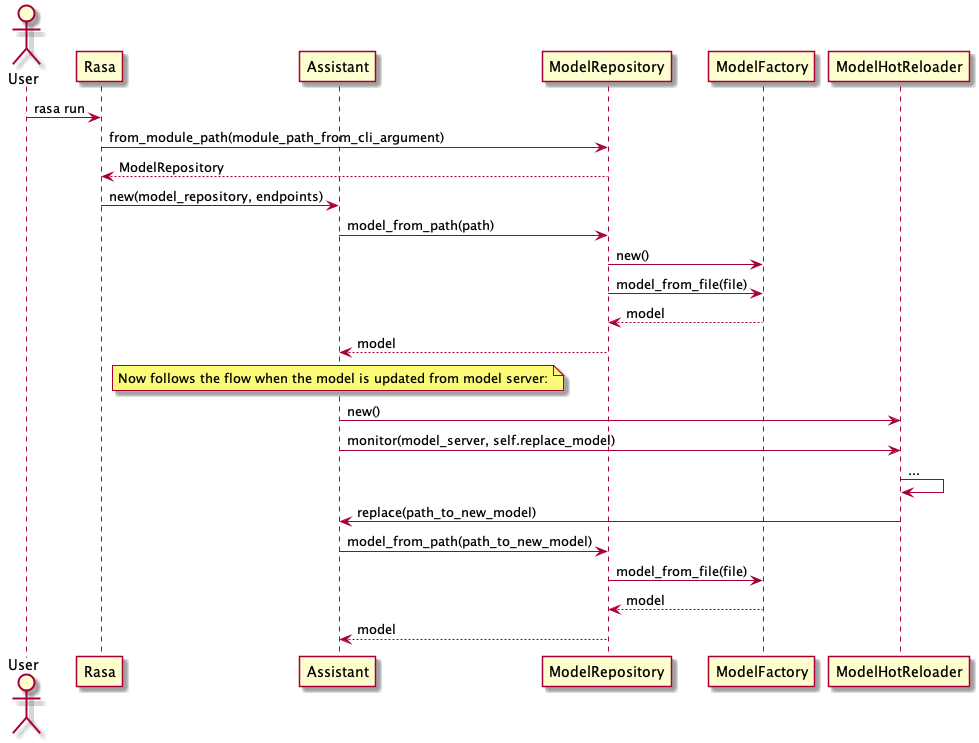
Starting a Rasa Server and loading a model
This shows how:
- the right repository / factory classes are selected to load the desired model type
- a model is loaded from disk
- how models are re-loaded when using a
ModelServer(that's the most vague part I'd say)
 wochinge
All 11 comments
This looks very interesting and I want to understand it better - would you mind adding a very short description of what each UML diagram describes? (just to understand their context better)
 federicotdn
on 18 Mar 2020
federicotdn
on 18 Mar 2020
@federicotdn Done. Do you have any specific questions which I should clarify?
wochinge
on 18 Mar 2020
How does this simplify e.g. the implementation of the response selector?
 tmbo
on 18 Mar 2020
tmbo
on 18 Mar 2020
A couple of questions:
- This means that you would like to merge
AgentandProcessorinto a new class,Assistant, right? Asking because it's not explicitly mentioned. - I like the idea of adding a
ModelFactory. It would separate the logic of creating a model (which is relatively complex, if training is involved) with actually using the model. However, I don't understand whyModelFactoryis in charge of saving the models to files. That sounds like it could go either inModelitself (like it is now), or maybeModelFactoryshould be renamed to represent the fact that it has more responsibilities than just loading models. - Why do you think
TrackerStore.get_or_create_trackershould return a list of events, rather than aDialogueStateTrackeritself? Isn't the latter a better way of representing a series of conversation events? - I couldn't understand the objective of having the
ModelRepositoryclass. In the last UML diagram, it looks like it is delegating the model loading toModelFactory. - Can we rename
DialogueStateTrackertoTracker? (and then addDialogueStateTracker = Trackerbelow the class declaration 🤠 )
federicotdn
on 18 Mar 2020
How does this simplify e.g. the implementation of the response selector?
Good question. If we would have a structure as proposed then you would approach implementing the feature less from a "how can I fit this in" but rather a "where does this belong" perspective. To be honest I know too less about the difficulties of the response selector implementation to propose how I would have done it given the proposed changes.
An easier example is maybe implementing an end-to-end model. You could simply create a new Model subclass and start coding (while re-using what you need from the existing modules). Both models could live side by side until we decide that we are ready too switch completely.
This means that you would like to merge Agent and Processor into a new class, Assistant, right? Asking because it's not explicitly mentioned.
I wouldn't say merging. Actually it would be more separating them since they are quite entangled at the moment. I guess that a lot of Processor logic would go into RasaModel while the Assistant would be more focused on delegating between channels / tracker stores / lock stores / models .
However, I don't understand why ModelFactory is in charge of saving the models to files.
True, I think both is possible. Might be that the ModelFactory is too much abstraction. From my view the ModelFactory is responsible for everything around (de)-serialization of the model. You could e.g. implement a different ModelFactory to store models on different sources (e.g. S3, disk, ...) or in different formats.
I couldn't understand the objective of having the ModelRepository class. In the last UML diagram, it looks like it is delegating the model loading to ModelFactory.
The ModelRepository is responsible for selecting the appropriate model, e.g. selecting the suited model from a directory on disk or from bucket on AWS. The ModelFactory would then deal with converting the selected model to the right Python objet.
Why do you think TrackerStore.get_or_create_tracker should return a list of events, rather than a DialogueStateTracker itself? Isn't the latter a better way of representing a series of conversation events?
The TrackerStore currently requires the Domain to return the DialogueStateTracker. The Domain is part of the model and shouldn't be exposed to the TrackerStore in my opinion (e.g. different models might handle the events differently). I completely agree that the Model should then apply a suited data structure to this raw lists to make the handling easier.
Can we rename DialogueStateTracker to Tracker? (and then add DialogueStateTracker = Tracker below the class declaration 🤠
I'd prefer ConversationHistory actually since it's more intuitive 😄
In general this is just a first draft / proposal. A lot details about the interactions (e.g. between ModelRepository / ModelFactory still need revisiting.
wochinge
on 18 Mar 2020
Thanks for your detailed feedback @federicotdn !
wochinge
on 18 Mar 2020
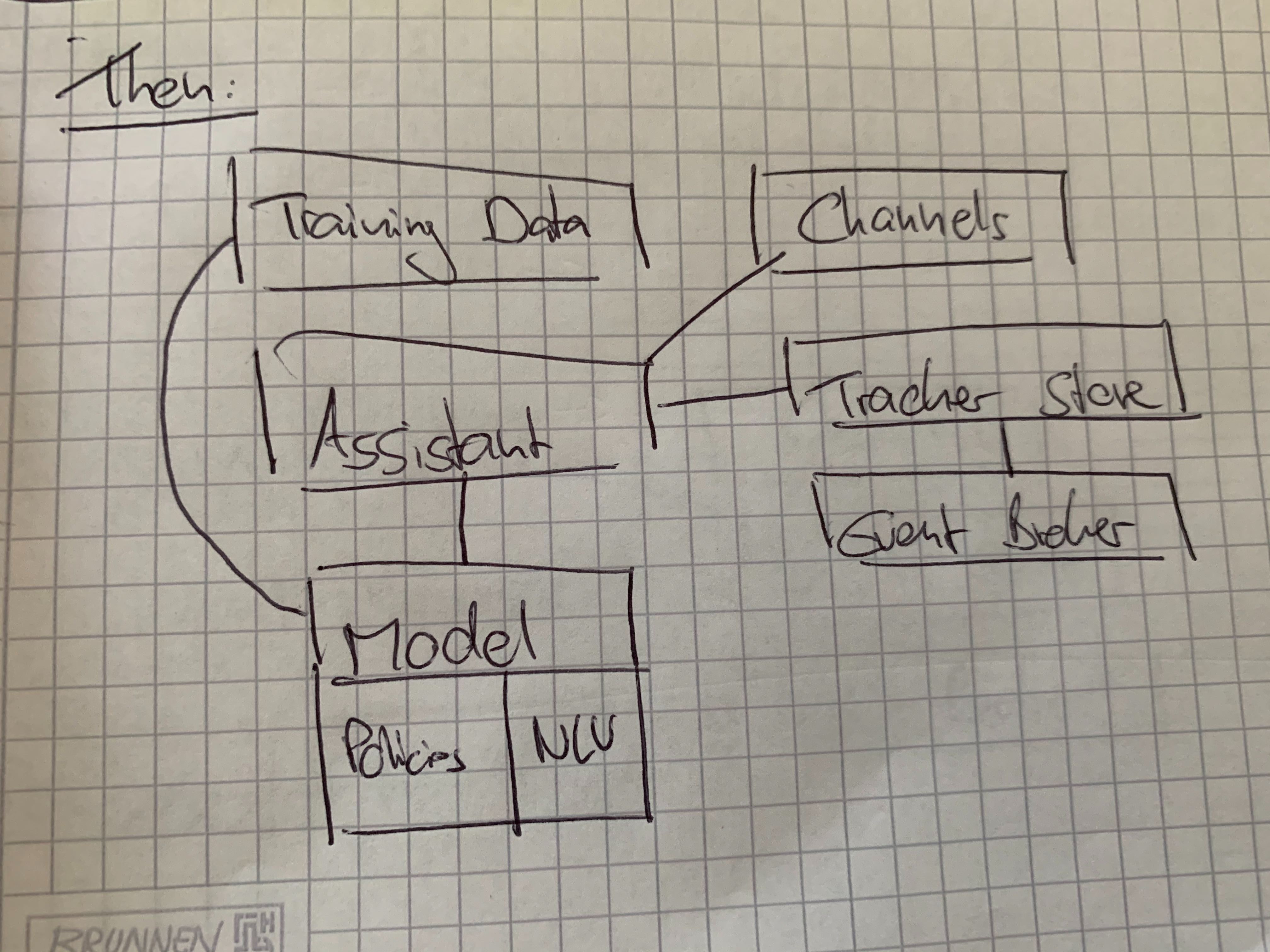
The way I see our code is as that it is organized as a bunch of lego blocks which interact with each other through clearly defined interfaces. This makes the single blocks replaceable, the code concise and hence more flexible.
Currently, the agent / processor logic leaks into some of our existing "lego blocks" (e.g. training data, tracker store, policies) (sorry, that I forgot the lockstore).
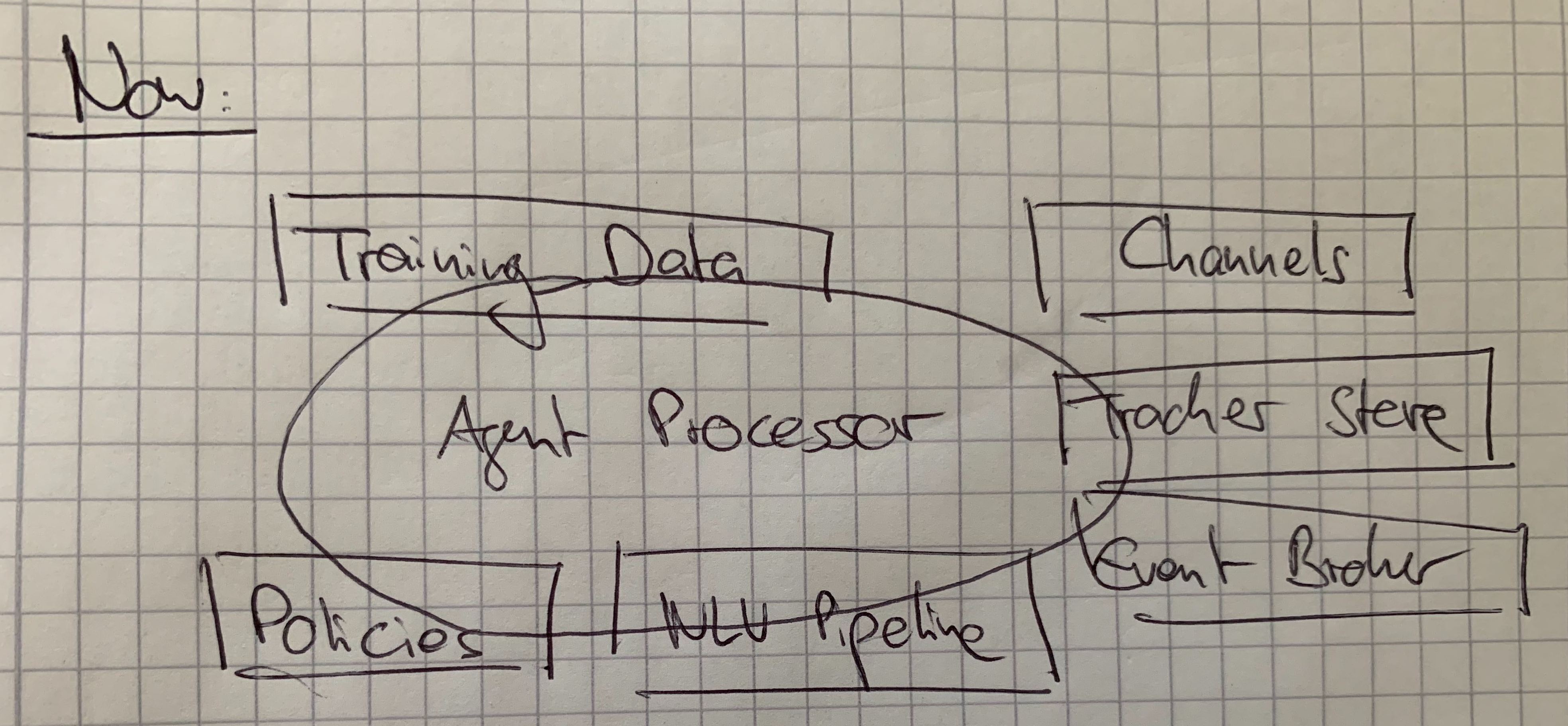
(I believe) Introducing a Model interface + the other changes would reinforce the re-usable blocks and remove the leaks.
wochinge
on 6 Apr 2020
That looks great, I like the idea of reworking the Agent and Processor classes into Assistant, while at the same time making the boundaries between all classes better defined. Currently Agent and Processor are very tightly related and sometimes it's difficult to see what each of them individually is meant to do. I think these changes also give us the opportunity to improve our public Python API.
federicotdn
on 7 Apr 2020
An issue regarding process safe handling of models. Not necessary part of this issue, but worth thinking about before implementing this https://github.com/RasaHQ/rasa/issues/5376
wochinge
on 17 Apr 2020
Refactoring steps
Simplifications
- no need to dynamically load the factory for the model in the beginning. That can be a later step
Todos
- Think about
processor._cancel_remindersand_schedule_reminders
Steps
Part 0: Agree on a Model interface
- The current suggestion in the issue is just a quick draft and needs to be discussed with the team.
Part 1: The divorce of Domain and TrackerStore
Rough plan
- return a
List[Event]forget_or_create_tracker - move
init_trackersomewhere else (probably toDialogueStateTracker) - optional: refactor
TrackerStore.saveto accept aList[Event] - adapt sub implementations
Current Dependencies (just for plan ideation)
processor.get_trackerexporter._fetch_events_within_time_rangesavereturns a DialogueStateTracker
- imo it can continue to accept a
DialogueStateTracker
- imo it can continue to accept a
Part 2: Hello Model interface
Rough plan
- Create
Model Interface - Let
Processsorimplement model interface - Let
Agentonly speak to processor via interface
Current Dependencies (just for plan ideation)
- Dependencies Agent <- -> Processor
Model.parse_message
Agent.parse_message_using_nlu_interpreter
Model.predict
Agent.handle_messageAgent.trigger_intent
Model.predict_next
Agent.predict_next
Model.execute
- ‼️ This is missing in the interface declaration
Agent.execute_action
- do we want to remove this?
- Open for discussion
Agent.log_message
- Do we even need that?
- seems to a weird way to add the result of
parse_messagedirectly to the tracker + adding slots
Part 3: Remove TrackerStore from Processor
Rough plan
- Remove direct access from
servermodule toprocessor
- speak to my
Agent🤚
- speak to my
- Pass in current
Events(notDialogueStateTracker!) to every function of the processor which needs it - Remove
tracker_storefromProcessorconstructor
Current Dependencies (just for plan ideation)
- Server currently skips the agent and speaks to model directly, e.g.
get_tracker
- Processor always deals with TrackerStore itself
Situation after Part 3
- Agent still knows about training
- Agent still knows to much about model loading
- The
Agentstill knows to much about the insides ofProcessor
- interpreter
- domain
- policies
Part 4: Hello ModelFactory : Removing Rasa Core training from Agent
Rough plan
- Create
ModelFactoryinterface - Create a
ModelFactorywith afrom_training_data_importerfunction
- Do all of the
Agent.trainsteps in here - this will return a
PolicyEnsembleat this step
- Do all of the
- Add a save function to
ModelFactorywhich accepts the model and can save it - point
rasa.core.trainto implementation ofModelFactory - dump all the train code from
Agent - pass trained
Ensembleto Agent as usually
Current Dependencies for Rasa Core training (just for plan ideation)
- References
restaurant bot examplerasa.core.train
- Agent has
- policy ensemble
- domain
load_data
- this one is just the
Agenttaking to theEnsemble
- this one is just the
- This is equivalent to
- Create policy ensemble
- generate
DialogueStateTrackers using Domain - Tell the policy ensemble to train
- set a fingerprint
- Agent knows how to persist models 🙈
Situation after Part 4
- Agent doesn't know about Core training any more
- Agent still knows to much about model loading
- The
Agentstill knows to much about the insides ofProcessor
- interpreter
- domain
- policies
Part 5: ModelFactory, let me introduce you to NLU
Rough Steps
- Move
nlu.train.trainto factory (same part where core is trained) - Let factory method
from_training_data_importeran implementation of theModelinterface (akaProcessor) - pimp the
savefunction in theModelFactoryto save everything as a Rasa Model - optional: Move the
no need to retrainlogic toModelFactory delete
toggle_memoizationor think about itOpen Question
How does our "no need to retrain" fit in there
Part 6: Agent, forget about the model internals
Rough Steps
- Add a function to
ModelFactoryto loadModelfrom path - make
rasa.core.run.load_agent_on_startjust pass thepathinstead of theinterpreter - Refactor
load_agentto use theModelFactorywhen loading model from path
- There are 3 cases
load_from_serverload_from_remote_storageload_local_model
- There are 3 cases
Situation after Part 6
- Agent doesn't know about Core training any more
- Agent still knows to much about model loading
- The
Agentdoes not now how a model looks inside anymore
Part 7: Specialized Model loader
Requirements
- Needs a
ModelFactory - needs to be able to replace the
Modelwithin theAgent
Rough Steps (needs further thoughts ‼️)
- Needs a
there are at least two ways to handle this: we need to think about pros / cons
- one centralised model downloader. Sets a variable which points to the latest model on disk and each workers just loads it from disk
- Each workers pulls separately and updates their model
- Make
Agentmodel loading one simple / function callback and move other related code to a new / different module
Thoughts
- Appscheduler or sanic background task for repeatedly pulling
- This should be process safe -> Same Rasa model for all Sanic workers
- Monitoring + pulling for a newer one shouldn't be related to where it is stored imo but test condition might change 🤔
Step 8: Remove Agent.visualize
Current Dependencies (just for plan ideation)
- policies are required to determine
max_history - domain is required
interpreteris None which means probablyRegexInterpreter
Rough steps
- use
TrainingDataImporterto load required data - pass
importertorasa.core.visualizeand just skipagent.visualize - determine configured
max_historybased on config + default value + CLI variable - remove
Agent.visualize
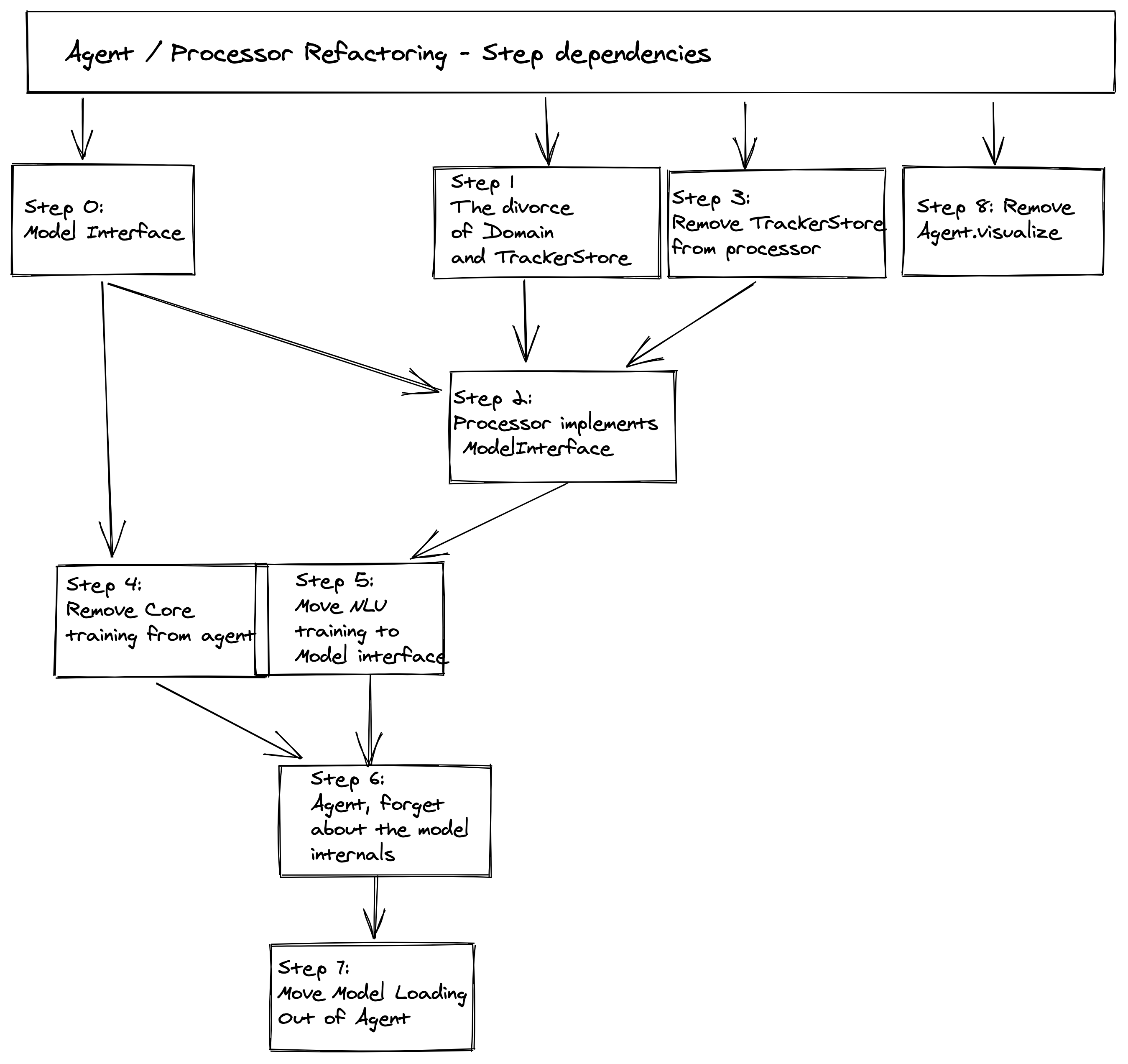
Step dependencies
wochinge
on 18 May 2020
@tmbo I split the proposal in single steps. The comment looks a bit daunting due to its size but you can focus on the step headlines and the rough plan sections. The image describes the dependencies between the steps (e.g. we can can't do Step 4 without doing Step 0 first). In my opinion every step (besides step 0, 2 & 5) makes sense to do, even if we don't continue with the subsequent steps. Some things are not figured out to the last detail, but imo that doesn't matter at this stage (e.g. how to move the details of model loading out of Agent)
wochinge
on 18 May 2020
Related issues
 mit4dev
·
4Comments
mit4dev
·
4Comments
 rayush7
·
3Comments
rayush7
·
3Comments
 connorbrinton
·
3Comments
connorbrinton
·
3Comments
 edouardlp
·
3Comments
edouardlp
·
3Comments
 Poojan66
·
3Comments
Poojan66
·
3Comments
Most helpful comment
Refactoring steps
Simplifications
Todos
processor._cancel_remindersand_schedule_remindersSteps
Part 0: Agree on a
ModelinterfacePart 1: The divorce of
DomainandTrackerStoreRough plan
List[Event]forget_or_create_trackerinit_trackersomewhere else (probably toDialogueStateTracker)TrackerStore.saveto accept aList[Event]Current Dependencies (just for plan ideation)
processor.get_trackerexporter._fetch_events_within_time_rangesavereturns a DialogueStateTrackerDialogueStateTrackerPart 2: Hello
ModelinterfaceRough plan
Model InterfaceProcesssorimplement model interfaceAgentonly speak to processor via interfaceCurrent Dependencies (just for plan ideation)
Model.parse_messageAgent.parse_message_using_nlu_interpreterModel.predictAgent.handle_messageAgent.trigger_intentModel.predict_nextAgent.predict_nextModel.executeAgent.execute_actionAgent.log_messageparse_messagedirectly to the tracker + adding slotsPart 3: Remove
TrackerStorefromProcessorRough plan
servermodule toprocessorAgent🤚Events(notDialogueStateTracker!) to every function of the processor which needs ittracker_storefromProcessorconstructorCurrent Dependencies (just for plan ideation)
get_trackerSituation after Part 3
Agentstill knows to much about the insides ofProcessorPart 4: Hello
ModelFactory: Removing Rasa Core training fromAgentRough plan
ModelFactoryinterfaceModelFactorywith afrom_training_data_importerfunctionAgent.trainsteps in herePolicyEnsembleat this stepModelFactorywhich accepts the model and can save itrasa.core.trainto implementation ofModelFactoryAgentEnsembleto Agent as usuallyCurrent Dependencies for Rasa Core training (just for plan ideation)
restaurant bot examplerasa.core.trainload_dataAgenttaking to theEnsembleDialogueStateTrackers using DomainSituation after Part 4
Agentstill knows to much about the insides ofProcessorPart 5: ModelFactory, let me introduce you to NLU
Rough Steps
nlu.train.trainto factory (same part where core is trained)from_training_data_importeran implementation of theModelinterface (akaProcessor)savefunction in theModelFactoryto save everything as a Rasa Modelno need to retrainlogic toModelFactorydelete
toggle_memoizationor think about itOpen Question
How does our "no need to retrain" fit in there
Part 6: Agent, forget about the model internals
Rough Steps
ModelFactoryto loadModelfrom pathrasa.core.run.load_agent_on_startjust pass thepathinstead of theinterpreterload_agentto use theModelFactorywhen loading model from pathload_from_serverload_from_remote_storageload_local_modelSituation after Part 6
Agentdoes not now how a model looks inside anymorePart 7: Specialized Model loader
Requirements
ModelFactoryModelwithin theAgentRough Steps (needs further thoughts ‼️)
there are at least two ways to handle this: we need to think about pros / cons
Agentmodel loading one simple / function callback and move other related code to a new / different moduleThoughts
Step 8: Remove
Agent.visualizeCurrent Dependencies (just for plan ideation)
max_historyinterpreteris None which means probablyRegexInterpreterRough steps
TrainingDataImporterto load required dataimportertorasa.core.visualizeand just skipagent.visualizemax_historybased on config + default value + CLI variableAgent.visualizeStep dependencies