Ramda: curry not working when being partially applied in point free style
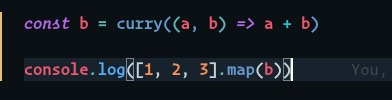
this returns => [ 1, 2, 3 ]
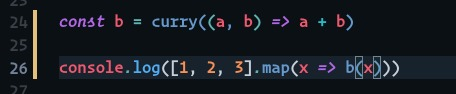
while this returns => [ function, function, function ]
Why didn't it work in point free style? What's the difference between these two?
 kanitsharma
All 3 comments
Your second example is the equivalent of:
console.log([1, 2, 3].map(R.unary(b)))
The reason it does not work is your function wants two arguments, and if given just one, it returns a function. That's how currying normally works.
Your first example works (not sure if it's "as expected", though), because Array.prototype.map() will pass 3 arguments, not just one, second argument being the index.
 foxbunny
on 5 Jul 2018
foxbunny
on 5 Jul 2018
@kanitsharma:
You may be running into the issue that Ramda's curry is not a standard curry. The idea is that if
const f = (a, b, c) => /* ... */
const g = curry(f)
then, while g still has an arity of 3, you can use it in any of these manners:
g(a, b, c) ~> f(a, b, c)
g(a, b)(c) ~> f(a, b, c)
g(a)(b, c) ~> f(a, b, c)
g(a)(b)(c) ~> f(a, b, c)
Note that your first example should log [1, 3, 5], not [1, 2, 3]. As @foxbunny pointed out, you're passing the index when you use Array.prototype.map. So you get calls to b(1, 0), b(2, 1), and b(3, 2), returning [1 + 0, 2 + 1, 3 + 2], which is [1, 3, 5]. (Actually, third parameter is supplied as well: the entire list. But it's ignored in this function.)
Note also that [1, 2, 3].map(b(20)) does return [21, 22, 23]
When you make the function unary, whether with a unary decorator or via x => b(x), then you get something equivalent to [x => 1 + x, x => 2 + x, x => 3 + x]
It's not clear to me what you're looking for as a correct result. You should expect when you map your function b over a list of numbers to get a list of functions. But that's only with a map that doesn't pass the additional parameters. For instance
R.map([1, 2, 3], b) ~> [x => 1 + x, x => 2 + x, x => 3 + x]
Also, a quick note. Please don't paste pictures of code, but the actual code itself. (See the Examples section in GitHub's Markdown Guide if you have any questions.)
 CrossEye
on 5 Jul 2018
CrossEye
on 5 Jul 2018
@foxbunny @CrossEye Thanks for your explanations, I forgot about the additional parameters in Array.prototype.map and yeah @CrossEye It was logging [1, 3, 5], my bad.
kanitsharma
on 5 Jul 2018
Related issues
 kostenko
·
3Comments
kostenko
·
3Comments
 zhaoyao91
·
3Comments
zhaoyao91
·
3Comments
 MadDeveloper
·
3Comments
MadDeveloper
·
3Comments
 ldk18501
·
3Comments
ldk18501
·
3Comments
 corporatepiyush
·
4Comments
corporatepiyush
·
4Comments
Most helpful comment
Your second example is the equivalent of:
The reason it does not work is your function wants two arguments, and if given just one, it returns a function. That's how currying normally works.
Your first example works (not sure if it's "as expected", though), because
Array.prototype.map()will pass 3 arguments, not just one, second argument being the index.