Racket: syntax-parse binding arrow points to the wrong binding occurrence
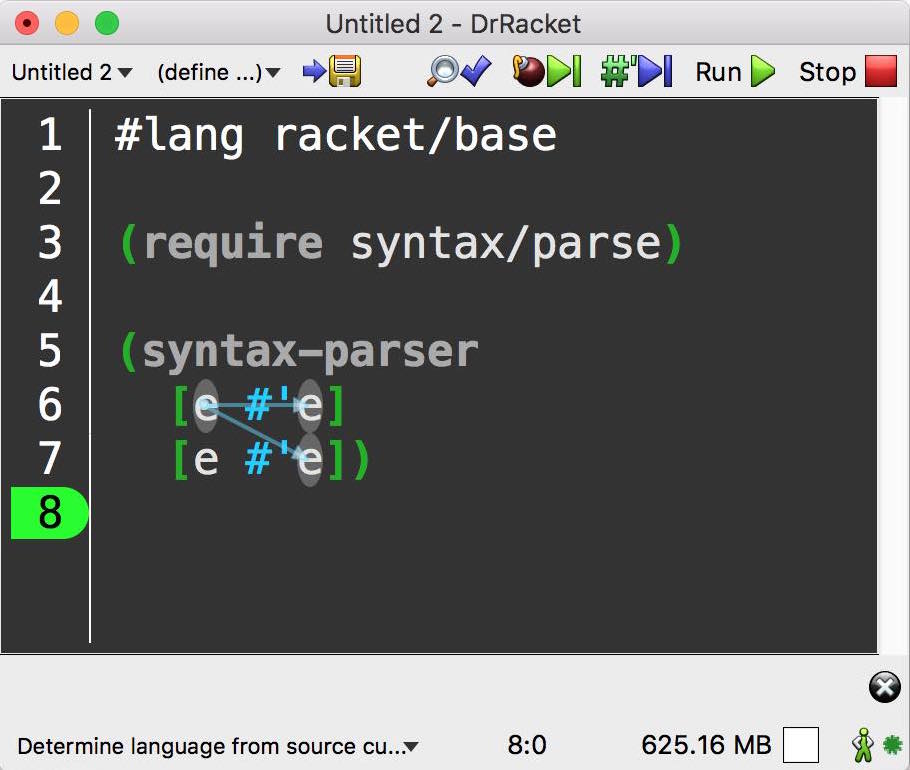
In the following code, the binding arrow of #'e at B points to the e at A.
#lang racket/base

(require syntax/parse)

(syntax-parser
  [e #'e]  ; A
  [e #'e]  ; B
  )
 shhyou
All 4 comments
Arguably, this is correct.
 mfelleisen
on 4 Nov 2017
mfelleisen
on 4 Nov 2017
I'm not sure what argument you have in mind, but the fact that this one does the more obvious thing seems like a counterargument:
(syntax-parser
  [e #'e]
  [f #'f])
 rfindler
on 4 Nov 2017
rfindler
on 4 Nov 2017
👍3
Also, I'll note that if I rename "f" to "e" (in my example) and then back I get different program, which also seems like a counterargument.
rfindler
on 4 Nov 2017
I think I can see that if there is a common prefix, it's better that the implementation do not re-match the prefix and use the same bound variable. But I would be against exposing this to the user because:
- Intuitively, the scope of first pattern variable
eshould span only in the first clause. - Renaming does not work anymore. For example, I cannot rename
thnandelscorrectly:
#lang racket/base

(require (for-syntax racket/base)
         syntax/parse)

(define-syntax (reversed-if _)
  (error 'reversed-if "bad syntax"))

(syntax-parser #:literals (quote reversed-if)
 [(reversed-if thn:expr els:expr '#t)
  #'thn]
 [(reversed-if thn:expr els:expr '#f)
  #'els]
 [(reversed-if thn:expr els:expr con:expr)
  #'(if con thn els)])
Was this page helpful?
0 / 5 - 0 ratings
Related issues
 sorawee
·
7Comments
sorawee
·
7Comments
 billop
·
5Comments
billop
·
5Comments
 willghatch
·
7Comments
willghatch
·
7Comments
 corpix
·
7Comments
willghatch
·
7Comments
corpix
·
7Comments
willghatch
·
7Comments
Most helpful comment
I'm not sure what argument you have in mind, but the fact that this one does the more obvious thing seems like a counterargument: