When the height of the placeholdertext i larger than the editor it just overflows out the bottom.
Steps for Reproduction
Expected behavior:
The editor should expand to contain the placeholder text
Actual behavior:
The placholder text flows out of the editor area.
Platforms:
Tested on Windows 10 and Linux in Chrome 70
Version:
1.3.6
 hoffmeyer
All 6 comments
The placeholder should normally be few words long.
You can give the editor min-height:
.ql-editor {
min-height: 200px;
}
 benbro
on 28 Nov 2018
benbro
on 28 Nov 2018
@hoffmeyer I just ran into this issue myself and wanted a fix that wasn't min-height related; that's not a truly dynamic solution because you need to know the length of your placeholder and the resolution of the device. The main issue lies with the absolute position of the before pseudo element. My fix was as follows:
.ql-editor.ql-blank::before {
display: block; /* needed to allow for the below margin */
margin-bottom: -1.42em; /* pulls content below the placeholder up to match the position: absolute behavior where content is on the same line as the placeholder; 1.42 matches the line-height of the editor */
position: static;
}
It looks like the offending code is here. I'd be happy to open up a PR to fix this, @benbro, if it's a fix that the core team is okay with. The behavior isn't perfect since multi-line placeholder text only pulls the cursor up one line, but the placeholder does wrap and the editor adjusts to its content.
 ajmueller
on 28 Aug 2019
ajmueller
on 28 Aug 2019
I like the solution by @ajmueller - although I might suggest a slight change. If you use this method, you'll find that the actual content of the editor will be pushed down by the now statically positioned placeholder ::before pseudo element - and so this gives the awkward behavior of the cursor being _underneath_ the placeholder.
Hopefully this might help someone else if they run into this issue:
The simplest fix that you could employ without this being a PR to Quill would be to do the following in your own codebase:
.ql-editor.ql-blank::before {
  content: none;
}

.ql-editor.ql-blank::after {
  color: rgba(0,0,0,0.6);
  content: attr(data-placeholder);
  font-style: italic;
  pointer-events: none;
  display: block;
  margin-top: -1.42rem;
}
The ::after pseudo element is just using the base styles already defined on the ::before pseudo element, without the position: relative left and right rules.
 jesselloyd
on 31 Oct 2019
jesselloyd
on 31 Oct 2019
@jesselloyd awesome solution! This worked wonderfully, except I changed the -1.42rem to -1.42em to get the cursor placement perfect (and keep it relative to the font-size of the Quill editor).
ajmueller
on 1 Nov 2019
Good point! Thanks for catching that. I forgot to switch the units, that'll do it!
jesselloyd
on 1 Nov 2019
@jesselloyd one more minor tweak that I've found is necessary is to add a fallback for the content property. So the entire snippet is:
.ql-editor.ql-blank::before {
    content: none;
}

.ql-editor.ql-blank::after {
    color: rgba(0, 0, 0, 0.6);
    content: attr(data-placeholder, '');
    display: block;
    font-style: italic;
    margin-top: -1.42em;
    pointer-events: none;
}
Without this, Chrome renders the initial state of the editor like so:

Adding this fallback fixes the initial render:
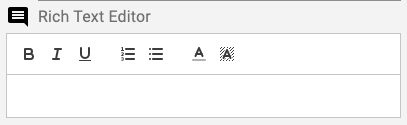
Evidently Chrome doesn't like pseudo elements with content pointing to non-existent attributes. Firefox renders it fine either way.
EDIT I should have read the MDN docs more carefully. Fallbacks are experimental and not yet supported by browsers. Someday this will fix the problem! In the meantime, a slightly more hacky min-height addition will fix it:
.ql-editor.ql-blank::before {
    content: none;
}

.ql-editor.ql-blank::after {
    color: rgba(0, 0, 0, 0.6);
    content: attr(data-placeholder);
    display: block;
    font-style: italic;
    margin-top: -1.42em;
    min-height: 1em;
    pointer-events: none;
}
Related issues
 aletorrado
·
3Comments
aletorrado
·
3Comments
 sferoze
·
3Comments
sferoze
·
3Comments
 Yves-K
·
3Comments
Yves-K
·
3Comments
 DaniilVeriga
·
3Comments
DaniilVeriga
·
3Comments
 visore
·
3Comments
visore
·
3Comments
Most helpful comment
I like the solution by @ajmueller - although I might suggest a slight change. If you use this method, you'll find that the actual content of the editor will be pushed down by the now statically positioned placeholder
::beforepseudo element - and so this gives the awkward behavior of the cursor being _underneath_ the placeholder.Hopefully this might help someone else if they run into this issue:
The simplest fix that you could employ without this being a PR to Quill would be to do the following in your own codebase:
The
::afterpseudo element is just using the base styles already defined on the::beforepseudo element, without theposition: relativeleftandrightrules.