Quarkus: Could not deserialize watch event - exception only when run in native mode
My small k8s object watcher app - https://github.com/iamvvra/k8swatcher - throws the below deserialization exception only when the app is run as binary, I never faced this exception running with maven or with the uber jar. I am connecting to an Openshift cluster.
2019-08-22 21:52:06,559 ERROR [io.fab.kub.cli.dsl.int.WatchConnectionManager] (OkHttp https://mycluster.com/...) Could not deserialize watch event: {"type":"ADDED","object":{"kind":"Pod","apiVersion":"v1","metadata":{" ...

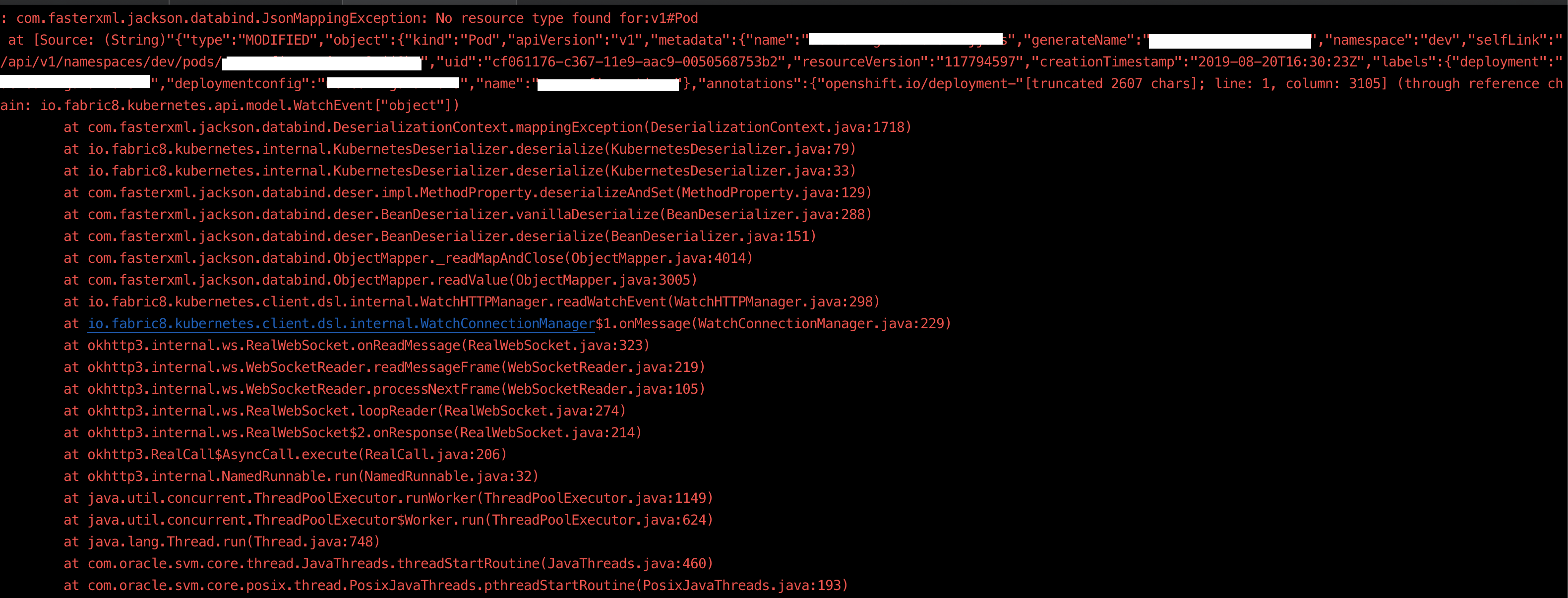
com.fasterxml.jackson.databind.JsonMappingException: No resource type found for:v1#Pod
 at [Source: (String)"{"type":"ADDED","object":{"kind":"Pod","apiVersion":"v1","metadata":{"name":"pod1-1-msbsr","generateName":"pod1-1-","namespace":"dev","selfLink":"/api/v1/namespaces/dev/pods/pod1-1-msbsr","uid":"5de8eead-c3e3-11e9-aac9-0050568753b2","resourceVersion":"117436928","creationTimestamp":"2019-08-21T07:14:51Z","labels":{"deployment":"deployment1-1","deploymentconfig":"deployment1-server","name":"app1"},"annotations":{"openshift.io/deployment-con"[truncated 2691 chars]; line: 1, column: 3189] (through reference chain: io.fabric8.kubernetes.api.model.WatchEvent["object"])
    at com.fasterxml.jackson.databind.DeserializationContext.mappingException(DeserializationContext.java:1718)
    at io.fabric8.kubernetes.internal.KubernetesDeserializer.deserialize(KubernetesDeserializer.java:79)
    at io.fabric8.kubernetes.internal.KubernetesDeserializer.deserialize(KubernetesDeserializer.java:33)
    at com.fasterxml.jackson.databind.deser.impl.MethodProperty.deserializeAndSet(MethodProperty.java:129)
    at com.fasterxml.jackson.databind.deser.BeanDeserializer.vanillaDeserialize(BeanDeserializer.java:288)
    at com.fasterxml.jackson.databind.deser.BeanDeserializer.deserialize(BeanDeserializer.java:151)
    at com.fasterxml.jackson.databind.ObjectMapper._readMapAndClose(ObjectMapper.java:4014)
    at com.fasterxml.jackson.databind.ObjectMapper.readValue(ObjectMapper.java:3005)
    at io.fabric8.kubernetes.client.dsl.internal.WatchHTTPManager.readWatchEvent(WatchHTTPManager.java:298)
    at io.fabric8.kubernetes.client.dsl.internal.WatchConnectionManager$1.onMessage(WatchConnectionManager.java:229)
    at okhttp3.internal.ws.RealWebSocket.onReadMessage(RealWebSocket.java:323)
    at okhttp3.internal.ws.WebSocketReader.readMessageFrame(WebSocketReader.java:219)
    at okhttp3.internal.ws.WebSocketReader.processNextFrame(WebSocketReader.java:105)
    at okhttp3.internal.ws.RealWebSocket.loopReader(RealWebSocket.java:274)
    at okhttp3.internal.ws.RealWebSocket$2.onResponse(RealWebSocket.java:214)
    at okhttp3.RealCall$AsyncCall.execute(RealCall.java:206)
    at okhttp3.internal.NamedRunnable.run(NamedRunnable.java:32)
    at java.util.concurrent.ThreadPoolExecutor.runWorker(ThreadPoolExecutor.java:1149)
    at java.util.concurrent.ThreadPoolExecutor$Worker.run(ThreadPoolExecutor.java:624)
    at java.lang.Thread.run(Thread.java:748)
    at com.oracle.svm.core.thread.JavaThreads.threadStartRoutine(JavaThreads.java:460)
    at com.oracle.svm.core.posix.thread.PosixJavaThreads.pthreadStartRoutine(PosixJavaThreads.java:193)
Expected behavior
Should deserialize and provide the received value as object
To Reproduce
Steps to reproduce the behavior:
- Write a program to watch an object, say Pod.
- Generate a binary, MAC
- Connect to a Kubernetes cluster - possibly it can be an Openshift.
Configuration
quarkus.kubernetes-client.trust-certs=true
quarkus.log.console.enable=true
quarkus.log.level=INF
Screenshots
Environment (please complete the following information):
- Output of
uname -aorver: Darwin vvra-mac.local 18.7.0 Darwin Kernel Version 18.7.0: Thu Jun 20 18:42:21 PDT 2019; root:xnu-4903.270.47~4/RELEASE_X86_64 x86_64 - Output of
java -version: openjdk version "1.8.0_222"
OpenJDK Runtime Environment (build 1.8.0_222-20190711112007.graal.jdk8u-src-tar-gz-b08)
OpenJDK 64-Bit GraalVM CE 19.1.1 (build 25.222-b08-jvmci-19.1-b01, mixed mode) - GraalVM version (if different from Java): same as above
- Quarkus version or git rev:
0.20.0
 iamvvra
All 17 comments
@geoand looks like an issue for you :)
 gsmet
on 22 Aug 2019
gsmet
on 22 Aug 2019
Sure thing, I'll take a look!
 geoand
on 22 Aug 2019
geoand
on 22 Aug 2019
Can you please try with Quarkus 0.21.1 and see if the problem is still there?
I remember there was some fix made that might be relevant, but I'm not sure what version it was added (although I can certainly dig it up)
Thanks
geoand
on 23 Aug 2019
I'll also check your reproducer tomorrow and see how it's different from what I had used to test watch of pods (which worked)
geoand
on 23 Aug 2019
I was able to reproduce the problem. Looking into it now
geoand
on 23 Aug 2019
Can you please try with Quarkus 0.21.1 and see if the problem is still there?
I remember there was some fix made that might be relevant, but I'm not sure what version it was added (although I can certainly dig it up)Thanks
The issue persists.
iamvvra
on 23 Aug 2019
I have figured out the root cause of this, unfortunately it's tricky...
So to begin with, we need some context:
When building a native binary with GraalVM, we need to tell GraalVM which classes need reflection (in this cases Pod needs to be registered for reflection since it's used by Jackson). In a lot of cases Quarkus can determine this precicely and will gladly register everything for the developer automatically.
The Kubernetes model posses a unique challenge in that it is very large (400+ classes) so we absolutely don't want to register the whole thing (as this would significantly increase the native binary size and build time - see this for a showcase of what happens in such a case).
For implementations of io.fabric8.kubernetes.client.Watcher, Quarkus tries to register whatever class of the Kubernetes model the watcher handles. What this means practically is that if you write something like:
    client.pods().watch(new Watcher<Pod>() {
      @Override
      public void eventReceived(Action action, Pod pod) {
        System.out.println("Received " + action + " event for Pod " + pod.getMetadata().getName());
      }

      @Override
      public void onClose(KubernetesClientException e) {
      }
    });
Quarkus can successfully determine that Pod needs to be registered for reflection.
In your case you use your custom com.k8swatcher.ResourceWatcher that does bind a specific type to Watcher (nor is this class ever subclassed thus binding it to a specific type), therefore making it impossible for Quarkus to determine what Kubernetes model class is being handled by the io.fabric8.kubernetes.client.Watcher.
I will look into it more and see if there are any clever tricks we can apply, but I am not optimistic.
@gsmet I wonder if in cases like this it would make sense for the extension to provide a configuration property for the user to explicitly configure which classes are needed for reflection, WDYT?
geoand
on 23 Aug 2019
Since frankly I see no elegant way around this problem that could be applied in Quarkus itself, I suggest that you add classes like the following to your application:
public class PodResourceWatcher extends ResourceWatcher<Pod> {

    public PodResourceWatcher(WatchConfig config, NotificationPublisher notificationPublisher) {
        super(config, notificationPublisher);
    }
}
I know that from a purely Java language perspective it shouldn't be needed, however it's the best compromise IMHO in order to efficiently leverage the capabilities (and work around the limitations) of GraalVM.
geoand
on 23 Aug 2019
@gsmet @gastaldi since there is no good way around this issue and an explicit coding pattern is required, I wonder if it should be documented?
geoand
on 23 Aug 2019
Since frankly I see no elegant way around this problem that could be applied in Quarkus itself, I suggest that you add classes like the following to your application:
public class PodResourceWatcher extends ResourceWatcher<Pod> {

    public PodResourceWatcher(WatchConfig config, NotificationPublisher notificationPublisher) {
        super(config, notificationPublisher);
    }
}
I know that from a purely Java language perspective it shouldn't be needed, however it's the best compromise IMHO in order to efficiently leverage the capabilities (and work around the limitations) of GraalVM.
Exactly what I had designed it earlier. As the generics had the maturity to infer the types automatically, and also the details I was interested exited in the parent class (io.fabric8.kubernetes.api.model.HasMetadata) I went with this design.
Anyhow, I am now testing implementing just for Pod and see if this work.
Beside, I wish certain things are documented explicitly.
iamvvra
on 23 Aug 2019
Anyhow, I am now testing implementing just for
Podand see if this work.
It should, I tested it locally and it worked as expected.
Beside, I wish certain things are documented explicitly.
This is why I asked two colleagues what they think about documenting a specific coding pattern :)
geoand
on 23 Aug 2019
@geoand +1 to document that. Is there any way to issue a warning during augmentation?
 gastaldi
on 23 Aug 2019
gastaldi
on 23 Aug 2019
@gastaldi In this specific case, yes. The augmentation phase could warn that no generic type could be bound / matched (I don't know what the proper verb is here) for com.k8swatcher.ResourceWatcher during build time.
That's a very good idea actually. It might be a false warning in some cases, but probably best to warn anyway.
I'll open a PR later on for adding a warning and for documenting the coding pattern.
geoand
on 23 Aug 2019
It should, I tested it locally and it worked as expected.
@geoand Could you tell me how you tested? I get deserialization errors because of no empty arg constructor found in the EventMessageDeserializer - though I have one explicitly defined.
Also, I have defined the Jackson's class com.fasterxml.jackson.databind.ObjectMapper in reflection-config.json and passed it to GRAAL in <additionalBuildArg>-H:ReflectionConfigurationFiles=${project.basedir}/reflection-config.json</additionalBuildArg> - is it correct? Did I miss anything?
iamvvra
on 23 Aug 2019
All I did was add:
package com.k8swatcher;

import io.fabric8.kubernetes.api.model.HasMetadata;
import io.fabric8.kubernetes.api.model.Pod;

public class PodResourceWatcher extends ResourceWatcher<Pod> {

    public PodResourceWatcher(WatchConfig config, NotificationPublisher notificationPublisher) {
        super(config, notificationPublisher);
    }
}
and then changed WatchConfigurer to use it:
                case POD:
                    ResourceWatchMap.watchPods(new PodResourceWatcher(watchConfig, notificationPublisher)).apply(client,
                            ns);
                    break;
I tested against an Openshift cluster where I was adding and removing pods
geoand
on 23 Aug 2019
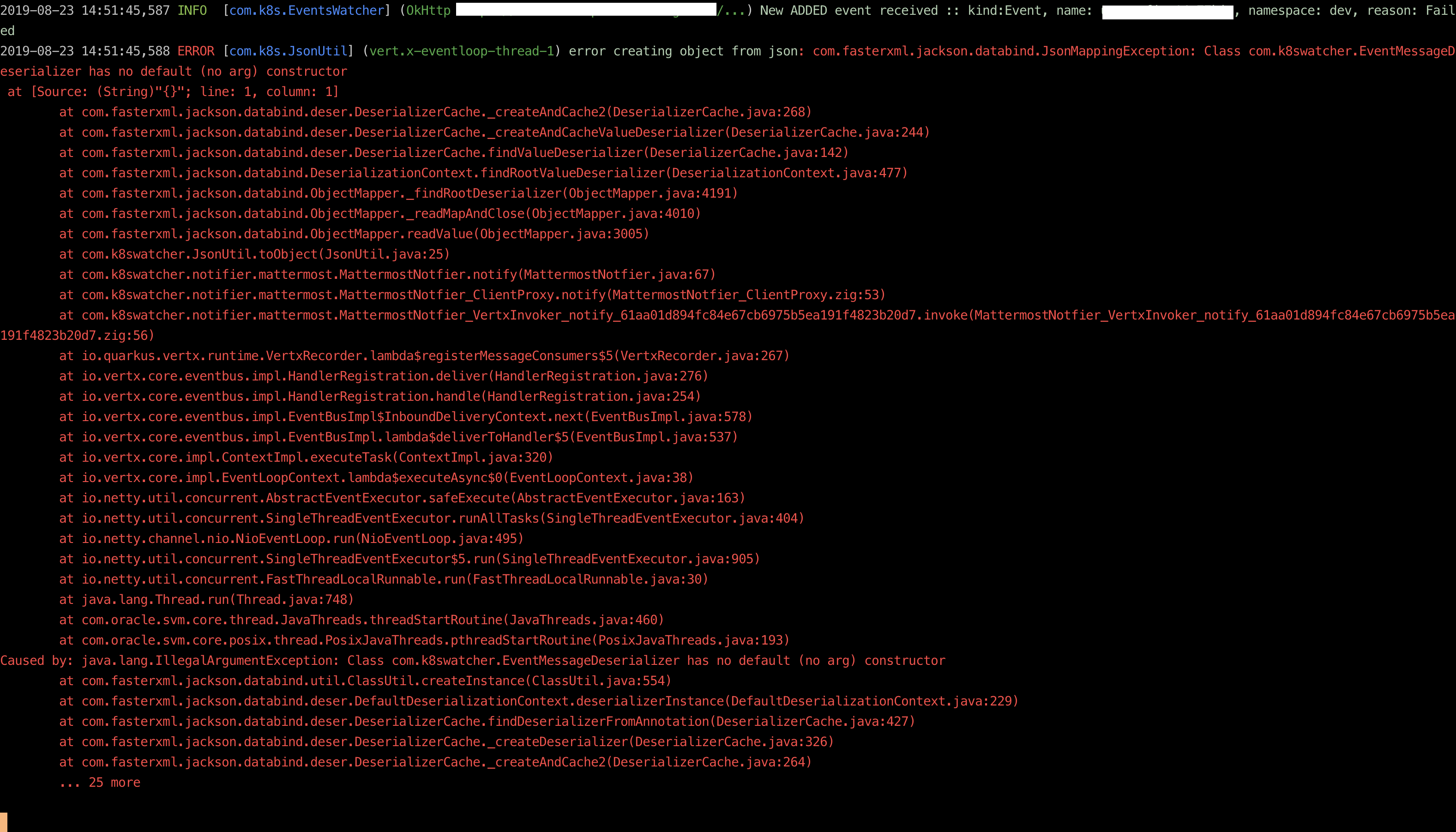
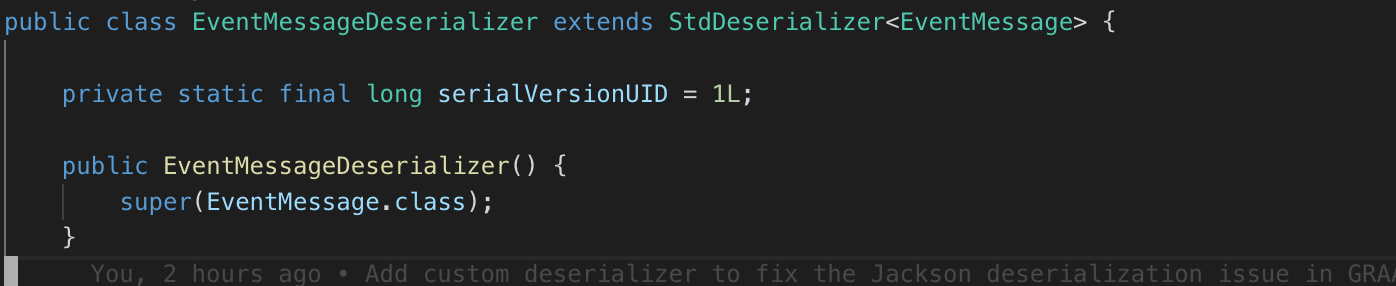
Surprise! I get the below error, however I have changed the deserializer inherit from StdDeserializer and invoke super(EventMessage.class) in its constructor.
iamvvra
on 23 Aug 2019
When I checked out your code there was no EventMessageDeserializer.
To get passed that problem, simply annotate that class with @RegisterForReflection
geoand
on 23 Aug 2019
Related issues
 lburgazzoli
·
3Comments
lburgazzoli
·
3Comments
 dcdh
·
3Comments
dcdh
·
3Comments
 mswiderski
·
3Comments
mswiderski
·
3Comments
 dansiviter
·
3Comments
dansiviter
·
3Comments
 blsouthr
·
3Comments
blsouthr
·
3Comments