Pytorch3d: Convert camera extrinsic openCV to R and T matrix of SfMPerspectiveCameras
camera_pose  = np.array([[ 0.10624042,  0.99397693,  0.0268858,   0.2087519 ],
                            [-0.68876547,  0.05406284,  0.72296565,  0.61393758],
                            [ 0.71715765, -0.09532618,  0.69036065,  3.16445006],
                            [0.0        ,           0.0,        0.0,        1.0]])


def getNewCameraPose(camera_pose=camera_pose):
    rot_X       = np.array([[ 1.0, 0.0, 0.0, 0],
                            [ 0.0, -1.0, 0.0, 0],
                            [ 0.0, 0.0, -1.0, 0],
                            [0, 0, 0, 1]])
    rot_X_1     = np.array([[ 1.0, 0.0, 0.0, 0],
                            [ 0.0, 0.0, 1.0, 0],
                            [ 0.0, -1.0, 0.0, 0],
                            [0, 0, 0, 1]])
    A = np.dot(rot_X,camera_pose)
    A = np.dot(A,rot_X_1)
    camera_pose = np.linalg.inv(A)
    return camera_pose

camera_pose = getNewCameraPose(camera_pose=camera_pose)
R             = torch.Tensor([camera_pose[:3,:3]])
T             = torch.Tensor([camera_pose[:3,3]])
After using OpenCV cabliration, i got a 4x4 extrinsic matrix. I want to convert it to 2 matrix R and T form OpenCV coordinate to Pytorch3D coordinate, those matrix are used in SfMPerspectiveCameras projection function.
I tried a lot of approach but it didnt work correctly, maybe the problem is related to right-hand and left-hand coordinate system.
How can I do it?
 hiro050696
All 7 comments
So to clarify you used the R & T (from the code example above) with SfMPerspectiveCameras and did got get the correct rendering/transformation result?
There are two things you should check:
- Internally in the
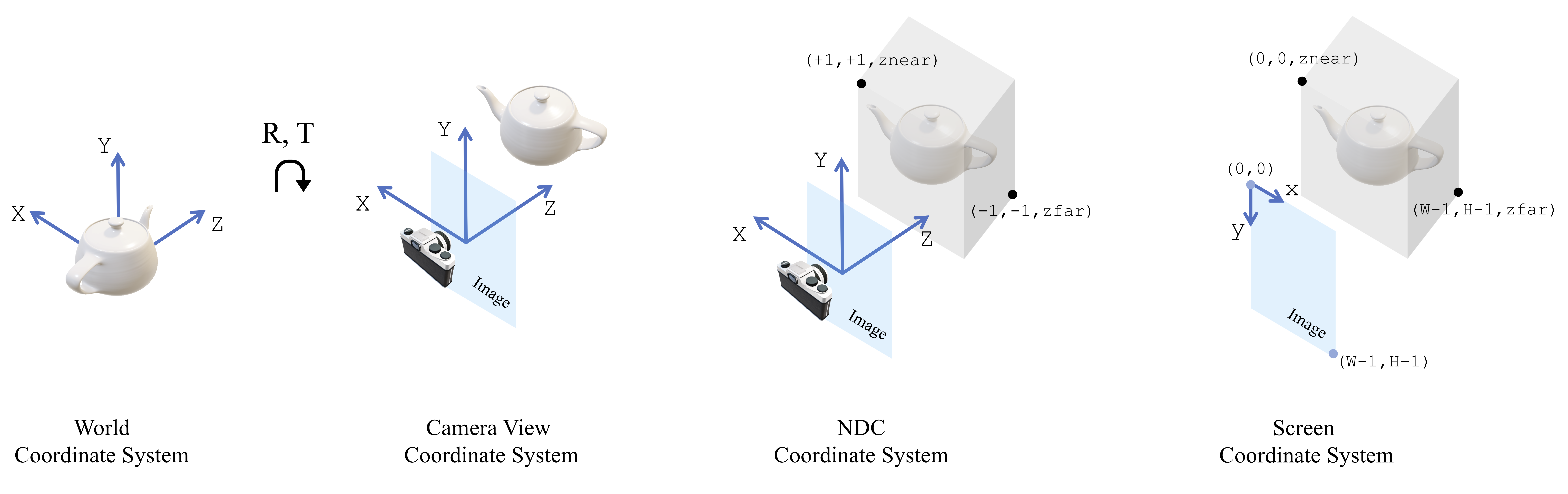
Camerasclass we use theTransforms3Dclass for the transforms. This assumes that transformations are applied on inputs which are row vectors. Does this apply for your case with the R matrix? https://github.com/facebookresearch/pytorch3d/blob/master/pytorch3d/transforms/transform3d.py#L114-L133 - The coordinate system conventions are aligned. Here is a reference for the convention used in PyTorch3d:

 nikhilaravi
on 6 Aug 2020
nikhilaravi
on 6 Aug 2020
Here is another illustration of the coordinate systems if it helps
 gkioxari
on 15 Aug 2020
gkioxari
on 15 Aug 2020
We have provided a more comprehensive description of our cameras along with coordinate systems. You can read more in our notes here:
https://github.com/facebookresearch/pytorch3d/blob/master/docs/notes/cameras.md
and also in the codebase. Let us know if you need any more info.
gkioxari
on 21 Aug 2020
@hiro050696 we will close this issue. If you have further questions feel free to reopen it.
nikhilaravi
on 22 Aug 2020
@hiro050696 Have you solved this problem? I'm also trying to convert extrinsics from ScanNet (which is in OpenCV coordinate system), but feeding converted [R, T] into SfMPerspective got empty rendering results.
 BostonLobster
on 22 Sep 2020
BostonLobster
on 22 Sep 2020
I'm also working on this problem. Has anyone figured it out?
Looking at the opencv documentation, I think the reason for the issue is the coordinate systems. OpenCV uses a X-right, Y-down, Z-out (positive) coordinate system for pinhole camera model

As Nikhila and Georgia showed in the really nice docs, Pytorch3D uses a X-left, Y-up, Z-out coordinate system.
 jbohnslav
on 31 Dec 2020
jbohnslav
on 31 Dec 2020
Hi,
For those who are still looking for the solution, here is my solution: https://github.com/facebookresearch/pytorch3d/issues/522#issuecomment-762793832.
Hope it helps.
Best,
Songyou
 pengsongyou
on 19 Jan 2021
pengsongyou
on 19 Jan 2021
Related issues
 shersoni610
·
3Comments
shersoni610
·
3Comments
 udemegane
·
3Comments
udemegane
·
3Comments
 MarkTension
·
3Comments
MarkTension
·
3Comments
 cihanongun
·
3Comments
cihanongun
·
3Comments
 unlugi
·
3Comments
unlugi
·
3Comments
Most helpful comment
@hiro050696 we will close this issue. If you have further questions feel free to reopen it.