In this issue, I will be creating a new tensor type called PromiseTensor. This Issue will be updated to reflect what I intend to build as I am working on it.
This will allow one worker to:
1) tell another worker that it will receive a tensor with a certain id in the future.
x = th.tensor([1,2,3,4]).promise() # initialize a promise
x_promise = sy.PromiseTensor() # alternative promise initialization
ptr_to_x_promise = x_promise.send(bob)
2) give another worker a list of operations to execute once the tensor arrives.
# send Bob an operation to execute once the promise x is fulfilled - returns promise y
ptr_to_y_promise = ptr_to_x_promise + ptr_to_x_promise

# send Bob an operation to execute once the promise y is fulfilled
ptr_to_z_promise = ptr_to_y_promise + ptr_to_y_promise
3) keep the promise at any time
ptr_to_z = x.keep(th.tensor([1,2,3])
z = ptr_to_z.get()
However, while this above example uses a PromiseTensor, the promise architecture should be created as a generic Promise object (not unlike our generic Pointer object).
 iamtrask
All 8 comments
Out of curiosity: Is there any inherent time-dimensionality to this Promise work, such as when the promise is expected to be fulfilled? This might be important for real-life applications I reckon.
 akirahirohito
on 15 Aug 2019
akirahirohito
on 15 Aug 2019
Interesting feature idea! I hadn't considered it but it seems plausible that someone would use it! What kind of use case do you think might be interested in such a feature?
iamtrask
on 16 Aug 2019
I could see one of the use cases being if in the context of some contractual obligation the promise is guaranteed to be delivered on a specific date (or in stages). However, if the promise is not delivered on time, some contractual agreement is violated, and thereby some punishment say in the form of a payment is incurred... This is quite generic though. For a more concrete example, the promise can be a target indicator value for gauging the impact of an ad campaign on a social media platform. The target indicator can be the popularity of the company running the campaign.
akirahirohito
on 18 Aug 2019
Will keep that in mind. At the moment, Promise/PrmoiseTensor is mostly a method for constructing asynchronous code execution to increase low level performance. There are a lot of other features that we would need in order to get promises to be more of a user-facing feature.
iamtrask
on 19 Aug 2019
UPDATE: So far I've got basic local promises working for addition.
a = sy.Promises.FloatTensor(shape=th.Size((3,3)))
b = sy.Promises.FloatTensor(shape=th.Size((3,3)))

print("Promise A:")
print(a)

y = a + b
z = y + y

print("\nPromise Z:")
print(z)

a.keep(th.ones(3,3))

print("\nZ After Keep A:")
print(z)

b.keep(th.ones(3,3))

print("\nZ After Keep B:")
print(b)
Returns:
Promise A:
(Wrapper)>PromiseTensor>None

Promise Z:
(Wrapper)>PromiseTensor>None

Z After Keep A:
(Wrapper)>PromiseTensor>None

Z After Keep B:
tensor([[1., 1., 1.],
        [1., 1., 1.],
        [1., 1., 1.]])
Note that the PromiseTensor piece of the chain disappears entirely when it is kept. Note further that I've created a sy.Promises package which allow for initialization of promises with a specific type and shape.
iamtrask
on 19 Aug 2019
And now TorchHook includes a method which hooks all torch.Tensor methods for use in PromiseTensor
iamtrask
on 19 Aug 2019
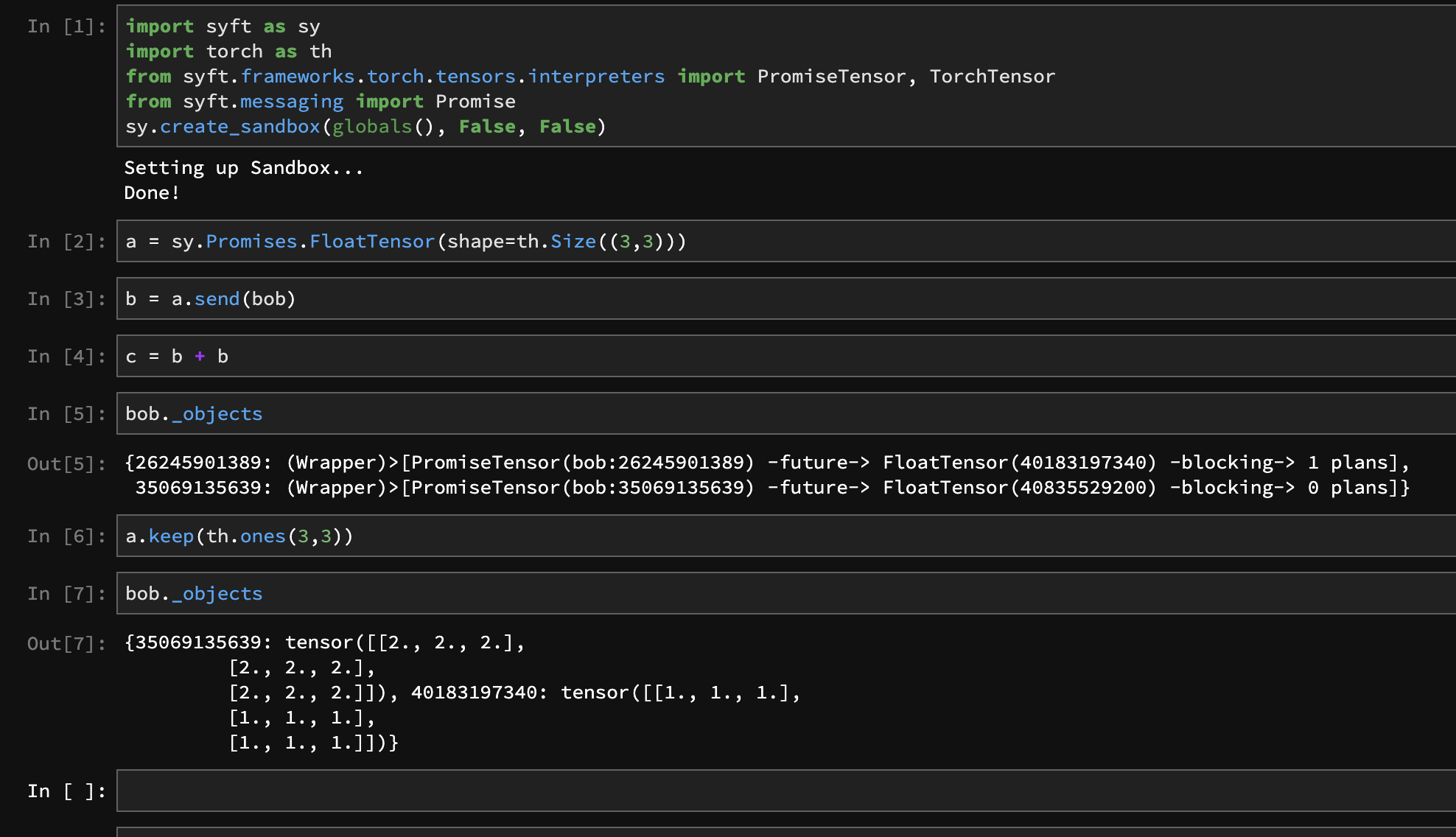
Made some progress.
iamtrask
on 22 Aug 2019
This issue has been marked stale because it has been open 30 days with no activity. Leave a comment or remove the stale label to unmark it. Otherwise, this will be closed in 7 days.
![github-actions[bot] picture](https://avatars2.githubusercontent.com/in/15368?v=4&s=40) github-actions[bot]
on 24 May 2020
github-actions[bot]
on 24 May 2020
Related issues
 tblazina
·
3Comments
tblazina
·
3Comments
 swaroopch
·
4Comments
akirahirohito
·
3Comments
swaroopch
·
4Comments
akirahirohito
·
3Comments
 alberduris
·
3Comments
alberduris
·
3Comments
 jvmncs
·
3Comments
jvmncs
·
3Comments
Most helpful comment
UPDATE: So far I've got basic local promises working for addition.
Returns:
Note that the PromiseTensor piece of the chain disappears entirely when it is kept. Note further that I've created a sy.Promises package which allow for initialization of promises with a specific type and shape.