Pyright: Aliasing generic type containing typevar doesn't work
Describe the bug
from typing import List, TypeVar

T = TypeVar("T")
L = List[T]

def f(x: L) -> L:
    ...

f([1, 2, 3]) # Error
Outputs:
  11:3 - error: Argument of type "list[int]" cannot be assigned to parameter "x" of type "L[T@L]" in function "f"
    TypeVar "_T@list" is invariant
      Type "int" cannot be assigned to type "T@L" (reportGeneralTypeIssues)
It works if the alias L is not used:
from typing import List, TypeVar

T = TypeVar("T")


def f(x: List[T]) -> List[T]: # not use alias `L`
    ...


f([1, 2, 3]) # OK
This problem also occurs for covariant container type:
from typing import List, TypeVar, FrozenSet

T = TypeVar("T")
L = FrozenSet[T] # Use FrozenSet (covariant type) insead of List

def f(x: L) -> L:
    ...
f(frozenset([1, 2, 3]))  # Error
Mypy doesn't output any error.
Expected behavior
No error
Additional context
pyright: 1.1.99
 tamuhey
All 4 comments
Pyright is doing the right thing here. You're defining a generic type alias L that takes a single type argument, but then you're failing to provide a type argument for it when you use it.
The following is a correct usage of a generic type alias L:
def f(x: L[T]) -> L[T]:
    ...
Arguably, Pyright should provide an error when you attempt to use L without any type arguments (since it is defined such that it requires a single type argument). I'll look into adding that error.
 erictraut
on 6 Jan 2021
erictraut
on 6 Jan 2021
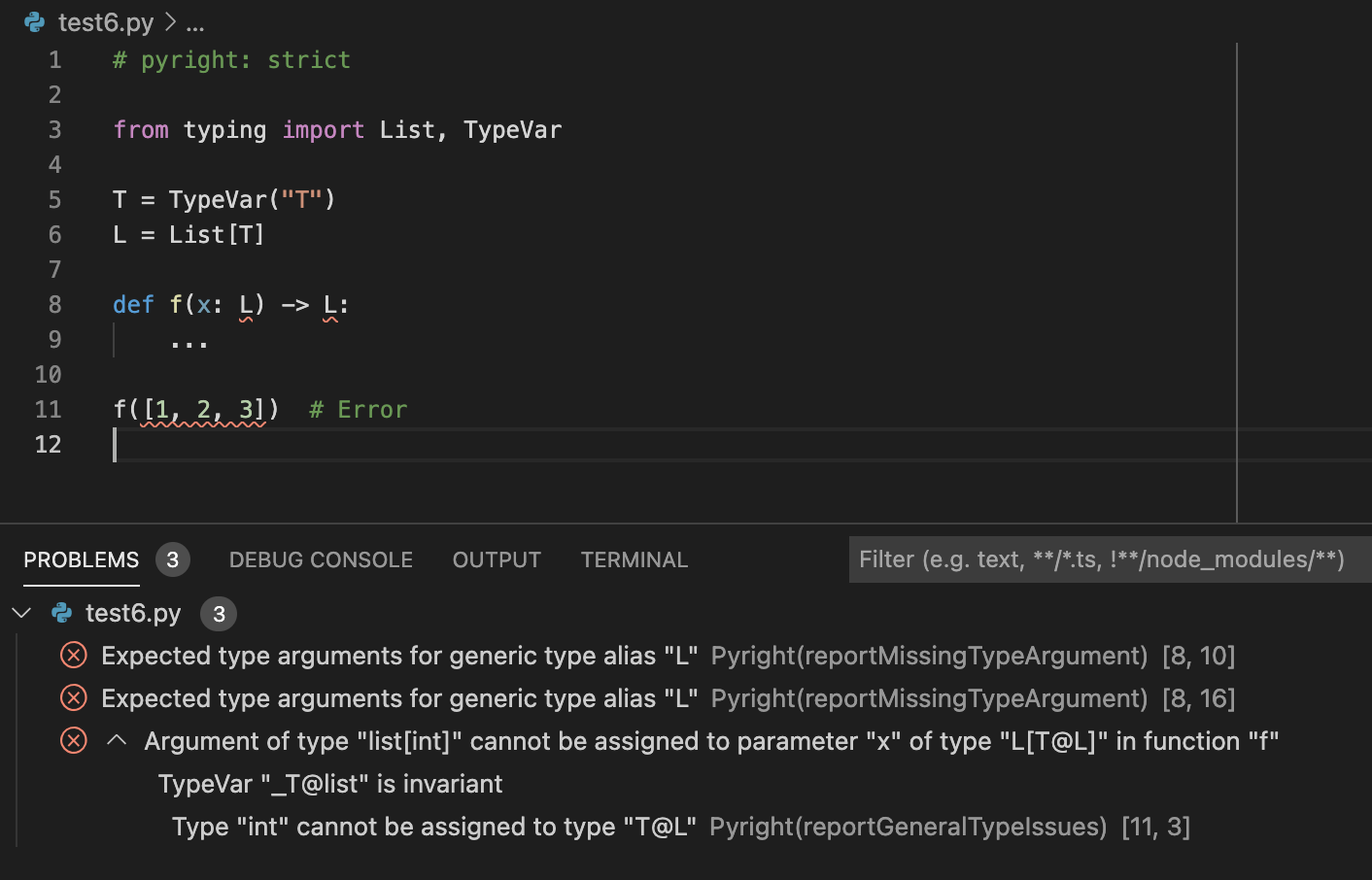
There was already code in place that was supposed to emit an error when a generic type alias was used without any type arguments provided, but there was a bug in this code. I've fixed that bug. Here's how it looks with that fix in place:
erictraut
on 6 Jan 2021
Thanks!!
tamuhey
on 7 Jan 2021
This is fixed in Pyright 1.1.100, which I just published. It will also be included in the next release of Pylance.
erictraut
on 11 Jan 2021
Related issues
 christopher-hesse
·
3Comments
tamuhey
·
3Comments
christopher-hesse
·
3Comments
tamuhey
·
3Comments
 lambdalisue
·
3Comments
lambdalisue
·
3Comments
 B4rtware
·
3Comments
B4rtware
·
3Comments
 nupanick
·
3Comments
nupanick
·
3Comments