Pyo3: [More documentation] Loading and using python functions
Can someone help me put together a full minimal example ?
I think it would be great to include it in the Readme in the "using python from rust" section which clearly lacks content.
It would create the basis for an app with the logic written in rust which rely on a few python functions. An example use case could be a machine learning (where almost everything is done with python libs) based app with some heavy post treatment that would benefit from being done in rust.
Here's my failed attempt :
main.rs
use std::include_str;
use pyo3::prelude::*;

fn main() -> PyResult<()> {
    let python_functions = include_str!("python-functions.py");

    let gil = Python::acquire_gil();
    let py = gil.python();

    py.eval(python_functions, None, None)?;

    let code = "test()";
    let res : String = py.eval(code, None, None)?.extract()?;


    println!("{}", res);

    Ok(())
}
python_functions.py
def test():
    return "hello"
it gives me Error: PyErr { type: Py(0x7ff14324ed60, PhantomData) } which isn't really a workable error.
The next step is to make a function that takes parameters and we'll be set !
 efugier
All 10 comments
I think rust-numpy crate has a better example, but yeah, we need good examples in this area.
 kngwyu
on 14 Sep 2019
kngwyu
on 14 Sep 2019
Thanks for pointing this out, it explains how to correctly output errors and that's useful.
However I think something is still off: when the code in the script relies on multiple lines it fails with a syntax error even though there is none (the script is correct and runs with python).
efugier
on 14 Sep 2019
eval only accepts Python's expression(≒ one liner).
So if you want to run long code, you can use py_run or so but it returns None.
kngwyu
on 15 Sep 2019
That's exactly the type of thing that the documentation is lacking, explaining basic high level stuff on what is used to do what. Thanks !
I'll make a PR as soon as I get some free time.
efugier
on 15 Sep 2019
Also, I wrote an example to get an Python object using Python::run.
    use pyo3::types::{IntoPyDict, PyDict, PyList};
    let gil = Python::acquire_gil();
    let py = gil.python();
    let ret_dict = [("ret", py.None())].into_py_dict(py);
    py.run(
        r#"
l = [8, 7, 3, 4, 5]
l.sort()
ret = l
"#,
        None,
        Some(ret_dict),
    );
    let list: &PyList = ret_dict.get_item("ret").unwrap().downcast_ref().unwrap();
    let ret: Vec<i32> = list.extract().unwrap();
    assert_eq!(&ret, &[3, 4, 5, 7, 8]);
I think might actually want PyModule::from_code instead of eval or run. I'd be happy if someone contributed examples to the guide on how to use PyModule::import and PyModule::from_code.
 konstin
on 18 Sep 2019
konstin
on 18 Sep 2019
@konstin
I updated #603 to include PyModule::from_code, please check it.
kngwyu
on 23 Sep 2019
Hello guys I also has trouble in the example of using PyModule.
The piece of code is not work properly.
use pyo3::{prelude::*, types::{IntoPyDict, PyModule}};
let gil = Python::acquire_gil();
let py = gil.python();
let activators = PyModule::from_code(py, "
def relu(x):
    return max(0.0, x)

def leaky_relu(x, slope=0.01):
    return x if x >= 0 else x * slope
", "activators.py", "activators")?;
let relu_result: f64 = activators.call1("relu", (-1.0,))?.extract()?;
assert_eq!(relu_result, 0.0);
let kwargs = [("slope", 0.2)].into_py_dict(py);
let lrelu_result: f64 = activators
    .call("leaky_relu", (-1.0,), Some(kwargs))?
    .extract()?;
assert_eq!(lrelu_result, -0.2);
And I'm keep getting this error message, do I miss something?
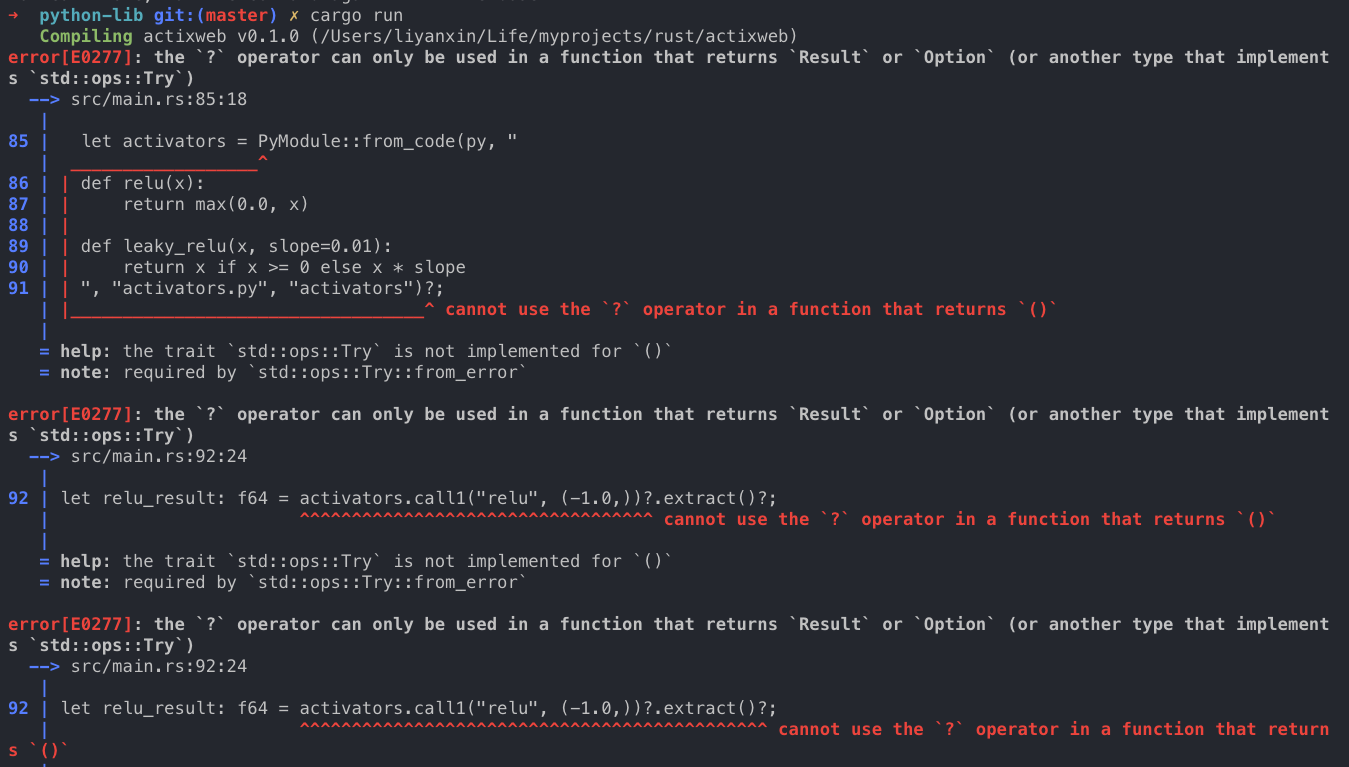
I changed in this way but is still not working.
fn main() -> Result<(), ()> {
    let gil = Python::acquire_gil();
    let py = gil.python();
    let activators = PyModule::from_code(py, "
    def relu(x):
        return max(0.0, x)

    def leaky_relu(x, slope=0.01):
        return x if x >= 0 else x * slope
    ", "activators.py", "activators")?;
    let relu_result: f64 = activators.call1("relu", (-1.0,))?.extract()?;
    assert_eq!(relu_result, 0.0);
    let kwargs = [("slope", 0.2)].into_py_dict(py);
    let lrelu_result: f64 = activators
        .call("leaky_relu", (-1.0,), Some(kwargs))?
        .extract()?;
    assert_eq!(lrelu_result, -0.2);
}
 abrcdf1023
on 6 Oct 2019
abrcdf1023
on 6 Oct 2019
Please use PyResult<()> instead of Result<(), ()> and return Ok(()).
kngwyu
on 6 Oct 2019
Closed by #603.
 Alexander-N
on 25 Nov 2019
Alexander-N
on 25 Nov 2019
Related issues
 jamesray1
·
3Comments
jamesray1
·
3Comments
 sebpuetz
·
5Comments
sebpuetz
·
5Comments
 tcztzy
·
4Comments
tcztzy
·
4Comments
 inv2004
·
4Comments
konstin
·
5Comments
inv2004
·
4Comments
konstin
·
5Comments