Pylance-release: Numpy ufunc has no intellisense!
Environment data
import numpy as np

nd1 = np.array([1, 2, 3])
nd2 = np.array([4, 5, 6])
nd3 = np.add(nd1, nd2)
 irish-coffee
All 10 comments
Thanks for the report. Could you please add a screenshot of what you see when you hover over add?
 judej
on 17 Dec 2020
judej
on 17 Dec 2020
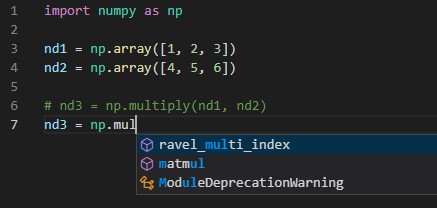
The language server is pylance.
irish-coffee
on 18 Dec 2020
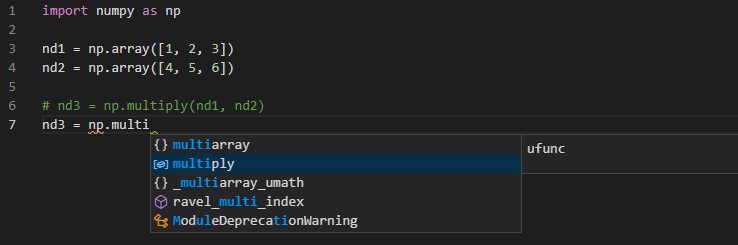
There is intellisense if the language server is Jedi.
irish-coffee
on 18 Dec 2020
I am also having this issue (I believe it to be the same).
Pylance Lang Server Version: 2021.2.0
OS: Microsoft Windows [Version 10.0.19042.789]
Python: Python 3.8.5
VSC: 1.53.0 (This also happens in the insiders version: 1.54.0-insider)
Actual Behavior (Pylance):

Expected Behavior (Jedi):

The behavior is unchanged when using Pylance 2021.2.1-pre.1
 jmahlers
on 7 Feb 2021
jmahlers
on 7 Feb 2021
The latest version of numpy (1.20), which was released within the last couple of weeks, now includes some type information. It's still nascent and incomplete, but symbols like sin and multiply now appear as completion suggestions.
If you don't want to upgrade to the latest version of numpy, you could try installing stubs from numpy-stubs: pip install git+https://github.com/numpy/numpy-stubs. It appears that this repo is no longer being maintained though, so upgrading numpy is a better option.
 erictraut
on 7 Feb 2021
erictraut
on 7 Feb 2021
@erictraut Just upgraded to numpy-1.20.1, it works perfectly now. Thank you!
Was the issue on numpy's side then? ie is this issue still relevant just for other libraries or is it only numpy?
@irish-coffee I would suggest updating numpy also if you can. Fixed this issue for me.
jmahlers
on 8 Feb 2021
Pylance relies on type information to provide accurate completion suggestions. That type information can come from a variety of sources. The most accurate and authoritative (and therefore preferred) type information comes from the package itself. Increasingly, library authors are distributing type information with their packages. That's what you see with the latest version of numpy.
In cases where a package does not yet include type information, type details can be provided by external type stubs, some of which we ship as part of pylance. Pylance is also sometimes able to infer type information if the library's source code is written in Python (as opposed to a binary compiled from C++ or other languages), but type inference is expensive and error-prone. In the fullness of time, as more package authors provide type information, type stubs and type inference will no longer be needed.
To answer your question, the issue isn't unique to numpy. It applies to many libraries. We've published guidance for library authors and are working with them to make the world a better place for Python developers.
erictraut
on 8 Feb 2021
@jmahlers Thanks for your suggestion. I just upgraded numpy to the latest version and it works very well.
@erictraut Thank you for your comments.
irish-coffee
on 9 Feb 2021
@erictraut Hi, thanks for your explanation, I've found the stub file for numpy in my Pylance extension path(USER_HOME\.vscode\extensions\ms-python.vscode-pylance-2021.2.3\dist\bundled\native-stubs\numpy\core\_multiarray_umath.pyi), and there are some functions of numpy like sin, cos, etc., but pylance still can't recognize those functions.
But it's worth mentioning that once Pylance worked fine before updating the anaconda environment. It's implausible that the higher anaconda version and numpy version goes wrong.
 JoeyRxy
on 24 Feb 2021
JoeyRxy
on 24 Feb 2021
If your anaconda environment updated to numpy 1.20, it's likely the fix we made to use this stub for numpy no longer operates; the fix was to resolve compiled modules to stubs, but if you're on numpy 1.20, then its own stubs will be used instead and their construction is unfortunately not too editor friendly (the stubs are structured much differently than the real code).
We're working on "partial stub" support to be able to patch in some things, but numpy's stubbing layout may have made it much, much more difficult to fix things.
 jakebailey
on 24 Feb 2021
jakebailey
on 24 Feb 2021
Related issues
 iwoloschin
·
3Comments
iwoloschin
·
3Comments
 ynouri
·
3Comments
ynouri
·
3Comments
 fbidu
·
3Comments
fbidu
·
3Comments
 tweakimp
·
3Comments
tweakimp
·
3Comments
 yankyhoffman
·
5Comments
yankyhoffman
·
5Comments
Most helpful comment
Pylance relies on type information to provide accurate completion suggestions. That type information can come from a variety of sources. The most accurate and authoritative (and therefore preferred) type information comes from the package itself. Increasingly, library authors are distributing type information with their packages. That's what you see with the latest version of numpy.
In cases where a package does not yet include type information, type details can be provided by external type stubs, some of which we ship as part of pylance. Pylance is also sometimes able to infer type information if the library's source code is written in Python (as opposed to a binary compiled from C++ or other languages), but type inference is expensive and error-prone. In the fullness of time, as more package authors provide type information, type stubs and type inference will no longer be needed.
To answer your question, the issue isn't unique to numpy. It applies to many libraries. We've published guidance for library authors and are working with them to make the world a better place for Python developers.