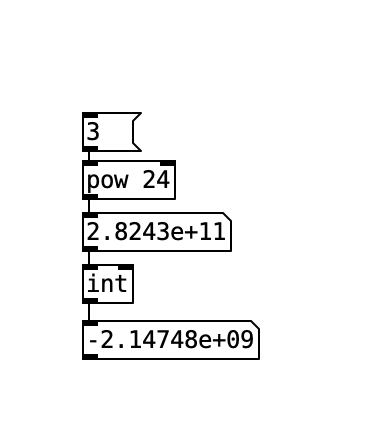
seems [int] can't handle values over 2ˆ24, but shouldn't it?
 porres
All 10 comments
the [int] object stores the number as a t_float but casts to an int and back to get rid of the fractional part. I think it should cast to a long long (the largest integer type) instead, because floats can be much larger than 2^31. actually, they can also be larger than 2^63, so the "correct" way to allow arbitrarily large floats to pass through would be using the trunc math function instead of an integer cast. on the other hand, 2^63 is already a pretty large number...
note that floating point numbers beyond 2^24 become imprecise anyway.
 Spacechild1
on 29 May 2019
Spacechild1
on 29 May 2019
BTW, did you mean to test with 2^24 (instead of 3^24)? that should work.
Spacechild1
on 29 May 2019
BTW, did you mean to test with 2^24 (instead of 3^24)? that should work.
no, I was just showing how numbers above 2^24 get screwed up
porres
on 30 May 2019
How does 3^24 show anything about 2^24? The former is orders of magnitude larger than the latter ;-) as I said, the current limit is really 2^31.
Spacechild1
on 30 May 2019
as I said, the current limit is really 2^31
oh, I just thought and assumed it was 2^24 :)
porres
on 30 May 2019
closed in a0816dc2ab196f544d257db56df35a055288264e, included in update/0.50 (#508)
 umlaeute
on 18 Jun 2019
umlaeute
on 18 Jun 2019
@umlaeute please close :-)
Spacechild1
on 21 Jun 2019
I guess is best to close when it's officially merged?
porres
on 21 Jun 2019
you're probably right.
Spacechild1
on 21 Jun 2019
well, it's been merged :)
porres
on 13 Sep 2019
Related issues
porres
·
9Comments
 jlquispec
·
5Comments
jlquispec
·
5Comments
 AydinHumphries
·
5Comments
AydinHumphries
·
5Comments
 haugan
·
7Comments
haugan
·
7Comments
 mariobuoninfante
·
3Comments
mariobuoninfante
·
3Comments