Prophet: Can prophet deal with minutely data?
Prophet is a good tool.
But it only support daily data, do not support minute timeseries data.
I hope make_future_dataframe(freq=**) cat support minutely data
How can I solve this problem?
 gongshaojie12
All 9 comments
 ghost
on 9 Jul 2018
ghost
on 9 Jul 2018
@WouterTromp thanks,but this url can't solve my problem.
my data is like this:
ds,y
2018/6/14 14:25:00,21.68
2018/6/14 14:26:00,21.65
2018/6/14 14:27:00,21.72
2018/6/14 14:28:00,21.78
2018/6/14 14:29:00,21.71
2018/6/14 14:30:00,21.67
2018/6/14 14:31:00,21.65
2018/6/14 14:32:00,21.64
result is
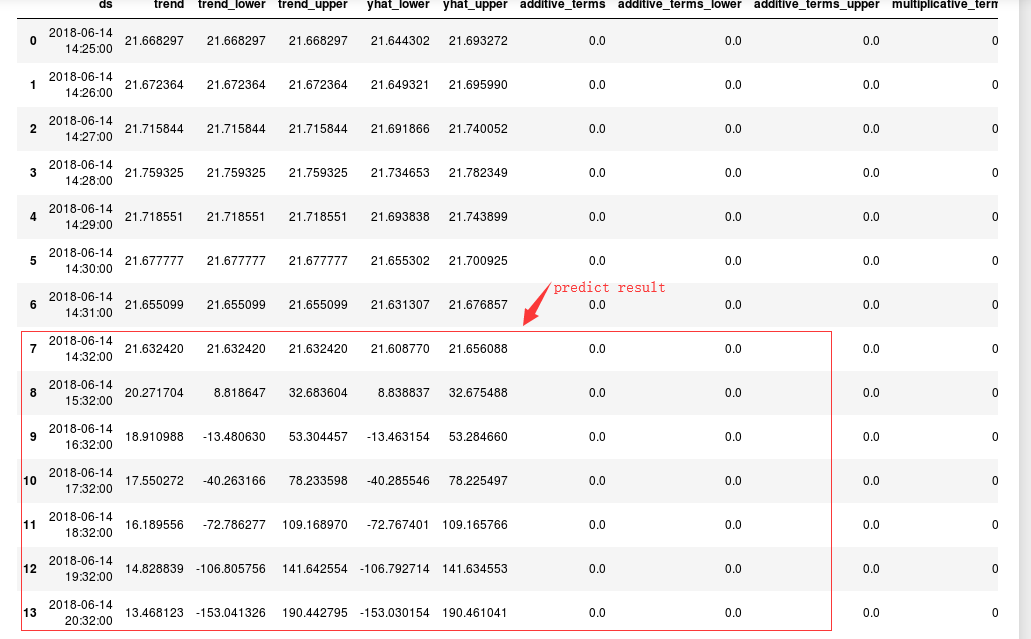
The result I expected was:
ds,y
2018/6/14 14:25:00,21.68
2018/6/14 14:26:00,21.65
2018/6/14 14:27:00,21.72
2018/6/14 14:28:00,21.78
2018/6/14 14:29:00,21.71
2018/6/14 14:30:00,21.67
2018/6/14 14:31:00,21.65
2018/6/14 14:32:00,21.64
2018/6/14 14:33:00,xx.xx
2018/6/14 14:34:00,xx.xx
2018/6/14 14:35:00,xx.xx
2018/6/14 14:36:00,xx.xx
gongshaojie12
on 9 Jul 2018
@WouterTromp Does the value of the 'freq' parameter represent minutes?
gongshaojie12
on 9 Jul 2018
That's indeed strange. Somehow it assumes there's an hourly frequency. You can give a frequency in minutes though. Did you try that?
Python:
future = m.make_future_dataframe(periods=300, freq='min')
R:
future <- make_future_dataframe(m, periods = 300, freq = 60)
The make_future_dataframe() function is rather simple. It only extends the existing dataframe with a basic Pandas function (in Python that is):
https://github.com/facebook/prophet/blob/8d804fce0cf6301c6ee6cdbdde3bcb6d377e7e19/python/fbprophet/forecaster.py#L1338
ghost
on 9 Jul 2018
@WouterTromp thank you very much!This solved my problem.
gongshaojie12
on 9 Jul 2018
periods=300, freq='min
Hi there, I am using an Hourly sampled data, what should be the periods and freq argument values?
Data is like:
ds,y
2020-01-20 00:00:00,10940.00
2020-01-20 01:00:00,7078.00
2020-01-20 02:00:00,17649.00
2020-01-20 03:00:00,13070.00
2020-01-20 04:00:00,12391.00
2020-01-20 05:00:00,7810.00
2020-01-20 06:00:00,7465.00
2020-01-20 07:00:00,7882.00
2020-01-20 08:00:00,10762.00
2020-01-20 09:00:00,20626.00
2020-01-20 10:00:00,46015.00
2020-01-20 11:00:00,65593.00
2020-01-20 12:00:00,90323.00
2020-01-20 13:00:00,146207.00
2020-01-20 14:00:00,162514.00
2020-01-20 15:00:00,178279.00
2020-01-20 16:00:00,118995.00
2020-01-20 17:00:00,108726.00
2020-01-20 18:00:00,163868.00
2020-01-20 19:00:00,168032.00
2020-01-20 20:00:00,158714.00
2020-01-20 21:00:00,126804.00
2020-01-20 22:00:00,62207.00
2020-01-20 23:00:00,22746.00
2020-01-21 00:00:00,17147.00
2020-01-21 01:00:00,15217.00
2020-01-21 02:00:00,14600.00
 RSwarnkar
on 4 Feb 2020
RSwarnkar
on 4 Feb 2020
Is it worth investing time for minute by minute forecast as on teh home page its mentioned its best suitable for :-
hourly, daily, or weekly observations with at least a few months (preferably a year) of history
They havent mentioned minute data.
 abhimanyu3
on 4 Mar 2020
abhimanyu3
on 4 Mar 2020
Depends on nature of data.
Mostly data don't show seasonality over minutes. Try aggregation by hourly and check seasonality.
RSwarnkar
on 5 Mar 2020
@RSwarnkar I am working on creating a real time alarm system and in which I have to identify anomaly in the incoming data point. So, I don't have that privilege to aggregate the data by hourly as I am already aggregating it to every minute.
abhimanyu3
on 5 Mar 2020
Related issues
 Earththing
·
3Comments
Earththing
·
3Comments
 sriramkraju
·
3Comments
sriramkraju
·
3Comments
 arnaudvl
·
3Comments
arnaudvl
·
3Comments
 ahash52
·
3Comments
ahash52
·
3Comments
 germayneng
·
3Comments
germayneng
·
3Comments
Most helpful comment
That's indeed strange. Somehow it assumes there's an hourly frequency. You can give a frequency in minutes though. Did you try that?
Python:
future = m.make_future_dataframe(periods=300, freq='min')
R:
future <- make_future_dataframe(m, periods = 300, freq = 60)
The make_future_dataframe() function is rather simple. It only extends the existing dataframe with a basic Pandas function (in Python that is):
https://github.com/facebook/prophet/blob/8d804fce0cf6301c6ee6cdbdde3bcb6d377e7e19/python/fbprophet/forecaster.py#L1338