Describe the bug
We are losing nested arrays in an object.
To Reproduce
re-launch prisma introspect over a postgresql object which includes a 1-N relation.
Expected behavior
Generate arrays, not an object.
Screenshots
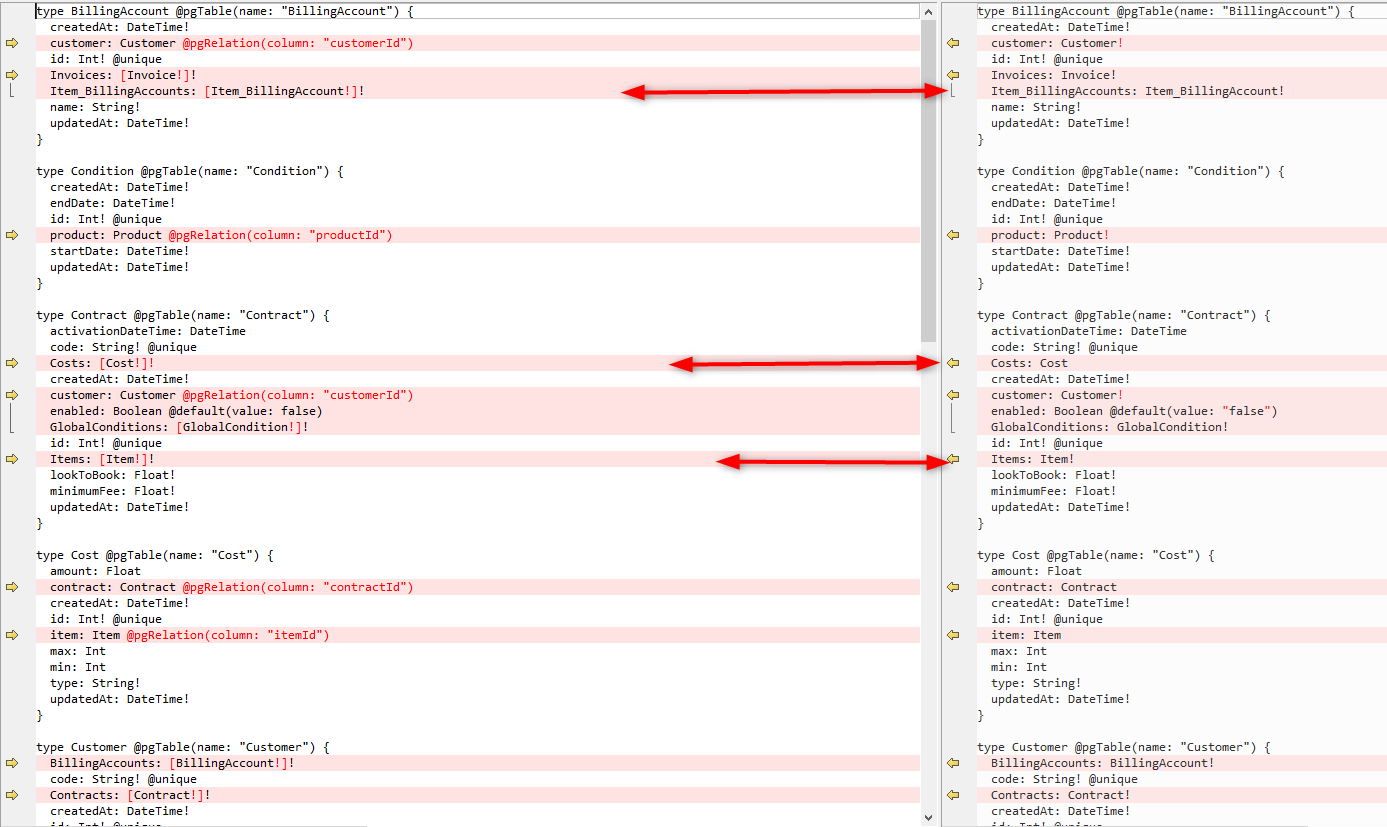
Versions (please complete the following information):
- Connector: Postgres
- Prisma Server: 1.27.1
prismaCLI: prisma/1.27.1 (windows-x64) node-v8.9.4- OS: W10
 marticrespi
All 11 comments
I can confirm this cc @ejoebstl
The sql dump I used: https://github.com/pantharshit00/prisma-issue-4019/blob/master/tables_dump_8_February_2019.sql
 pantharshit00
on 26 Feb 2019
pantharshit00
on 26 Feb 2019
Hello,
That behavior should be fixed already. With the current alpha branch, the introspection result looks like this.
 ejoebstl
on 27 Feb 2019
ejoebstl
on 27 Feb 2019
Thanks! It will be included in the next release? @ejoebstl
marticrespi
on 27 Feb 2019
@marticrespi
You can try it right now
npm i -g prisma@alpha
@pantharshit00 Hi, I have tried just now and I only can see a change, boolean values without quotes with alpha current version.
prisma/1.29.0-alpha.6 (windows-x64) node-v8.9.4

marticrespi
on 27 Feb 2019
@pantharshit00 For reference: This issue (booleans being rendered as strings) was fixed a while ago, so this is very odd.
@marticrespi Could you please share your workflow? I assume you are running prisma introspect, but without a prisma.yml or existing datamodel.
ejoebstl
on 27 Feb 2019
Hi @ejoebstl , I'm running prisma introspect with prisma.yml, here you have
````
endpoint: http://localhost:4467
datamodel: datamodel.prisma
secret: XXXXX
generate:
- generator: graphql-schema
output: ./generated/
- generator: typescript-client
output: ./generated/prisma-client/
hooks:
post-deploy:
# - prisma generate
- rm -r ./generated/nexus-prisma
- npx nexus-prisma-generate --client ./generated/prisma-client --output ./generated/nexus-prisma
````
And my current datamodel is this:
````
type BillingAccount @pgTable(name: "BillingAccount") {
createdAt: DateTime!
customer: Customer!
id: Int! @unique
Invoices: Invoice!
Item_BillingAccounts: Item_BillingAccount!
name: String!
updatedAt: DateTime!
}
type Condition @pgTable(name: "Condition") {
createdAt: DateTime!
endDate: DateTime!
id: Int! @unique
product: Product!
startDate: DateTime!
updatedAt: DateTime!
}
type Contract @pgTable(name: "Contract") {
activationDateTime: DateTime
code: String! @unique
Costs: Cost
createdAt: DateTime!
customer: Customer!
enabled: Boolean @default(value: "false")
GlobalConditions: GlobalCondition!
id: Int! @unique
Items: Item!
lookToBook: Float!
minimumFee: Float!
updatedAt: DateTime!
}
type Cost @pgTable(name: "Cost") {
amount: Float
contract: Contract
createdAt: DateTime!
id: Int! @unique
item: Item
max: Int
min: Int
type: ChargeType!
updatedAt: DateTime!
isPercentage: Boolean @default(value: "false")
}
type Customer @pgTable(name: "Customer") {
BillingAccounts: BillingAccount!
code: String! @unique
Contracts: Contract!
createdAt: DateTime!
id: Int! @unique
name: String!
updatedAt: DateTime!
type: CustomerType!
}
type GlobalCondition @pgTable(name: "GlobalCondition") {
amount: Float
contract: Contract!
createdAt: DateTime!
defaultFreeTrialDaysForItem: Int
globalEndFreeTrialPeriod: DateTime
globalStartFreeTrialPeriod: DateTime
id: Int! @unique
millionSearches: Int
numConnections: Int
type: ContractType!
updatedAt: DateTime!
}
type Invoice @pgTable(name: "Invoice") {
amount: Float!
amountPaid: Float!
billingAccount: BillingAccount!
createdAt: DateTime!
endDate: DateTime!
id: Int! @unique
InvoiceBreakdowns: InvoiceBreakdown!
paymentMethod: PaymentMethod!
paymentStatus: PaymentStatus!
startDate: DateTime!
updatedAt: DateTime!
}
type InvoiceBreakdown @pgTable(name: "InvoiceBreakdown") {
amount: Float!
createdAt: DateTime!
endDate: DateTime!
id: Int! @unique
invoice: Invoice!
itemBillingAccount: Item_BillingAccount!
startDate: DateTime!
updatedAt: DateTime!
}
type Item @pgTable(name: "Item") {
contract: Contract!
Costs: Cost
createdAt: DateTime!
enabled: Boolean @default(value: "false")
id: Int! @unique
Item_BillingAccounts: Item_BillingAccount!
Products: Product!
specificFreeTrialDays: Int
updatedAt: DateTime!
}
type Item_BillingAccount @pgTable(name: "Item_BillingAccount") {
billingAccount: BillingAccount!
createdAt: DateTime!
id: Int! @unique
InvoiceBreakdowns: InvoiceBreakdown!
item: Item!
updatedAt: DateTime!
}
type Product @pgTable(name: "Product") {
Conditions: Condition!
createdAt: DateTime!
id: Int! @unique
item: Item!
system: String!
type: ProductType!
updatedAt: DateTime!
}
type ChargeType {
code: String! @unique
cost: Cost!
createdAt: DateTime!
description: String!
id: Int! @unique
name: String!
updatedAt: DateTime!
}
type ContractType {
code: String! @unique
createdAt: DateTime!
description: String!
globalCondition: GlobalCondition!
id: Int! @unique
name: String!
updatedAt: DateTime!
}
type CustomerType {
code: String! @unique
createdAt: DateTime!
customer: Customer!
description: String!
id: Int! @unique
name: String!
updatedAt: DateTime!
}
type PaymentMethod {
code: String! @unique
createdAt: DateTime!
description: String!
id: Int! @unique
invoice: Invoice!
name: String!
updatedAt: DateTime!
}
type PaymentStatus {
code: String! @unique
createdAt: DateTime!
description: String!
id: Int! @unique
invoice: Invoice!
name: String!
updatedAt: DateTime!
}
type ProductType {
code: String! @unique
createdAt: DateTime!
description: String!
id: Int! @unique
name: String!
updatedAt: DateTime!
product: Product!
}
````
Thanks!
marticrespi
on 28 Feb 2019
Any news @ejoebstl ?
marticrespi
on 4 Mar 2019
Sorry for the late reply, @marticrespi, I'm currently on vacation.
When you introspect with an existing datamodel, the cardinality for relations from the existing datamodel takes precedence over the introspection result.
I'll discuss this behavior internally and keep you posted.
ejoebstl
on 4 Mar 2019
Solved! I have tried just now with alpha-7 and it's already fixed.
marticrespi
on 5 Mar 2019
I think this can be closed now.
pantharshit00
on 13 Mar 2019
Related issues
 notrab
·
3Comments
notrab
·
3Comments
 tbrannam
·
3Comments
tbrannam
·
3Comments
 sedubois
·
3Comments
sedubois
·
3Comments
 akoenig
·
3Comments
akoenig
·
3Comments
 marktani
·
3Comments
marktani
·
3Comments