Prisma-client-js: PostgreSQL `<table>WhereUniqueInput` including a column which isn't unique when composite primary key is used
Bug description
I have observed what looks like a bug with how prisma is generating a <table>WhereUniqueInput.
Setup is this...
PostgreSQL database, tables being defined with composite primary key as an experiment to see what is possible for supporting a SAAS multi-tenant with shared database/shared schema.
Two relevant tables for this are User and Tenant.
Tenant has columns... id, name
Primary key for Tenant is: id
User has columns... userId, tenant, email (uniqueconstraint), other-columns-etc...
Primary key (composite) for User table is userId, tenant
User.tenant is part of a foreign key relationship to Tenant.id
User.tenant is integer not null;
How to reproduce
Steps to reproduce the behavior:
- Confirm table setup as above
- Run
prisma introspect, thenprisma generate - See result...
In generated prisma client, see the following...
export type UserWhereUniqueInput = {
  email?: string | null
  tenant?: number | null
  userId_tenant?: UserIdTenantCompoundUniqueInput | null
}
Expected behavior
Would not expect to see tenant as one of the possible keys in UserWhereUniqueInput. In other words, would expect to see...
export type UserWhereUniqueInput = {
  email?: string | null
  userId_tenant?: UserIdTenantCompoundUniqueInput | null
}
Prisma information
model User {
  email                         String  @unique
  firstname                     String
  lastname                      String?
  tenant                        Int
  userId                        String  @default(dbgenerated()) @unique
  Tenant                        Tenant  @relation(fields: [tenant], references: [id])

  @@id([userId, tenant])
  @@index([tenant], name: "fki_User_Tenant_id_fkey")
}
model Tenant {
  id           Int            @default(autoincrement()) @id
  name         String
  User         User[]
}
Environment & setup
- OS: Windows
- Database: PostgreSQL 12.2
- Prisma version: @prisma/cli : 2.0.0-beta.4
- Node.js version: v13.9.0
 miller-productions
All 9 comments
This is expected. Composite filters are in unique filter as combination of fields of the composite filter yields a unique result.
For you example, client will have a composite filter like so:
await prisma.user.findOne({
  where:{
    userId_tenant:{
      userId: "something",
      tenant: "something_else"
   }
})
Combination of these two is unique so it is in the filter.
 pantharshit00
on 5 Jun 2020
pantharshit00
on 5 Jun 2020
Hi @pantharshit00 ,
Thanks for replying.
Yes, I understand that the composite filter, userId_tenant: is available as one of the possible options for UserWhereUniqueInput.
This is due to @@id([userId, tenant]) in the schema for User. This is expected :white_check_mark:
What I don't understand is... why would tenant be available as an alternative option in UserWhereUniqueInput :confused:
In my schema, tenant does not uniquely identify User.
i.e. in this particular schema, you shouldn't be able to do the following, should you?
await prisma.user.findOne({
  where:{
    tenant: "something_else"
   }
})
@miller-productions Can you please share the schema for that model?
pantharshit00
on 5 Jun 2020
Sure thing @pantharshit00, I have added it to the Prisma Information section above.
miller-productions
on 5 Jun 2020
@miller-productions Sorry for the late reply here? Can you please try again with the latest version? The input is not nullable anymore:
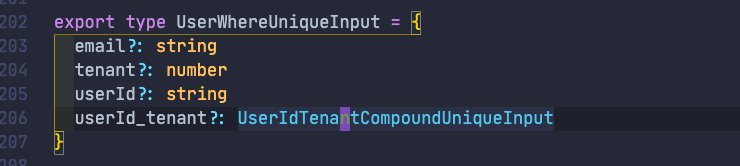
This is with version 2.1.3
pantharshit00
on 3 Jul 2020
We did some fixes recently so this might get patched there.
pantharshit00
on 3 Jul 2020
Hi @pantharshit00,
Just dropping back in on this.
I'm currently running version 2.6.1 . The issue still exists.
This is what is being generated.
export type UserWhereUniqueInput = {
  userId?: string
  email?: string
  tenant?: number
  userId_tenant?: UserIdTenantCompoundUniqueInput
}
It still doesn't make sense to me. The primary key defined in the database is userId + tenant, a composite key. So, I would assume that you would need to provide a value for both when trying to select unique results.
miller-productions
on 4 Sep 2020
Hey @miller-productions
Looks like I initially misread this issue. I can confirm it now that we should not generate tenant or userId in the unique input.
Thanks for your patience here.
pantharshit00
on 23 Sep 2020
Fix available from 2.9.0-dev.58 onward. Will be included in the 2.9.0 release.
 dpetrick
on 8 Oct 2020
dpetrick
on 8 Oct 2020
Related issues
 emroot
·
4Comments
emroot
·
4Comments
 AhmedElywa
·
4Comments
AhmedElywa
·
4Comments
 mrmntte
·
3Comments
pantharshit00
·
4Comments
mrmntte
·
3Comments
pantharshit00
·
4Comments
 maartenraes
·
4Comments
maartenraes
·
4Comments