Postgrest: Why do we have to use the jwt claim role
It'd be helpful if we can do custom as now you need to namespace returns in the id_token. Maybe we can just define the namespace?
 posix4e
All 34 comments
As I am new to the project, I do not really know where to look for the code to change this configuration, but I too am eager to allow arbitrary extraction of of information from a JWT for roles and other information, rather than being bound to using scope, especially as to be OIDC compliant custom scopes are now expected to be namespaced.
Where might one start on this? Are there any plans in progress for setting runtime variables in Postgres from arbitrary information in a JWT?
 fluffybonkers
on 17 Jul 2017
fluffybonkers
on 17 Jul 2017
can you be more specific as to what exactly you want to accomplish and why the key role in hte jwt payload is not good enough?
 ruslantalpa
on 17 Jul 2017
ruslantalpa
on 17 Jul 2017
My understanding of this article is that we should not use role, we should use, for example, "https://www.example.com/role": "admin" so that roles/claims are collision resistant and JWTs are OIDC compliant.
fluffybonkers
on 17 Jul 2017
so why can't role be thought of as "private claim"?
ruslantalpa
on 17 Jul 2017
It could be, but then the claim, as I understand it, is not collision resistant and role is possibly a common key.
Perhaps none of this matters, but I have just always understood it to be recommended that claims be namespaced and I think Auth0 suggest this in a few different bits of their documentation.
fluffybonkers
on 17 Jul 2017
If you'll be using the same jwt across multiple servers I guess there's the chance of a conflict for a name like role, but I'm not eager to change it and break compatibility. This is especially true since JWT has been an area of postgrest that already confuses people.
 begriffs
on 17 Jul 2017
begriffs
on 17 Jul 2017
Joe you need to fix this if you want to use auth0 with its new API. In
addition there's a question of whether or not assuming role is standards
complain private claim. Nowadays people namespace non standardized claims.
Perhaps make a note of what versions you support and tell people we are
broken with the new auth0 API. By the way this stuff works fine in
postgraphql. If we don't fix it I'll have to fork, switch to postgraphql or
make the change myself.I guess it's a good excuse to learn Haskell! Have we
sufficiently explained why Postgrest no longer works with auth0. Afaiac
being broken is bad no matter if we are right or not.
Alex
On Mon, Jul 17, 2017 at 7:52 AM Joe Nelson notifications@github.com wrote:
If you'll be using the same jwt across multiple servers I guess there's
the chance of a conflict for a name like role, but I'm not eager to
change it and break compatibility. This is especially true since JWT has
been an area of postgrest that already confuses people.—
You are receiving this because you authored the thread.
Reply to this email directly, view it on GitHub
https://github.com/begriffs/postgrest/issues/906#issuecomment-315774262,
or mute the thread
https://github.com/notifications/unsubscribe-auth/AAxN2yiWKcPWz0n1co4aTgIhFMx4ZfR3ks5sO3FYgaJpZM4OR3x3
.
posix4e
on 17 Jul 2017
I see, I had overlooked the consequences for Auth0. I can't dedicate the time to think about this at the moment, but am flagging it for more thorough review.
begriffs
on 17 Jul 2017
@begriffs Thanks for the quick reply. I am happy to test this for people and update the documentation v.v. auth0. I am happy to make the patch but I am such a haskell noob that it will probably take more mentoring than it's worth.
posix4e
on 17 Jul 2017
Any updates?
On Mon, Jul 17, 2017 at 9:58 AM Joe Nelson notifications@github.com wrote:
I see, I had overlooked the consequences for Auth0. I can't dedicate the
time to think about this at the moment, but am flagging it for more
thorough review.—
You are receiving this because you authored the thread.
Reply to this email directly, view it on GitHub
https://github.com/begriffs/postgrest/issues/906#issuecomment-315812067,
or mute the thread
https://github.com/notifications/unsubscribe-auth/AAxN25jP9r9DDBrw3HycnF-ZfTLN85V8ks5sO5E1gaJpZM4OR3x3
.
posix4e
on 31 Jul 2017
Can you point me to an example of the new auth0 api, like a howto guide? I can use that to learn more about how postgrest should fit in.
One piece of good news is that there is now a PR ready (except for a performance improvement) which allows asymmetric encryption keys, which I thought someone mentioned is another new auth0 requirement.
begriffs
on 6 Aug 2017
Great will do . https://github.com/posix4e/reserve-my-life should have it
but I haven't checked the code in a while.
On Sat, Aug 5, 2017 at 4:52 PM Joe Nelson notifications@github.com wrote:
Can you point me to an example of the new auth0 api, like a howto guide? I
can use that to learn more about how postgrest should fit in.One piece of good news is that there is now a PR ready (except for a
performance improvement) which allows asymmetric encryption keys, which I
thought someone mentioned is another new auth0 requirement.—
You are receiving this because you authored the thread.
Reply to this email directly, view it on GitHub
https://github.com/begriffs/postgrest/issues/906#issuecomment-320476881,
or mute the thread
https://github.com/notifications/unsubscribe-auth/AAxN21FOAsIs7T4qF6rjvpSjqYHWxA8iks5sVQBDgaJpZM4OR3x3
.
posix4e
on 6 Aug 2017
Details ++
Overview
Things are getting rowdy over at Auth0, but it’s all in the name of progress.
In order to bring their authentication process in line with published standards, Auth0 is making an effort to push people to a new authentication flow. A recent change, noted in this memo, makes the new flow the default. The process described on postgrest.com is only compatible with the now-”legacy” authentication process for reasons detailed below.
Auth0’s push here is to register services, such as postgrest, and give them their own oauthy-type access token JWTs instead of generic JWTs.
Key Terms
JSON Web Token (JWT) -- Signed token fitting the jwt spec
ID Token -- A JWT containing user profile information. Intended for use by the _client_.
Access Token -- A bearer token to use to access an OAuth resource server.
Open ID Connect (OIDC) -- the standard the that adds authentication to OAuth. OAuth provides the authorization mechanism.
Current Status
The “legacy” authentication process is no longer default, the docs need to instruct the user to turn off OIDC-strict mode. PR here.
Existing “legacy” integrations will continue to work. Integrations will break if they switch to the new flow. The new flow is used if an audience parameter is included in the authentication request OR the developer manually enables the OIDC-compliant toggle in Auth0’s client settings dashboard.
“Legacy” Flow Overview
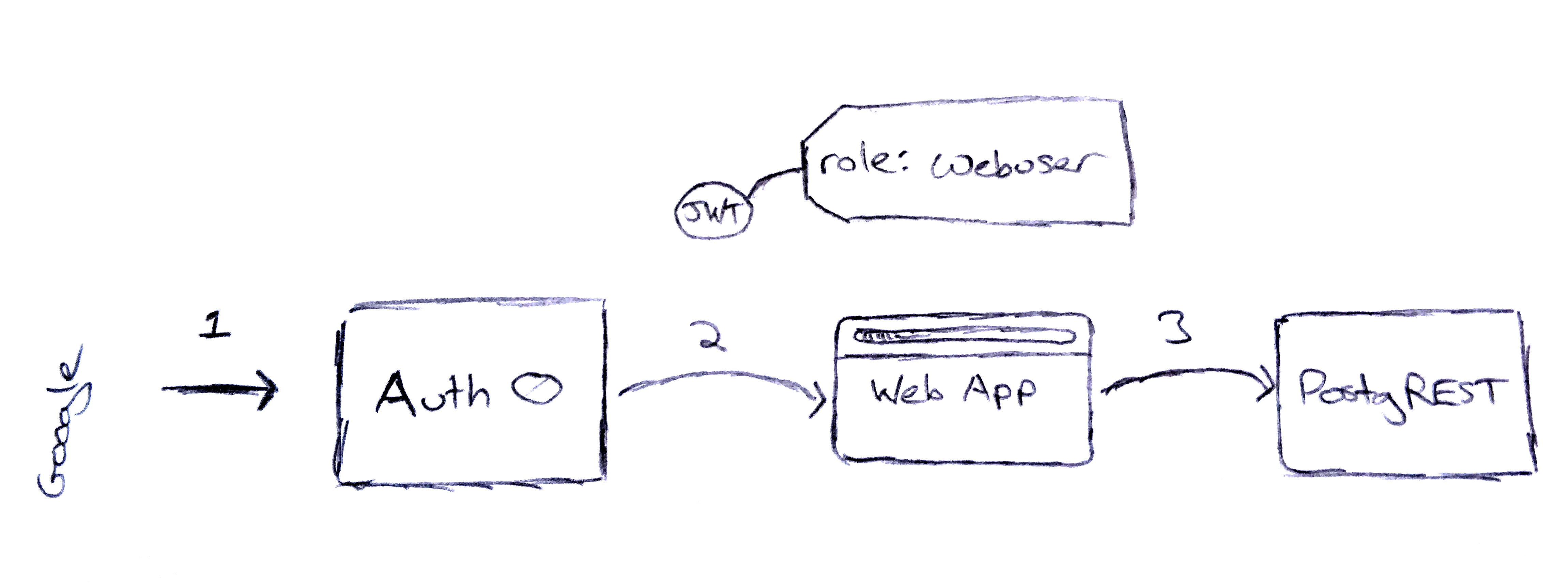
- User authentication provided by google to Auth0
- Auth0 grants a generic JWT to the web app
- Web app uses JWT to make requests to postgrest
OIDC-strict Flow Overview

- User authentication provided by google to Auth0
- Auth0 issues optionally two tokens to web app
Identity Token-- to use in the browser app. Contains user profile information. _Not to be passed on to APIs_Access Token-- to use as a bearer token making calls to postgrest. Contains only an arbitrary user identifier in thesubclaim
- Web app uses
Access Tokento make request to postgrest
OIDC-strict Requirements
For Auth0 applications:
- Role information will need to be provided in a different claim. The
roleclaim will now be filtered out by Auth0. Two options seem viable:
- Namespace role, so that it is not filtered out.
Eg.https/my-postgrest/role: basic_user - Use the
scopesclaim to determine a user’s role
Not sure what the mechanics would be here. Scopes are conventionally split up by read / write and resource. But looking for arole:<user-role>in thescopepart of the JWT might give us what we want.
- Namespace role, so that it is not filtered out.
- An
audclaim will be included in these new access tokens; per #955, this requires a way to match on that expectation. A setting in the config file seems like the way to do this. The same setting could be used to namespace other claims, such asrole.
For non-Auth0 applications:
- These will of course continue to work as they always have. Outside a speculative threat of token misappropriation, there’s no reason for users to configure a token’s audience.
roleis an acceptable name for a claim if developers assemble their own JWTs.
Integration Process from Developer’s Perspective (Draft)
The steps to integrate with the _new_ OIDC pipeline are similar, but with some changes and additions:
- NEW: An ‘API’ must be created in the Auth0 dashboard
This will be our postgrest api. - UNCHANGED: A ‘client’ must be created in the Auth0 dashboard
Eg. a single page app (SPA) that will access our postgrest api - CHANGED: Integrate client with Auth0
Now, we acquire an ‘access token’ instead of an ‘id token’
Lock.js does this pretty elegantly, just as before. However, new rules limit which claims can be added to this token, soroleinformation will have to be stored elsewhere. - CHANGED: Add a rule to Auth0 processing such that the role information is added to the access token. This information can be included in a namespaced claim, eg. https://my-postgrest/role, in one of the ~20 standard claims, or in token metadata, eg.
scope - NEW: Add an jwt-audience value to the postgrest configuration file
OIDC access tokens always have anaudfield. So unless we match it appropriately, we'll see the error noted in #955
I'm pretty confident there's a solution here that doesn't require any additional thought on the part of the developer, but it will take some work here.
 willscripted
on 30 Aug 2017
willscripted
on 30 Aug 2017
@will-ob great research, helps A LOT with implementing this compatibility
Well done, this will surely speed things up 👍
ruslantalpa
on 30 Aug 2017
@ruslantalpa of course :)
I think aud will be figured out shortly in #955. So really, if we want to go forward with supporting Auth0, the only decision here is to decide how role information will be passed.
In scope, or in a configurable claim like https://mypgst/role, are the two options that jumped out at me.
Most of the work will be in updating the documentation, I suspect.
willscripted
on 1 Sep 2017
So excited that y'all are working on this.
On Fri, Sep 1, 2017 at 9:07 AM will-ob notifications@github.com wrote:
@ruslantalpa https://github.com/ruslantalpa of course :)
I think aud will be figured out shortly in #955
https://github.com/begriffs/postgrest/issues/955. So really, if we want
to go forward with supporting Auth0, the only decision here is to decide
how role information will be passed.In scope, or in a configurable claim like https://mypgst/role, are the
two options that jumped out at me.Most of the work will be in updating the documentation, I suspect.
—
You are receiving this because you authored the thread.
Reply to this email directly, view it on GitHub
https://github.com/begriffs/postgrest/issues/906#issuecomment-326620241,
or mute the thread
https://github.com/notifications/unsubscribe-auth/AAxN25q6FwKc_SVKFDbN9VhPhVFJFke0ks5seCu_gaJpZM4OR3x3
.
posix4e
on 2 Sep 2017
It appears that the scope claim encodes which actions (read/write/delete) are permitted on which API endpoints. In PostgREST this is managed inside the database and cannot be specified by the client except indirectly by identifying the desired database role. Therefore I think using a custom claim is more appropriate for specifying the role.
As for which custom claim in particular, OIDC specifies:
other Claims MAY be used in conjunction with the standard Claims. When using such Claims, it is RECOMMENDED that collision-resistant names be used for the Claim Names
However Auth0 goes a step further and mandates that additional claims must be a well-formed url:
Any non-Auth0 HTTP or HTTPS URL can be used as a namespace identifier, and any number of namespaces can be used. The namespace URL does not have to point to an actual resource, it’s only used as an identifier and will not be called by Auth0.
If we were namespacing our role claim, I would have preferred a name like postgrest/role, but I guess the Auth0 gods have decreed otherwise. (Might be worth investigating Okta or Keycloak if Auth0 gets increasingly draconian.) To use the url style, I could imagine picking our actual documentation domain name, or a shorter one, one of these:
Does it need to include an actual top-level domain? If not we could also use https://postgrest/role
begriffs
on 6 Sep 2017
@begriffs or forget all of that, and just provide a config value like
role-claim-key = 'role'
where the default is the old name (backward compatible) and then each user can choose his own custom key (be that url or anything else)
ruslantalpa
on 6 Sep 2017
That sounds nice, just let them use whatever they want. 👍
begriffs
on 6 Sep 2017
Therefore I think using a custom claim is more appropriate for specifying the role.
That makes sense to me :+1:
Does it need to include an actual top-level domain?
It does not. It actually doesn't even allow . periods in the 'domain name' oddly enough
or forget all of that, and just provide a config value
I like this. Especially if role is the default value. Then existing postgrest users need not worry about additional configuration.
Might be worth investigating Okta or Keycloak if Auth0 gets increasingly draconian
With 10k stargazers, Okta or Keycloak might invest some engineering attention themselves. This would be a great opportunity for them to expand their product reach. I quite like Auth0, but I would not have discovered them if not for these docs.
willscripted
on 6 Sep 2017
I think specifying a config value as @ruslantalpa suggested is the best approach. However, I'd like it to be flexible enough to handle whatever the structure of the JWT (not just a top level claim key). To do this, I think using jspath would be a good choice.
So if you want to select the top level key "role" (the default) you could specify it as:
role-claim-key = '.role'
But if you'd prefer to have a nested key, e.g. {... "postgrest": {"role": "foo"} ... } then:
role-claim-key = '.postgrest.role'
 russelldavies
on 18 Sep 2017
russelldavies
on 18 Sep 2017
I do like the idea of being able to specify the path. As an example, here is how keycloak exposes roles for realms and for clients (where I was specifically configuring a "member" role in keycloak that I want to line up with the member role I defined in postgrest):
{
  "exp": 1505488999,
  "nbf": 0,
  "iat": 1505488699,
  "iss": "http://localhost:2015/auth/realms/havendev",
  "aud": "havendev",
  ... some stuff removed
  "realm_access": {
    "roles": [
      "member",
      "uma_authorization"
    ]
  },
  "resource_access": {
    "havendev": {
      "roles": [
        "member"
      ]
    },
    "account": {
      "roles": [
        "manage-account",
        "manage-account-links",
        "view-profile"
      ]
    }
  },
  "name": "User1 One",
  "preferred_username": "[email protected]",
  "email": "[email protected]"
}
 statik
on 19 Sep 2017
statik
on 19 Sep 2017
@statik I also use Keycloak so this is exactly the reason I suggested it although I was also thinking about other systems.
russelldavies
on 19 Sep 2017
ANy updates here?
posix4e
on 17 Oct 2017
I wish I'd stumbled upon this earlier. In my case I just changed the role claim directly in the postgrest code and built it from source again. Adding this as a parameter in the config file would be awesome.
 marsouin
on 26 Oct 2017
marsouin
on 26 Oct 2017
Updates on this?
 Sebastianbrg
on 15 Mar 2018
Sebastianbrg
on 15 Mar 2018
Hello everyone. I ran into this today, and it seems to be a showstopper. Even after disabling OIDC compliance in Auth0, I am unable to set non-namespaced keys on new clients. (Reference to forum discussion).
I would be glad to implement one of the suggestion here in a PR. Adding a configuration field to customize the name seems simple enough. It's probably worth deciding about json-path first though—it'd be great to hear from one of the maintainers on that!
Thanks
 kofigumbs
on 21 Mar 2018
kofigumbs
on 21 Mar 2018
Couldn't get the proposed jspath lib to work, so I implemented a subset of the jspath dsl, now is possible to use the role-claim-key config value like:
# for this jwt
# {.."postgrest":{"roles": ["other", "author"]}..}
role-claim-key = ".postgrest.roles[1]"

# {.."https://www.example.com/role": "author"..}
role-claim-key = ".\"https://www.example.com/role\""
# non (alphanumerical or one of "_$@") chars can go inside quotes
Anyone can checkout #1091 and see if it works for its use case.
 steve-chavez
on 8 Apr 2018
steve-chavez
on 8 Apr 2018
@steve-chavez Hey, I've been working on this bug too. I'll check it out.
 jxv
on 8 Apr 2018
jxv
on 8 Apr 2018
@jxv @hkgumbs Did the PR work for your use cases?
steve-chavez
on 23 Apr 2018
I'll consider the PR enough for all the use cases.
steve-chavez
on 30 Apr 2018
If anyone has a working example of the new role-claim-key config working with the new Auth0 flow please consider adding it to the docs https://github.com/begriffs/postgrest-docs/issues/85.
steve-chavez
on 3 May 2018
Is there any way to remove the default role-claim-key? We handle setting the role via pre-request and would like to disable the default mechanism. For now I'm setting role-claim-key to a bogus key, which works, but that's just a hack, of course…
 witsch
on 29 Jan 2019
witsch
on 29 Jan 2019
@witsch No way to disable the default jwt mechanism, maybe open another issue with your use case to discuss.
steve-chavez
on 4 Feb 2019
Related issues
 sscarduzio
·
30Comments
sscarduzio
·
30Comments
 tomberek
·
19Comments
tomberek
·
19Comments
 isairz
·
24Comments
isairz
·
24Comments
 ric2b
·
21Comments
ric2b
·
21Comments
 timbod7
·
20Comments
timbod7
·
20Comments
Most helpful comment
Details ++
Overview
Things are getting rowdy over at Auth0, but it’s all in the name of progress.
In order to bring their authentication process in line with published standards, Auth0 is making an effort to push people to a new authentication flow. A recent change, noted in this memo, makes the new flow the default. The process described on postgrest.com is only compatible with the now-”legacy” authentication process for reasons detailed below.
Auth0’s push here is to register services, such as postgrest, and give them their own oauthy-type access token JWTs instead of generic JWTs.
Key Terms
JSON Web Token (JWT) -- Signed token fitting the jwt spec
ID Token -- A JWT containing user profile information. Intended for use by the _client_.
Access Token -- A bearer token to use to access an OAuth resource server.
Open ID Connect (OIDC) -- the standard the that adds authentication to OAuth. OAuth provides the authorization mechanism.
Current Status
The “legacy” authentication process is no longer default, the docs need to instruct the user to turn off OIDC-strict mode. PR here.
Existing “legacy” integrations will continue to work. Integrations will break if they switch to the new flow. The new flow is used if an audience parameter is included in the authentication request OR the developer manually enables the OIDC-compliant toggle in Auth0’s client settings dashboard.
“Legacy” Flow Overview
OIDC-strict Flow Overview
Identity Token-- to use in the browser app. Contains user profile information. _Not to be passed on to APIs_Access Token-- to use as a bearer token making calls to postgrest. Contains only an arbitrary user identifier in thesubclaimAccess Tokento make request to postgrestOIDC-strict Requirements
For Auth0 applications:
roleclaim will now be filtered out by Auth0. Two options seem viable:Eg.
https/my-postgrest/role: basic_userscopesclaim to determine a user’s roleNot sure what the mechanics would be here. Scopes are conventionally split up by read / write and resource. But looking for a
role:<user-role>in thescopepart of the JWT might give us what we want.audclaim will be included in these new access tokens; per #955, this requires a way to match on that expectation. A setting in the config file seems like the way to do this. The same setting could be used to namespace other claims, such asrole.For non-Auth0 applications:
roleis an acceptable name for a claim if developers assemble their own JWTs.Integration Process from Developer’s Perspective (Draft)
The steps to integrate with the _new_ OIDC pipeline are similar, but with some changes and additions:
This will be our postgrest api.
Eg. a single page app (SPA) that will access our postgrest api
Now, we acquire an ‘access token’ instead of an ‘id token’
Lock.js does this pretty elegantly, just as before. However, new rules limit which claims can be added to this token, so
roleinformation will have to be stored elsewhere.scopeOIDC access tokens always have an
audfield. So unless we match it appropriately, we'll see the error noted in #955I'm pretty confident there's a solution here that doesn't require any additional thought on the part of the developer, but it will take some work here.