Postgraphile: Pagination via cursor on custom query functions does not work (4.4.x)
I'm submitting a ...
- [x] bug report
- [ ] feature request
- [ ] question
PostGraphile version: 4.4.4
Minimal SQL file that can be loaded into a clean database:
CREATE OR REPLACE FUNCTION filter_articles(
    published_before timestamp with time zone DEFAULT NULL,
    published_after timestamp with time zone DEFAULT NULL,
    published_last text DEFAULT NULL,
    search_plain text DEFAULT ''::text,
    search_tsquery text DEFAULT ''::text,
    category_filter text DEFAULT ''::text,
    tags_filter text[] DEFAULT ARRAY[]::text[],
    tag_ids_filter text[] DEFAULT ARRAY[]::text[],
    districts_filter district[] DEFAULT ARRAY[]::district[],
    capability_filter capability[] DEFAULT ARRAY[]::capability[],
    reference_point point DEFAULT POINT(-1, -1),
    distance double precision DEFAULT 10,
    publication_priority_filter priority DEFAULT NULL::priority,
    revision_by text DEFAULT ''::text,
    status_filter status DEFAULT NULL,
    push_notification_filter push_notification[] DEFAULT ARRAY[]::push_notification[],
    only_templates boolean DEFAULT false,
    sort_by filter_articles_sort DEFAULT NULL)
 RETURNS SETOF articles
 LANGUAGE plpgsql
 STABLE
  …
Steps to reproduce:
Current behavior:
every GraphQL query trying to paginate on that function returns the same value for pageInfo.endCursor. Downgrading postgraphile to 4.3.3 solved the problem for us.
Expected behavior:
pageInfo.endCursor should return a different value, for every value the of after
 saerdnaer
All 6 comments
Reproducing using this function from the kitchen-sink-schema:
create function c.table_set_query() returns setof c.person as $$ select * from c.person $$ language sql stable;
{
  tableSetQuery(first: 3){
    edges {
      cursor
      node {
        id
      }
    }
    pageInfo {
      startCursor
      endCursor
    }
  }
}
gives
{
  "data": {
    "tableSetQuery": {
      "edges": [
        {
          "cursor": "WyJuYXR1cmFsIiwxXQ==",
          "node": {
            "id": 1
          }
        },
        {
          "cursor": "WyJuYXR1cmFsIiwyXQ==",
          "node": {
            "id": 2
          }
        },
        {
          "cursor": "WyJuYXR1cmFsIiwzXQ==",
          "node": {
            "id": 3
          }
        }
      ],
      "pageInfo": {
        "startCursor": "WyJuYXR1cmFsIiwxXQ==",
        "endCursor": "WyJuYXR1cmFsIiwzXQ=="
      }
    }
  }
}
So far so good.
{
  tableSetQuery(first: 3, after:"WyJuYXR1cmFsIiwzXQ=="){
    edges {
      cursor
      node {
        id
      }
    }
    pageInfo {
      startCursor
      endCursor
    }
  }
}
returns
{
  "data": {
    "tableSetQuery": {
      "edges": [
        {
          "cursor": "WyJuYXR1cmFsIiw0XQ==",
          "node": {
            "id": 4
          }
        },
        {
          "cursor": "WyJuYXR1cmFsIiw1XQ==",
          "node": {
            "id": 5
          }
        },
        {
          "cursor": "WyJuYXR1cmFsIiw2XQ==",
          "node": {
            "id": 6
          }
        }
      ],
      "pageInfo": {
        "startCursor": "WyJuYXR1cmFsIiw0XQ==",
        "endCursor": "WyJuYXR1cmFsIiw2XQ=="
      }
    }
  }
}
This is working as expected.
Please can you file a minimal SQL file that reproduces the issue? Your current example is incomplete.
 benjie
on 6 Nov 2019
benjie
on 6 Nov 2019
I'm seeing differences between plpgsql functions and sql functions. Taking your kitchen sink example function and creating an equivalent plpgsql function reproduced the issue that I believe OP is seeing.
Function:
create or replace function c.table_set_query_1171() returns setof c.person as
  $$
  begin
    return query select * from c.person;
    return;
  end
  $$ language plpgsql stable;
Running this with a 2 row limit (data from master only had 5 rows).
query Test3{
  tableSetQuery1171(first: 2){
    edges {
      cursor
      node {
        id
      }
    }
    pageInfo {
      startCursor
      endCursor
    }
  }
}
gives
{
  "data": {
    "tableSetQuery1171": {
      "edges": [
        {
          "cursor": "WyJuYXR1cmFsIiwxXQ==",
          "node": {
            "id": 1
          }
        },
        {
          "cursor": "WyJuYXR1cmFsIiwyXQ==",
          "node": {
            "id": 2
          }
        }
      ],
      "pageInfo": {
        "startCursor": "WyJuYXR1cmFsIiwxXQ==",
        "endCursor": "WyJuYXR1cmFsIiwyXQ=="
      }
    }
  }
}
So far so good here as well.
query Test4{
  tableSetQuery1171(first: 2, after:"WyJuYXR1cmFsIiwzXQ=="){
    edges {
      cursor
      node {
        id
      }
    }
    pageInfo {
      startCursor
      endCursor
    }
  }
}
returns
{
  "data": {
    "tableSetQuery1171": {
      "edges": [
        {
          "cursor": "WyJuYXR1cmFsIiwxXQ==",
          "node": {
            "id": 3
          }
        },
        {
          "cursor": "WyJuYXR1cmFsIiwyXQ==",
          "node": {
            "id": 4
          }
        }
      ],
      "pageInfo": {
        "startCursor": "WyJuYXR1cmFsIiwxXQ==",
        "endCursor": "WyJuYXR1cmFsIiwyXQ=="
      }
    }
  }
}
Note the repeated cursor values compared to the first page of results. The test data I loaded had 5 rows so this problem makes retrieving page 3 impossible via the cursor.
 jogoodma
on 6 Nov 2019
jogoodma
on 6 Nov 2019
Fascinating.
benjie
on 6 Nov 2019
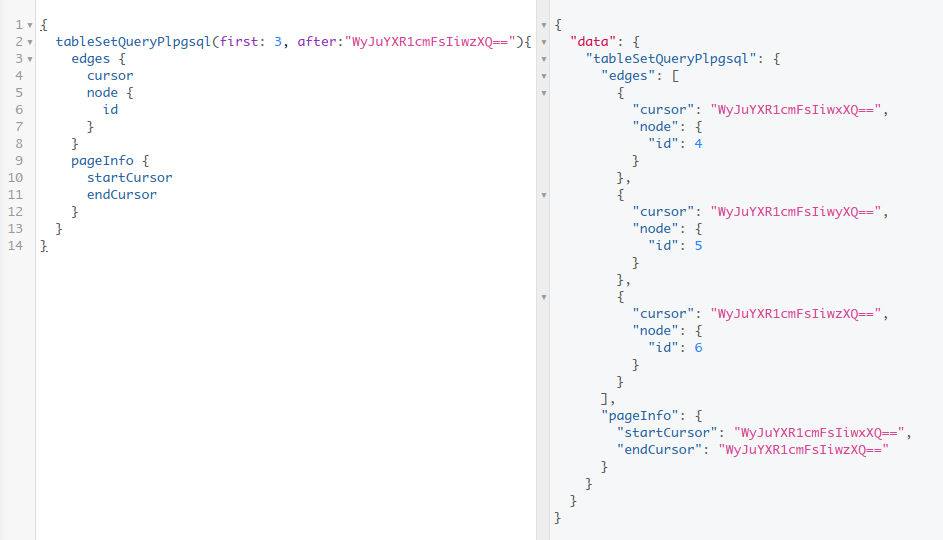
Can confirm; have reproduced with this function:
create function c.table_set_query_plpgsql() returns setof c.person as $$ begin return query select * from c.person; end $$ language plpgsql stable;
benjie
on 6 Nov 2019
The SQL is subtly different.
SQL:
with __local_0__ as (
  select to_json(
    (
      json_build_object(
        '__identifiers'::text,
        json_build_array(__local_1__."id"),
        '@node'::text,
        (
          json_build_object(
            'id'::text,
            (__local_1__."id"),
            'name'::text,
            (__local_1__."person_full_name")
          )
        )
      )
    )
  ) as "@edges",
  to_json(
    json_build_array(
      'natural',
      (
        row_number( ) over (partition by 1)
      )
    )
  ) as "__cursor"
  from (
    select __local_1__.*
    from "c"."table_set_query_plpgsql"( ) as __local_1__
    where (TRUE) and (TRUE)
    limit 2 offset 2
  ) __local_1__
),
__local_2__ as (
  select json_agg(
    to_json(__local_0__)
  ) as data
  from __local_0__
)
select coalesce(
  (
    select __local_2__.data
    from __local_2__
  ),
  '[]'::json
) as "data"
plpgsql:
with __local_0__ as (
  select to_json(
    (
      json_build_object(
        '__identifiers'::text,
        json_build_array(__local_1__."id"),
        '@node'::text,
        (
          json_build_object(
            'id'::text,
            (__local_1__."id"),
            'name'::text,
            (__local_1__."person_full_name")
          )
        )
      )
    )
  ) as "@edges",
  to_json(
    json_build_array(
      'natural',
      (
        row_number( ) over (partition by 1)
      )
    )
  ) as "__cursor"
  from "c"."table_set_query"( ) as __local_1__
  where (TRUE) and (TRUE)
  limit 2 offset 2
),
__local_2__ as (
  select json_agg(
    to_json(__local_0__)
  ) as data
  from __local_0__
)
select coalesce(
  (
    select __local_2__.data
    from __local_2__
  ),
  '[]'::json
) as "data"
diff:
--- a.sql   2019-11-06 19:48:43.511473647 +0000
+++ b.sql   2019-11-06 19:46:44.711593022 +0000
@@ -24,12 +24,9 @@
       )
     )
   ) as "__cursor"
-  from (
-    select __local_1__.*
-    from "c"."table_set_query_plpgsql"( ) as __local_1__
-    where (TRUE) and (TRUE)
-    limit 2 offset 2
-  ) __local_1__
+  from "c"."table_set_query"( ) as __local_1__
+  where (TRUE) and (TRUE)
+  limit 2 offset 2
 ),
 __local_2__ as (
   select json_agg(
We have to run the PL/pgSQL function inside a subquery, and interestingly we add the limit/offset THERE rather than in the parent. This is almost certainly a performance optimisation because we don't have to evaluate the rows at all until we've already done the limiting. However it messes up the row_number() logic that we're doing above because it no longer factors in the offset.
benjie
on 6 Nov 2019
Fixed in https://github.com/graphile/graphile-engine/pull/559
That was... unpleasant. Somebody needs to buy me a beer :rofl:
benjie
on 6 Nov 2019
Related issues
 CarlFMateus
·
4Comments
CarlFMateus
·
4Comments
 angelosarto
·
3Comments
angelosarto
·
3Comments
 srghma
·
3Comments
srghma
·
3Comments
 outsidenote
·
4Comments
outsidenote
·
4Comments
 giacomorebonato
·
3Comments
giacomorebonato
·
3Comments
Most helpful comment
Fixed in https://github.com/graphile/graphile-engine/pull/559
That was... unpleasant. Somebody needs to buy me a beer :rofl: