Pomerium: proxy: Proxy configuration file preprocessed incorrectly, creating incorrect routes
Bug Description
When configuring a proxy locally with a policy.yaml file, some of the routes created are incorrect. This leads to the proxy routing requests incorrectly.
Environment
- Running the source locally. Latest commit to the
masterbranch - Windows 10 with Windows Subsystem for Linux
Impact
Minimal: I cannot test my fix to #129 with this bug in place. However, I believe I have a fix for this bug (below).
Root Cause
Specifically, I noticed that Proxy::routeConfigs is incorrectly initialized. In the image below, notice that two routes (with the configuration file given below) have the same memory address for the policy - highlighted in red. This should not occur, as each policy should be unique.
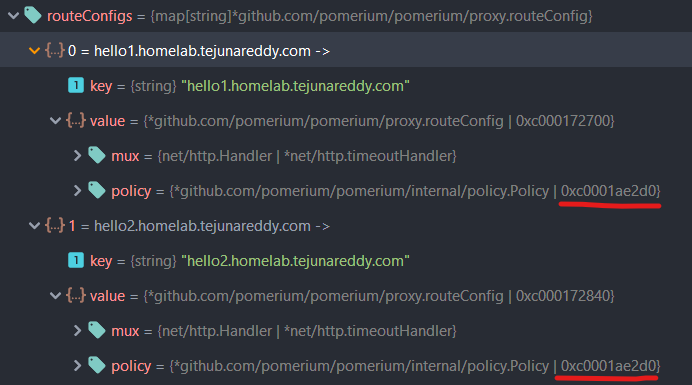
After some further digging, I noticed issues with memory addresses in this section of code. p.Handle(route.Source.Host, handler, &route), where the last argument is a pointer to route. However, the proxy must store a copy of the route for later requests outside of this function.
Proposed Fix
I will make a PR with the fix. The main modification would be here to store policies as a copy of the data, instead of pointers that do not exist after the main function exits.
Reproducibility
Policy Configuration
- from: hello1.homelab.tejunareddy.com
  to: http://localhost:8081
  allowed_users:
    - [email protected]
- from: hello2.homelab.tejunareddy.com
  to: http://localhost:8082
  allowed_users:
    - [email protected]
- from: hello3.homelab.tejunareddy.com
  to: http://localhost:8083
  allow_public_unauthenticated_access: true
Repro Steps
- Start the server locally with this file
- All requests to hello1.homelab.tejunareddy.com, hello2.homelab.tejunareddy.com, and hello3.homelab.tejunareddy.com are handled by the 3rd route, so they all redirect to http://localhost:8003.
Expected Behavior
It's expected that each route is handled by the correct proxy handler.
 nareddyt
All 4 comments
@nareddyt Thank you for the very well written bug report.
This is super odd -- what you are showing makes complete sense and I am seeing what you are seeing in relationship to the pointer being re-used but I am not able to reproduce what you are seeing (all requests being redirected to the last policy route.
log.Info().Str("src", route.Source.Host).Str("dst", route.Destination.Host).Msgf("proxy: new route: %p", &route)
func (p *Proxy) policy(r *http.Request) (*policy.Policy, bool) {
    config, ok := p.routeConfigs[r.Host]
    if ok {
+       log.Info().Str("host", r.Host).Msgf("config*: %p config.policy: %p", config, config.policy)
        return config.policy, true
    }
    return nil, false
}
httpbin.corp.beyondperimeter.com
4:24PM INF config*: 0xc00028e4a0
+config.policy: 0xc0002ec360 config.policy={
   "AllowedDomains":[
      "pomerium.io"
   ],
   "AllowedEmails":null,
   "AllowedGroups":null,
   "CORSAllowPreflight":false,
   "Destination":{
      "ForceQuery":false,
      "Fragment":"",
      "Host":"localhost:8080",
      "Opaque":"",
      "Path":"",
      "RawPath":"",
      "RawQuery":"",
      "Scheme":"http",
      "User":null
   },
+   "From":"hello.corp.beyondperimeter.com",
   "Source":{
      "ForceQuery":false,
      "Fragment":"",
+      "Host":"hello.corp.beyondperimeter.com",
      "Opaque":"",
      "Path":"",
      "RawPath":"",
      "RawQuery":"",
      "Scheme":"https",
      "User":null
   },
   "To":"http://localhost:8080",
   "UpstreamTimeout":0
+} host=httpbin.corp.beyondperimeter.com
hello.corp.beyondperimeter.com
4:24PM INF config*: 0xc00028e700 config.policy:
+0xc0002ec360 config.policy=
{
   "AllowedDomains":[
      "pomerium.io"
   ],
   "AllowedEmails":null,
   "AllowedGroups":null,
   "CORSAllowPreflight":false,
   "Destination":{
      "ForceQuery":false,
      "Fragment":"",
      "Host":"localhost:8080",
      "Opaque":"",
      "Path":"",
      "RawPath":"",
      "RawQuery":"",
      "Scheme":"http",
      "User":null
   },
+   "From":"hello.corp.beyondperimeter.com",
   "Source":{
      "ForceQuery":false,
      "Fragment":"",
      "Host":"hello.corp.beyondperimeter.com",
      "Opaque":"",
      "Path":"",
      "RawPath":"",
      "RawQuery":"",
      "Scheme":"https",
      "User":null
   },
   "To":"http://localhost:8080",
   "UpstreamTimeout":0
+} host=hello.corp.beyondperimeter.com
policy yaml
```policy.yaml
- from: httpbin.corp.beyondperimeter.com
to: http://localhost:8000
allowed_domains:
- pomerium.io
- from: hello.corp.beyondperimeter.com
to: http://localhost:8080
allowed_domains:
- pomerium.io
```bash
curl 'https://httpbin.corp.beyondperimeter.com/get' \
-H 'cookie: _pomerium=snip' \
--compressed
```json
{
"args": {},
"headers": {
"Accept": "text/html,application/xhtml+xml,application/xml;q=0.9,image/webp,image/apng,/;q=0.8,application/signed-exchange;v=b3",
"Accept-Encoding": "gzip, deflate, br",
"Accept-Language": "en-US,en;q=0.9",
"Cache-Control": "no-cache",
"Cookie": "",
"Dnt": "1",
"Host": "localhost:8000",
"Pragma": "no-cache",
"Referer": "https://httpbin.corp.beyondperimeter.com/",
"Upgrade-Insecure-Requests": "1",
"User-Agent": "Mozilla/5.0 (Macintosh; Intel Mac OS X 10_14_5) AppleWebKit/537.36 (KHTML, like Gecko) Chrome/74.0.3729.157 Safari/537.36",
"X-Forwarded-Host": "httpbin.corp.beyondperimeter.com",
"X-Pomerium-Authenticated-User-Email": "[email protected]",
"X-Pomerium-Authenticated-User-Groups": "[email protected],[email protected],[email protected]",
"X-Pomerium-Authenticated-User-Id": "111432655977273150308",
"X-Pomerium-Jwt-Assertion": "eyJhbGciOiJFUzI1NiIsImtpZCI6IiIsInR5cCI6IkpXVCJ9.eyJhdWQiOlsiaHR0cGJpbi5jb3JwLmJleW9uZHBlcmltZXRlci5jb20iXSwiZW1haWwiOiJiZGRAcG9tZXJpdW0uaW8iLCJleHAiOjE1NTg0ODAwMjIsImdyb3VwcyI6ImFkbWluc0Bwb21lcml1bS5pbyxldmVyeW9uZUBwb21lcml1bS5pbyxzdXBwb3J0QHBvbWVyaXVtLmlvIiwiaWF0IjoxNTU4NDc5OTYyLCJpc3MiOiJwb21lcml1bS1wcm94eSIsIm5iZiI6MTU1ODQ3OTkwMiwic3ViIjoiMTExNDMyNjU1OTc3MjczMTUwMzA4In0.59yqdje6HLXh6JXhOaoy1SiVMc4yny-wxpe9X3_YPCv0B_aQKgXoDZ0swKbY2EWeg6ShCOeFNqZPSKo0X3wAoQ"
},
"origin": "192.168.1.1",
"url": "http://httpbin.corp.beyondperimeter.com/get"
}
```bash
curl 'https://hello.corp.beyondperimeter.com' \
-H 'cookie: _pomerium=snip' \
--compressed
Hello, world!
Version: 2.0.0
Hostname: e14371a6b5de
where the last argument is a pointer to route. However, the proxy must store a copy of the route for later requests outside of this function.
Just so I understand, this issue only occurs if we want to modify a route after the fact and this only works today because we iterate over the list of policies but the pointer keeps getting moved forward.
 desimone
on 22 May 2019
desimone
on 22 May 2019
tl;dr --Ok. I think I've got it. Routes work today by a happy accident but this is still very much a bug. Thank you @nareddyt
desimone
on 22 May 2019
No problem! Yeah I found it odd because I was not able to reproduce this bug with the latest docker image, but it does occur when running from source code on my machine.
Just curious, do you have any guesses on why this bug hasn't caused problems beforehand? Let me know if you need me to provide any other logs like you did above.
nareddyt
on 22 May 2019
I don't know why it is working differently on your machine vs docker (windows? that would be too weird!).
My best guess for why this ws working as intended is that the handler map is still being built so router() is still going to find an entry. Authentication and authorization are still being enforced because they are still being properly loaded in those services.
However, I speculate CORS is not working as intended. It's a newer feature but, as I write this, I remember I wasn't actually able to reproduce working CORS configuration until I used the contributors policy file which ... makes sense now looking back on it. I had several policies, the first of which was CORS enabled. His was the last.
desimone
on 22 May 2019
Related issues
 fiahil
·
4Comments
fiahil
·
4Comments
 ncmans
·
3Comments
ncmans
·
3Comments
 victornoel
·
9Comments
victornoel
·
9Comments
 travisgroth
·
8Comments
travisgroth
·
8Comments
 deltabweb
·
9Comments
deltabweb
·
9Comments