Pluto.jl: One-dimensional arrays lose relevant info in display
In the REPL:
julia> using OffsetArrays

julia> kernel = OffsetArray([0.2, 1, 0.3], -1:1)
3-element OffsetArray(::Vector{Float64}, -1:1) with eltype Float64 with indices -1:1:
 0.2
 1.0
 0.3
In Pluto:
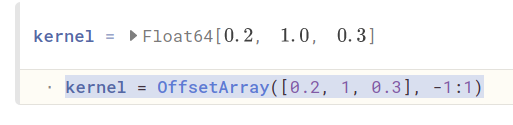
which doesn't reveal that the first element is accessed as kernel[-1].
 timholy
All 8 comments
It also seems odd to me that ranges are displayed as lists.
timholy
on 20 Sep 2020
In this case, you will see the indices when you click, but I agree that we should differentiate between different AbstractArrays, also in the unexpanded form. Any ideas?
Maybe we can write it in the current form when it is an Array{T,1}, and write it as:
OffsetArray(::Vector{Float64}, -1:1)([0.2, 1.0, 0.3])
for other types?
 fonsp
on 20 Sep 2020
fonsp
on 20 Sep 2020
How is the display done? For 2d arrays it seems to use the normal display machinery, but 1d seems different.
timholy
on 20 Sep 2020
1D abstractarrays, dicts, structs and some others use our custom display system, which is an interactive tree viewer.
fonsp
on 20 Sep 2020
fonsp
on 20 Sep 2020
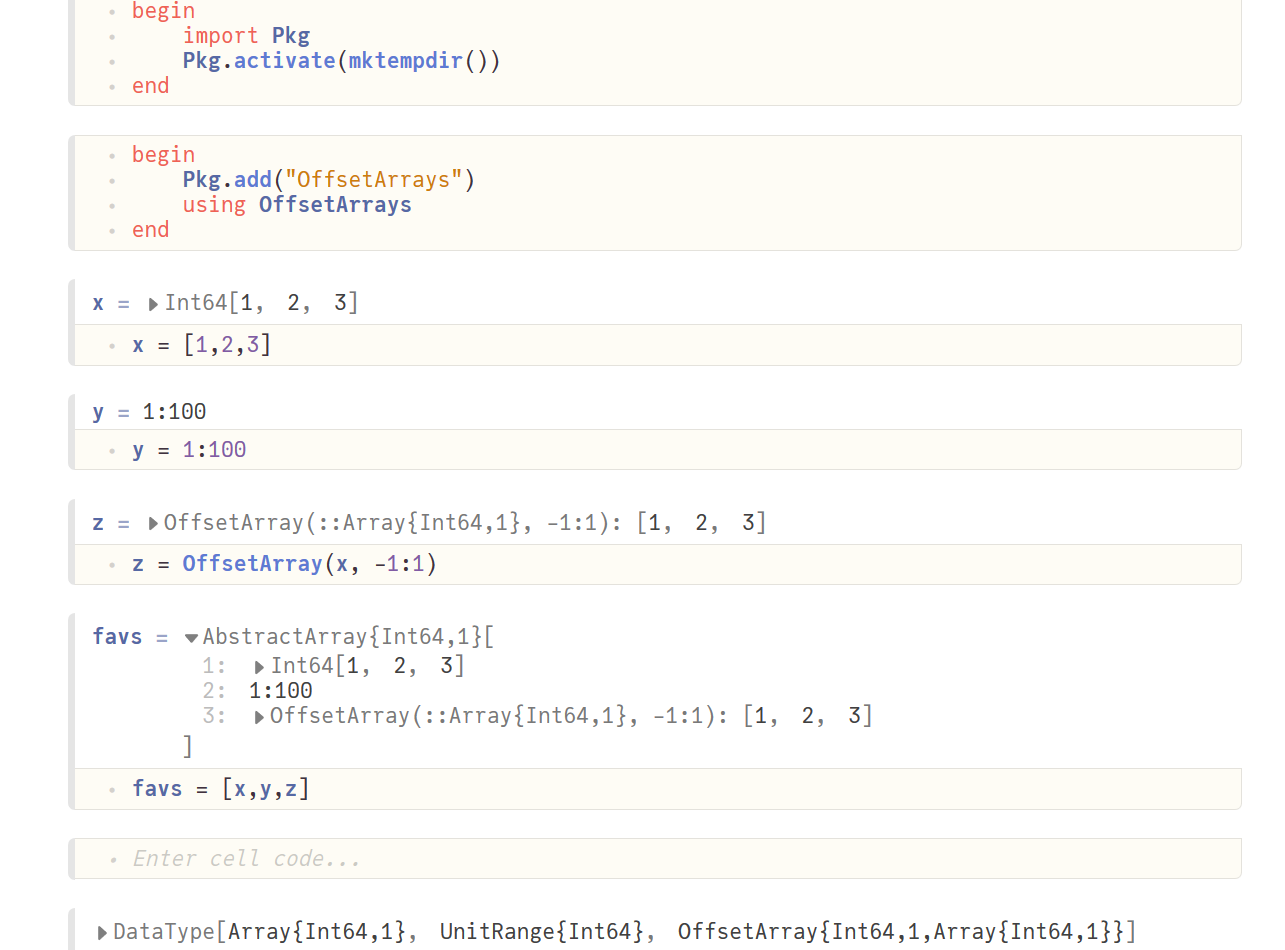
New behaviour:
fonsp
on 23 Sep 2020
I also added a : between the type and the array for AbstractArrays that are not Arrays, like the OffsetArray, to differentiate an offsetarray from an Array of offsetarrays :)
fonsp
on 23 Sep 2020
Oh, that's very sweet! Thanks so much!
timholy
on 23 Sep 2020
Related issues
 briochemc
·
6Comments
briochemc
·
6Comments
 dpsanders
·
6Comments
briochemc
·
5Comments
dpsanders
·
6Comments
briochemc
·
5Comments
 MikaelSlevinsky
·
7Comments
MikaelSlevinsky
·
7Comments
 karlwessel
·
4Comments
karlwessel
·
4Comments
Most helpful comment
New behaviour: