Pluto.jl: Support defining methods of a function in multiple cells
The other solution is much harder to implement consistently - i.e. being able to detect multiple methods with the same argument types (instead of just detecting multiple functions with the same name) and deleting only the methods from one cell, while leaving the others.
All of this is possible within the scope of Pluto, but not something for the next couple of months :)
_Originally posted by @fonsp in https://github.com/fonsp/Pluto.jl/issues/109#issuecomment-628060038_
 karlwessel
All 19 comments
I would like to track this feature in an actual issue, since at least I am really really missing this.
Multiple dispatch and therefore multiple methods of the same function is a key feature of Julia. Often those methods are implemented in completely different contexts (for example Base.show). Having to put them all in the same cell makes exploratory implementation of custom types really hard.
karlwessel
on 10 Jun 2020
(split into two issues: #178)
 fonsp
on 11 Jun 2020
fonsp
on 11 Jun 2020
It would be helpful if someone with an eye for edge cases (@karlwessel) would write the test cases for this _before_ thinking up a solution.
(Writing test cases is fairly easy, and they don't need to be perfect yet.)
fonsp
on 16 Jun 2020
Strictly speaking, two cells f(x::Int) = 1 & f(x::Int) = 2 should not be allowed, and we can find those cases and throw a MultipleDefinitionsError. _However_, there are some very difficult situations like:
f(x::Int) = 1 & f(x::Int64) = 2 (built in type synonyms)
A = Number & f(x::A) = 1 & f(x::Number) = 2 (dynamic types)
A = rand(Bool) ? Number : String & f(x::A) = 1 & f(x::Number) = 2 (aaah)
f = 1 & f(x) = 1 (variables vs methods)
f(x::Int) = 1; f(x::String) = 2 && f(x::String) = 3; f(x::Vector) = 4 (multiple methods per cell)
f(x::Int) = 1; f(x::Int) = 2 && f(x::Vector) = 3 (number of methods in code might not equal number of defined methods)
f() = 1 && f(; s) = 2 (kwargs)
f(x::T) where T = 1 && f(x) = 2
f(x::(rand(Bool) ? Int64 : Float64)) = 1 &
f(x::(rand(Bool) ? Int64 : Float64)) = 2
If all of these situations are allowed without a MultipleDefinitionsError (which is the easy solution), then a notebook could be _ambiguous_ (ignoring the SECRET fact that the _order in which cells are placed_ is used as a tie-breaker when two cells are mutually independent.) They need to be handled correctly.
fonsp
on 17 Jun 2020
Is it possible to detect those cases during execution of a notebook by comparing the methodswith count for each function for which there are cells defining methods for? And throw a runtime exception if one cell that should increase the count doesn't because it replaced another method?
karlwessel
on 17 Jun 2020
That's going in the right direction! (Although my 5th example would not get detected with that method)
fonsp
on 17 Jun 2020
Well, maybe we don't have to catch _all_ corner cases...
karlwessel
on 17 Jun 2020
Building on your counting methods idea:
It's very nice if we can keep all of the syntax analysis in one place, _before_ running the code, and then run cells in a precomputed order. Checking the number of defined methods after running cells (in the middle of a reactive run), and then taking that information back to do something special makes that tricky. But there are three reasons to do this kind of "dynamic" code analysis instead of static anaylsis:
- https://github.com/fonsp/Pluto.jl/issues/177 (this issue)
- https://github.com/fonsp/Pluto.jl/issues/24
- https://github.com/fonsp/Pluto.jl/issues/196
The common hurdles in these three are:
- the dependency graph can only be determined after runtime
- the dependency graph depends on the global state
- we'd like to know things about external packages without
- analysing their source code, nor
- importing them into the server process
Solution?
We need to do some dynamic analysis, but we can try to keep it simple and isolated. The runner process will have three new APIs:
do_signatures_overlap(signatures::Array{NTuple{Type}})::Bool

symbols_exported_by_module(name::Symbol)::Set{Symbol}

macroexpand(expr::Expr)::Expr
to solve these three problems, respectively.
do_signatures_overlap?
Create a new test module, import all globals into the test module, and then define a dummy functions with the given signatures. If the number of methods is less than the number of signatures, then they overlap. (Thanks @karlwessel!)
symbols_exported_by_module
Create a new test module, call the using statement there, and then return Core.eval(testmodule, :(names($(name_of_usinged_module))) ).
macroexpand
This is just Base.macroexpand :)
Separate using+import from all other code
using and import already get some of special treatment - they always execute first in a "tie" scenario of a reactive run. This is a _heuristic_: we know that our syntax analysis fails for using so this is a hacky way to fix most scenarios. All using X sub-expressions are also extracted from cell code and stored separately.
To support the solutions above, we need to go from:
- syntax analysis (in server process)
- reactive run (in worker process)
to:
- mini syntax analysis to find
using(in server process) - call the
usingstatements (in worker process) - syntax analysis (in server process), with
symbols_exported_by_moduleto fill in the gaps - reactive run (in worker process), but use
do_signatures_overlapduring the run to somehow figure out if cells should err.
fonsp
on 5 Aug 2020
We can simplify the do_signatures_overlap quite a bit by dropping support for:
A = B
f(x::A) = 1
f(x::B) = 2
Although it is common to have user-defined types, I hope that it's uncommon for user defined _aliases_ to cause this kind of trouble. So:
do_signatures_overlap?
Create a new test module, ~import all globals into the test module~, create dummy types for all unknown types, and then define dummy functions with the given signatures. If the number of methods is less than the number of signatures, then they overlap.
So:
function f(x::Int, y::MyType, z::random_type())
    asdf
end
will become
struct var"MyType" end
struct var"random_type()" end

function f(x::Int, y::var"MyType", z::var"random_type()")
end
(var"..." is how you define variables with possibly illegal names in Julia).
- mini syntax analysis to find
using(in server process) - call the
usingstatements (in worker process) - syntax analysis (in server process), with
symbols_exported_by_moduleanddo_signatures_overlapto fill in the gaps - reactive run (in worker process)
fonsp
on 5 Aug 2020
f(x::Int) = 1&f(x::Int64) = 2(built in type synonyms)
A = Number&f(x::A) = 1&f(x::Number) = 2(dynamic types)
A = rand(Bool) ? Number : String&f(x::A) = 1&f(x::Number) = 2(aaah)
f = 1&f(x) = 1(variables vs methods)
f(x::Int) = 1; f(x::String) = 2&&f(x::String) = 3; f(x::Vector) = 4(multiple methods per cell)
f(x::Int) = 1; f(x::Int) = 2&&f(x::Vector) = 3(number of methods in code might not equal number of defined methods)
f() = 1&&f(; s) = 2(kwargs)
f(x::T) where T = 1&&f(x) = 2
f(x::(rand(Bool) ? Int64 : Float64)) = 1&
f(x::(rand(Bool) ? Int64 : Float64)) = 2
I guess the next step is me implementing those tests :-)
karlwessel
on 10 Sep 2020
Yes please! Although I think we will be going with a solution where half of those tests are broken :)
fonsp
on 10 Sep 2020
The tests for stacktraces on the master branch are currently failing for me, is this "intentional"?
One of the failed test messages:
Stack traces: Test Failed at /home/karl/Pluto.jl/test/React.jl:155
  Expression: ((st["stacktrace"])[4])["line"] == 1
   Evaluated: 111 == 1
Stacktrace:
 [1] macro expansion at /home/karl/Pluto.jl/test/React.jl:155 [inlined]
 [2] macro expansion at /build/julia/src/julia-1.5.1/usr/share/julia/stdlib/v1.5/Test/src/Test.jl:1115 [inlined]
 [3] macro expansion at /home/karl/Pluto.jl/test/React.jl:148 [inlined]
 [4] macro expansion at /build/julia/src/julia-1.5.1/usr/share/julia/stdlib/v1.5/Test/src/Test.jl:1115 [inlined]
 [5] (::var"#111#139")() at /home/karl/Pluto.jl/test/React.jl:8
Stack traces: Test Failed at /home/karl/Pluto.jl/test/React.jl:156
Yes please! Although I think we will be going with a solution where half of those tests are broken :)
Why is that? Is the method-counting version to complicated?
karlwessel
on 10 Sep 2020
Hm what Julia version do you use?
fonsp
on 10 Sep 2020
1.5.1
karlwessel
on 10 Sep 2020
Why is that? Is the method-counting version to complicated?
Counting methods is not too complicated, but then there needs to be a feedback loop: too few methods were detected, so we error those cells manually, delete the methods, and then continue.
Instead of:
Syntax analysis > topological ordering > execution
where each of those steps does not depend on the results of later steps
fonsp
on 10 Sep 2020
It thought that was the process you described in your comment above. What is the simpler alternative?
karlwessel
on 10 Sep 2020
Hi!
I made a little proof of concept to solve this issue using a shallow module where all the types referenced are redefined using struct var"$name" end and where the functions have an empty body (following @fonsp's idea). Iterating on @karlwessel's idea of counting the number of methods defined, we visit the methods table to extract all defined methods for a function. We can then reduce by using the signature as a key to identify which signature is defined more than once. This prevent one problem I have identified with counting: We couldn't have overridden method from the Base package for example since the number of methods would have stayed the same.
The complete process would be:
- [x] Collect the function signatures in
ExpressionExplorerso that the symbols states contains the type signature and not just the references. - [x] Before a reactive run if a function name is assigned in multiple cells we can construct this shallow module with a empty definition for every type.
- [x] Define a
get_errorsfunction which can identify which methods are duplicated
- [x] For every function name which is assigned more than once run
get_errorsto identify whether or not there are duplicate methods - [x] Match the duplicate methods with their respective cells using a
LineNumberNodecontaining the cell id for each shallow function - [x] Dispatch errors for those cells
- [x] Remove previously dispatched
MultipleDefinitionserrors,topology[cell].assignmentswill no longer contains symbols for function names
- [x] For every function name which is assigned more than once run
What don't work yet
- [ ] Handle curly types
Union{A, B},Option{A}and so on... - [ ] Handle optional parameters
a::Bool=false - [ ] Handle
::AnyParameters (parameters without types) ->f(a) === f(a::Any) - [ ] Handle type aliases
A = Int64 - [ ] Currently I am "_polluting_" the
Mainmodule with these shallow modules, using another process withDistributedwill be cleaner - [ ] Currently, the detection is run every time there is a change on every cells, there must be a way to filter every function that has not changed
- [ ] Plenty of tests -> #471
A quick demo of the progress
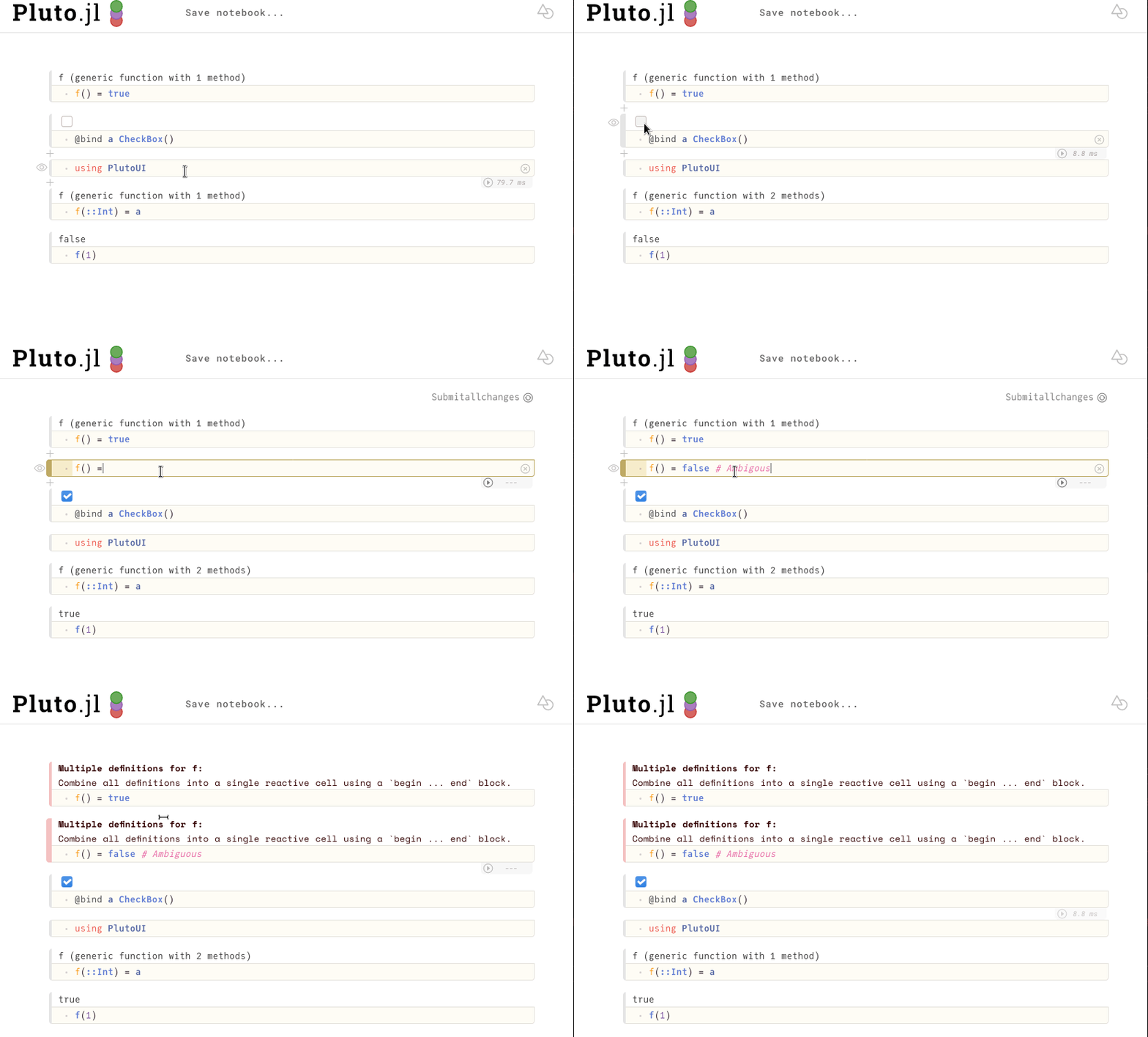
I have pushed my changes on this branch if you want to take a look at the implementation and compare the changes. If the methods implemented seems good to you I can open a draft PR to discuss more technical details of the implementation :sparkler:
 Pangoraw
on 4 Oct 2020
Pangoraw
on 4 Oct 2020
_(ramble)_
Hi @Pangoraw!
Thanks so much for your contribution! I've sent you an email in case you would like to call!
Your work looks promising, but motivated by @karlwessel (https://github.com/fonsp/Pluto.jl/issues/177#issuecomment-645629771) I think we should take a different direction:
These tricky corner cases are very difficult to solve, and will probably make Pluto's internals much more complicated (if we go with the crazy solution I proposed, although I see some good middle ground solutions).
So instead, I think we should only attempt to catch super simple cases like f(x) = 1 vs f(wow::Any) = 2, and leave anything more complicated for later.
I'm also not sure whether I like having the function signature info in its SymbolState. I think it would be better to store it in its name. I have started working on this in a new branch, so far it's just refactoring old code.
During my refactoring, I found that a bunch of tricky code can be eliminated! https://github.com/fonsp/Pluto.jl/pull/536
fonsp
on 6 Oct 2020
Related issues
fonsp
·
5Comments
 briochemc
·
6Comments
briochemc
·
6Comments
 MikaelSlevinsky
·
5Comments
fonsp
·
5Comments
karlwessel
·
4Comments
MikaelSlevinsky
·
5Comments
fonsp
·
5Comments
karlwessel
·
4Comments
Most helpful comment
Well, maybe we don't have to catch _all_ corner cases...