Platformio-core: LDF not working correct
Configuration
Operating system: Windows 10 x64
PlatformIO Version (platformio --version): PlatformIO, version 3.5.2a8
Description of problem
I experience problems with the LDF. I hope, this issue is in the right place here.
The desired library config.h is shown in the dependency graph but using its elements leads to a compilation error (see below)
I am using this folder structure (pretty standard):
├── lib
│   ├── config
│   │   └── config.h
│   └── readme.txt
├── platformio.ini
└── src
    └── main.cpp
Steps to Reproduce
- Create files
- Paste content
- Build
Actual Results
[02/08/18 08:06:06] Processing nodemcuv2 (build_flags: -std=c++11; lib_deps: Blynk, PCA9685; platform: espressif8266; board: nodemcuv2; framework: arduino; lib_ldf_mode: chain+)
----------------------------------------------------------------------------
Verbose mode can be enabled via `-v, --verbose` option
Platform: Espressif 8266 :: NodeMCU 1.0 (ESP-12E Module)
System: ESP8266 80MHz RAM/80KB Flash/4MB
Library Dependency Finder -> http://bit.ly/configure-pio-ldf
Modes: Finder/chain+ Compatibility/light
Collected 29 compatible libraries
Scanning dependencies...
Dependency Graph
|-- <Blynk> v0.5.0
|-- <PCA9685>
|-- <config>
Compiling .pioenvs\nodemcuv2\src\main.o
Compiling .pioenvs\nodemcuv2\lib3d7\Blynk_ID415\utility\BlynkDebug.o
Compiling .pioenvs\nodemcuv2\lib3d7\Blynk_ID415\utility\BlynkHandlers.o
Compiling .pioenvs\nodemcuv2\lib3d7\Blynk_ID415\utility\BlynkTimer.o
src\main.cpp: In function 'void loop()':
src\main.cpp:9:20: error: 'MY_UNIQUE_CONST' was not declared in this scope
Serial.println(MY_UNIQUE_CONST);
^
*** [.pioenvs\nodemcuv2\src\main.o] Error 1
======================== [ERROR] Took 3.79 seconds ========================
Expected Results
Successful build
If problems with PlatformIO Build System:
The content of platformio.ini:
; PlatformIO Project Configuration File
;
;   Build options: build flags, source filter
;   Upload options: custom upload port, speed and extra flags
;   Library options: dependencies, extra library storages
;   Advanced options: extra scripting
;
; Please visit documentation for the other options and examples
; http://docs.platformio.org/page/projectconf.html

[env:nodemcuv2]
platform = espressif8266
board = nodemcuv2
framework = arduino
build_flags = -std=c++11
lib_ldf_mode = chain+
lib_deps =
    Blynk
    PCA9685
Source file to reproduce issue:
*main.cpp*
#include <Arduino.h>
#include <config.h>

void setup() {
    Serial.begin(115200);
}

void loop() {
    Serial.println(MY_UNIQUE_CONST);
}
*config.h*
#ifndef config_h
#define config_h

#define MY_UNIQUE_CONST 5

#endif
Additional info
 serioustk
All 22 comments
lib_deps =
    config
    Blynk
    PCA9685
Does it work?
 ivankravets
on 8 Feb 2018
ivankravets
on 8 Feb 2018
No, it doesn't. The error still persists:
[02/08/18 14:55:02] Processing nodemcuv2 (build_flags: -std=c++11; lib_deps: config, Blynk, PCA9685; platform: espressif8266; board: nodemcuv2; framework: arduino; lib_ldf_mode: chain+)
----------------------------------------------------------------------------------------------------------------------------------------------------------------------------------------------------------------
Warning! Library `{'requirements': None, 'name': 'config'}` has not been found in PlatformIO Registry.
You can ignore this message, if `{'requirements': None, 'name': 'config'}` is a built-in library (included in framework, SDK). E.g., SPI, Wire, etc.
Verbose mode can be enabled via `-v, --verbose` option
Platform: Espressif 8266 :: NodeMCU 1.0 (ESP-12E Module)
System: ESP8266 80MHz RAM/80KB Flash/4MB
Library Dependency Finder -> http://bit.ly/configure-pio-ldf
Modes: Finder/chain+ Compatibility/light
Collected 29 compatible libraries
Scanning dependencies...
Dependency Graph
|-- <Blynk> v0.5.0
|-- <PCA9685>
|-- <config>
Compiling .pioenvs\nodemcuv2\src\main.o
Compiling .pioenvs\nodemcuv2\lib3d7\Blynk_ID415\utility\BlynkDebug.o
Compiling .pioenvs\nodemcuv2\lib3d7\Blynk_ID415\utility\BlynkHandlers.o
Compiling .pioenvs\nodemcuv2\lib3d7\Blynk_ID415\utility\BlynkTimer.o
src\main.cpp: In function 'void loop()':
src\main.cpp:9:20: error: 'MY_UNIQUE_CONST' was not declared in this scope
Serial.println(MY_UNIQUE_CONST);
^
*** [.pioenvs\nodemcuv2\src\main.o] Error 1
========================================================================================== [ERROR] Took 5.73 seconds ==========================================================================================
platform.ini:
; PlatformIO Project Configuration File
;
;   Build options: build flags, source filter
;   Upload options: custom upload port, speed and extra flags
;   Library options: dependencies, extra library storages
;   Advanced options: extra scripting
;
; Please visit documentation for the other options and examples
; http://docs.platformio.org/page/projectconf.html

[env:nodemcuv2]
platform = espressif8266
board = nodemcuv2
framework = arduino
build_flags = -std=c++11
lib_ldf_mode = chain+
lib_deps =
    config
    Blynk
    PCA9685
Blynk library does not depend on "config" library. I recommend doing configuration in platformio.ini
[common]
config =
  -D MY_UNIQUE_CONST=5

[env:nodemcuv2]
platform = espressif8266
board = nodemcuv2
framework = arduino
build_flags =
  ${common.config}
  -std=c++11
lib_ldf_mode = chain+
lib_deps =
    Blynk
    PCA9685
I think we are missunderstanding each other: the problem persists in LDF. I have broken it down to the smallest example I can imagine:
*main.cpp*
#include <config.h>

void setup() {
}

void loop() {
    int a = MY_UNIQUE_CONST;
}
*config.h*
#ifndef config_h
#define config_h

#define MY_UNIQUE_CONST 5

#endif
*platform.ini*
[env:nodemcuv2]
platform = espressif8266
board = nodemcuv2
framework = arduino
According to readme.txt file in lib folder this should work, but in fact, it fails with the following error:
[02/08/18 15:21:27] Processing nodemcuv2 (platform: espressif8266; board: nodemcuv2; framework: arduino)
----------------------------------------------------------------------------------------------------------------------------------------------------------------------------------------------------------------
Verbose mode can be enabled via `-v, --verbose` option
Platform: Espressif 8266 :: NodeMCU 1.0 (ESP-12E Module)
System: ESP8266 80MHz RAM/80KB Flash/4MB
Library Dependency Finder -> http://bit.ly/configure-pio-ldf
Modes: Finder/chain Compatibility/light
Collected 29 compatible libraries
Scanning dependencies...
Dependency Graph
|-- <config>
Compiling .pioenvs\nodemcuv2\src\main.o
Archiving .pioenvs\nodemcuv2\libc52\libconfig.a
Archiving .pioenvs\nodemcuv2\libFrameworkArduinoVariant.a
Compiling .pioenvs\nodemcuv2\FrameworkArduino\Esp.o
Compiling .pioenvs\nodemcuv2\FrameworkArduino\FS.o
Compiling .pioenvs\nodemcuv2\FrameworkArduino\FunctionalInterrupt.o
src\main.cpp: In function 'void loop()':
src\main.cpp:7:13: error: 'MY_UNIQUE_CONST' was not declared in this scope
int a = MY_UNIQUE_CONST;
^
*** [.pioenvs\nodemcuv2\src\main.o] Error 1
========================================================================================== [ERROR] Took 1.97 seconds ==========================================================================================
I have similar problem. It seems that opposite to what LDF manual is saying, lib directory within project is not scanned at all.
Operating system: Windows 10 x64
PlatformIO Version (platformio --version): PlatformIO, version 3.5.2rc1
 vanklompf
on 27 Feb 2018
vanklompf
on 27 Feb 2018
Ok, I have investigated this issue:
- For libraries in LibraryManager dir ArduinoLibBuilder is used, but for libraries in project
libdir PlatformIOLibBuilder is used. I'm not sure if it makes any difference. - If library has
srcsubdir (even if empty), than it is scanned instead of root directory of library. This was actual root cause of my issue.
I'm not sure if this is actual bug or not. Looking on some examples it seems that some libraries have code in src and other in root. But probably never in both. I guess that some parameter in library.json that shows location of "public" headers in library might be useful. Arduino library.properties has similar concept.
vanklompf
on 27 Feb 2018
If you use library.proeprties or have Arduino-based library, ArduinoLibBuilder will be used by default. See specification https://github.com/arduino/Arduino/wiki/Arduino-IDE-1.5:-Library-specification#layout-of-folders-and-files
You can use any library structure with PlatformIO. Just add library.json manifest to the root of library.
ivankravets
on 2 Mar 2018
library.json was there. It was TFT_eSPI library. It seems that Arduino library.properties have precedence over PlatformIO library.json?
vanklompf
on 2 Mar 2018
library.json should be used firstly. See https://github.com/platformio/platformio-core/blob/develop/platformio/builder/tools/piolib.py#L41
ivankravets
on 6 Mar 2018
Hello,
I did not want to open a new issue for this, but I am experiencing similar problems with the LDF regarding defined preprocessor constants.
PlatformIO version: 3.5.3a8, Atom version: 1.25.0
My platformio.ini looks like this:
[env:esp32dev]
platform = espressif32
board = esp32dev
framework = arduino
lib_ldf_mode = deep+
This main.cpp compiles just fine as expected:
#include <Arduino.h>

#define BOARD_ESP32     1
#define BOARD_ESP8266   2

#define MY_PLATFORM 1

#if MY_PLATFORM == BOARD_ESP32

    #include <Basecamp.hpp>

#endif

void setup() { }
void loop() { }
while this does not compile:
#include <Arduino.h>

#define BOARD_ESP32     1
#define BOARD_ESP8266   2

#define MY_PLATFORM BOARD_ESP32

#if MY_PLATFORM == BOARD_ESP32

    #include <Basecamp.hpp>

#endif

void setup() { }

void loop() { }
I receive the error src/main.cpp:10:28: fatal error: Basecamp.hpp: No such file or directory.
This is kind of strange, since the Basecamp library is still in the same place. The only difference now is that I re-used the preprocessor constant BOARD_ESP32 as a value for MY_PLATFORM. This should not affect the include of the Basecamp library.
The error only occurs when using lib_ldf_mode = deep+ or lib_ldf_mode = chain+, not when using the other modes (without the + sign). This is why i think it is related to the preprocessor handling of LDF.
Any ideas on this? Thanks in advance!
 nicolashimmelmann
on 5 Apr 2018
nicolashimmelmann
on 5 Apr 2018
Is it possible in the last few days, something has changed in the PlatformIO code handling the platformio.ini file?
It looks like the set build_flags are not processed properly, or at least somewhere cached?
I have a rather elaborate setup with ESP32 and ESP8266 configurations in the same .ini file and when I try to build a configuration for ESP8266, it also tries to compile code for ESP32. Even though this code is surrounded by #ifdef ESP32 and #endif.
The color coding in Visual Studio Code also suggest those flags are active.
I am running PlatformIO "home 0.9.6", "Core 3.6.0a" and
ESP32: platform = [email protected]
ESP82xx: platform = [email protected]
This is running on Windows, but Travis had the same issues last night and that's running on some Linux environment I guess. (ESP32 run in Travis output is not related to this issue, but the other build errors are)
 TD-er
on 5 Jul 2018
TD-er
on 5 Jul 2018
You use default LDF mode which does not handle C preprocessor's conditions. See https://github.com/letscontrolit/ESPEasy/blob/mega/platformio.ini#L89
Please use lib_ldf_mode = chain+. See http://docs.platformio.org/en/latest/librarymanager/ldf.html#dependency-finder-mode
ivankravets
on 8 Jul 2018
This LDF dude doesn't even work with the libraries from platformio library registry!!!
It looks like this LDF issue is a quite persistent one and really annoying. Primitive project setup is already taking 1 day from me and it still doesn't work!
I have the same issue with FreeRTOS library. No matter what I tried: lib_ldf_mode, rebuild indexes, specify lib_deps as name or id, whatever... nothing helps!
platformio.ini
[env:disco_l475vg_iot01a]
platform = ststm32
board = disco_l475vg_iot01a
framework = stm32cube
board_build.mcu = stm32l475vgt6
board_build.f_cpu = 80000000L
upload_protocol = mbed
monitor_speed = 115200
lib_deps = STM32duino FreeRTOS
lib_ldf_mode = chain+
The library is obviously there:
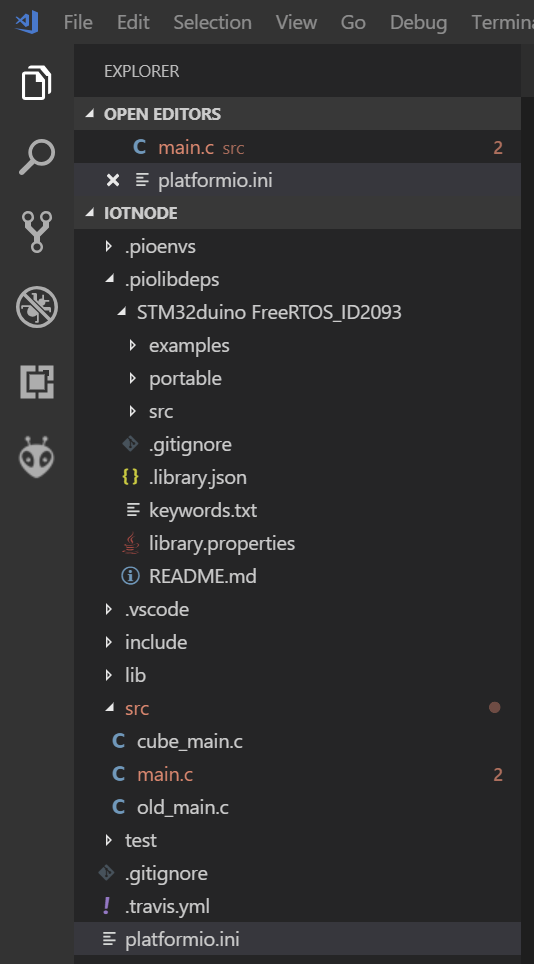
But I cannot build the code. It doesn't see:
#include <STM32FreeRTOS.h>
The main is an example from the FreeRTOS library itself:
/*
 * Based on AnalogRead_DigitalRead example from: https://github.com/feilipu/Arduino_FreeRTOS_Library
 * Modified by: Frederic Pillon <frederic.pillon (at) st.com>
 */
#include <STM32FreeRTOS.h>

// If no default pin for user button (USER_BTN) is defined, define it
#ifndef USER_BTN
#define USER_BTN 2
#endif

// Declare a mutex Semaphore Handle which we will use to manage the Serial Port.
// It will be used to ensure only only one Task is accessing this resource at any time.
SemaphoreHandle_t xSerialSemaphore;
Build console:
> Executing task: C:\Users\ademyankov\.platformio\penv\Scripts\platformio.exe run <

Processing disco_l475vg_iot01a (framework: stm32cube; platform: ststm32; board: disco_l475vg_iot01a)
-----------------------------------------------------------------------------------------------------------------------------------------------------------------------------------
Verbose mode can be enabled via `-v, --verbose` option
CONFIGURATION: https://docs.platformio.org/page/boards/ststm32/disco_l475vg_iot01a.html
PLATFORM: ST STM32 > ST DISCO-L475VG-IOT01A
HARDWARE: STM32L475VGT6 80MHz 128KB RAM (1MB Flash)
DEBUG: CURRENT(stlink) ON-BOARD(stlink) EXTERNAL(blackmagic, jlink)
Library Dependency Finder -> http://bit.ly/configure-pio-ldf
LDF MODES: FINDER(chain+) COMPATIBILITY(soft)
Collected 29 compatible libraries
Scanning dependencies...
No dependencies
Compiling .pioenvs\disco_l475vg_iot01a\src\main.o
src\main.c:5:10: fatal error: STM32FreeRTOS.h: No such file or directory

***********************************************************************
* Looking for STM32FreeRTOS.h dependency? Check our library registry!
*
* CLI  > platformio lib search "header:STM32FreeRTOS.h"
* Web  > https://platformio.org/lib/search?query=header:STM32FreeRTOS.h
*
***********************************************************************

#include <STM32FreeRTOS.h>
^~~~~~~~~~~~~~~~~
compilation terminated.
Compiling .pioenvs\disco_l475vg_iot01a\FrameworkBSP\stm32l475e_iot01_magneto.o
Compiling .pioenvs\disco_l475vg_iot01a\FrameworkBSP\stm32l475e_iot01_psensor.o
*** [.pioenvs\disco_l475vg_iot01a\src\main.o] Error 1
Compiling .pioenvs\disco_l475vg_iot01a\FrameworkBSP\stm32l475e_iot01_qspi.o
============================================================================ [ERROR] Took 6.35 seconds ============================================================================
The terminal process terminated with exit code: 1

Terminal will be reused by tasks, press any key to close it.
 ademyankov
on 9 May 2019
ademyankov
on 9 May 2019
Sorry, I didn't add the version of the software, here are those:
PlatformIO, version 3.6.7
VSCode, version 1.33.1
Windows 10 Enterprise, version 1709, OS Build: 16299.1087
ademyankov
on 9 May 2019
COMPATIBILITY(soft)
See http://docs.platformio.org/en/latest/projectconf/section_env_library.html#lib-compat-mode
You are going to use Arduino library for STM32Cube framework. Are they compatible?
ivankravets
on 9 May 2019
Shoot! :) How would I know?! I saw STM32 in the supported platforms and I thought it would work for my board.
Ok, so I have FreeRTOS port from STM32 System Workbench project that works with my board. What is the correct way to use it with VSCode and platformio? Use it not as an external dependency (library) but as local lib? (put it into lib folder?)
ademyankov
on 9 May 2019
Yes, please put a source code of this port to project/lib/STM32RTOS/src.
ivankravets
on 10 May 2019
Ok, got it... thanks! I am new to this iot world and there are a lot of confusing things.
One more question though, if these works, does it make sense to create a platformio library w/ that .library.json file and host this port on GitHub and publish it?
ademyankov
on 10 May 2019
does it make sense to create a platformio library w/ that .library.json file and host this port on GitHub and publish it?
Could you create a repo?
ivankravets
on 10 May 2019
I'll do it if I make it work with VS Code
ademyankov
on 10 May 2019
Hey all,
Does the latest version of PIO Core 4.0 work for you? If yes, we can close this issue.
pio upgrade --dev
Thanks!
ivankravets
on 24 May 2019
Please reopen if you still need help
ivankravets
on 25 May 2019
Related issues
 probonopd
·
6Comments
probonopd
·
6Comments
 positron96
·
5Comments
positron96
·
5Comments
 gianiaz
·
4Comments
gianiaz
·
4Comments
 424778940z
·
5Comments
424778940z
·
5Comments
 andig
·
5Comments
andig
·
5Comments