Pkg.jl: Use libCURL instead of platform engines
_This is very speculative, so mainly for brainstorming_
Currently HTTTP downloads within Pkg are done using the PlatformEngines subsystem, which shell out to locally installed commandline tools to perform the download. This generally means the curl/wget/fetch executables on unix and PowerShell on windows. This code is reasonably complex and difficult to maintain (I think)
In order to make things streamlined, one thought is to replace this with HTTP.jl. However, that is a large library, and splitting it will be some effort.
Another idea is to use libCurl.
- libCURL is widely used and very stable. Every car, phone and TV has multiple instances.
- It's very efficient, in CPU and memory -- it can do multiple downloads simultaneously in async mode.
- There is now a well maintained libCURL_jll, and the recent jll work on base julia makes it easy to pull in. One important feature here is that the jll correctly builds against the mbedTLS jll
- libCURL has http2 support (and ftp support and a dozen other protocols ...)
A few concerns, not insurmountable:
- libCURL has a low level C API. A higher level Julia API needs to be written, ideally using the multi-api. There are julia examples using the easy api
- proxies (potentially authenticated) need to be handled
- root certificates needs to be handled
cc: @StefanKarpinski @staticfloat
 aviks
aviks
All 13 comments
Yeah, I have thought the exact same thing. It is also in the spirit of the artifact system in that it doesn't rely (too much) on the state of the user's system. I think this would be a good idea.
Tangentially, I think Cargo also uses libcurl.
 KristofferC
on 20 May 2020
KristofferC
on 20 May 2020
I spent a while yesterday looking at the libcurl multi API and it is... complicated. We can probably get this to work but figuring out how to make it work nicely with our event loop feels non-trivial.
 StefanKarpinski
on 20 May 2020
StefanKarpinski
on 20 May 2020
I don't see why "our event loop" is relevant. Wouldn't we just call the multi API from a single-threaded synchronous Julia loop (as in https://ec.haxx.se/libcurl/libcurl-drive/libcurl-drive-multi).
int transfers_running;
do {
   curl_multi_wait ( multi_handle, NULL, 0, 1000, NULL);
   curl_multi_perform ( multi_handle, &transfers_running );
} while (transfers_running);
That wait call is blocking and we don't want to block all tasks.
StefanKarpinski
on 20 May 2020
Alright, so it is the socket system (https://ec.haxx.se/libcurl/libcurl-drive/libcurl-drive-multi-socket) that we need to use?
KristofferC
on 20 May 2020
Yes, the multi_socket API seems like it might be the right one. I'm still processing the docs on that one but it seems like the one we'd want to use (no blocking, maximum scalability).
StefanKarpinski
on 21 May 2020
There is an example of using libuv with the multi api, which might be instructive? https://curl.haxx.se/libcurl/c/multi-uv.html
aviks
on 21 May 2020
That example users uv_run which I'm hoping can be offloaded into a Task in Julia?
aviks
on 22 May 2020
Nice! Yes, I don't see any obviously blocking operations in that so it may well work.
StefanKarpinski
on 22 May 2020
A very old version of code using curl_multi_perform already exists, with polling using sleep/yield:
https://github.com/JuliaWeb/HTTPClient.jl/blob/master/src/HTTPC.jl#L623
aviks
on 30 May 2020
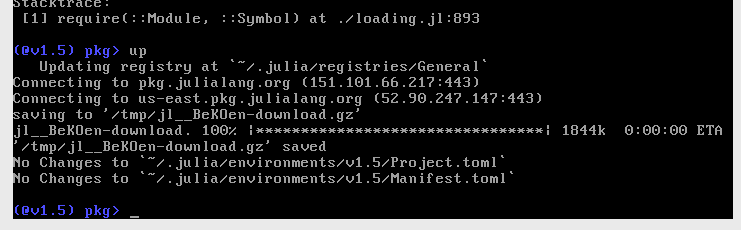
One of the issues with PlatformEngines is that you get different types of outputs on different platforms. Here's one from Alpine. I originally thought it was Pkg printing it. When multiple packages are being installed, it floods your screen with a lot of messages.
 ViralBShah
on 28 Jun 2020
ViralBShah
on 28 Jun 2020
Yeah, it’s a mess. I’m working on using libcurl instead.
StefanKarpinski
on 28 Jun 2020
Glad to see this issue tackled and I see there's already good progress being made by Stefan using LibCurl!
Should this functionality should go in Base so we can get rid of the shelling that the download function uses, which also suffers from the same problem. There's an open issue discussing the future of download over at the Julia repo regarding this.
 musm
on 25 Jul 2020
musm
on 25 Jul 2020
Related issues
 jlperla
·
3Comments
jlperla
·
3Comments
 DilumAluthge
·
3Comments
KristofferC
·
4Comments
DilumAluthge
·
3Comments
KristofferC
·
4Comments
 cossio
·
3Comments
KristofferC
·
4Comments
cossio
·
3Comments
KristofferC
·
4Comments
Most helpful comment
Yeah, it’s a mess. I’m working on using libcurl instead.