Background
Current TensorFlow produces a small network for InstanceNorm op.
- Related issue: #1741
In our circle we introduced an OpCode for this as BuiltinOperator_INSTANCE_NORM
_luci_ provides a Pass to fuse this small network into CircleInstanceNorm IR
Current Pass supports old(?) network when we started last year
- https://github.com/Samsung/ONE/blob/master/res/TensorFlowTests/NET_0028/test.pbtxt
- link to tflite recipe for this: Net_InstanceNorm_001
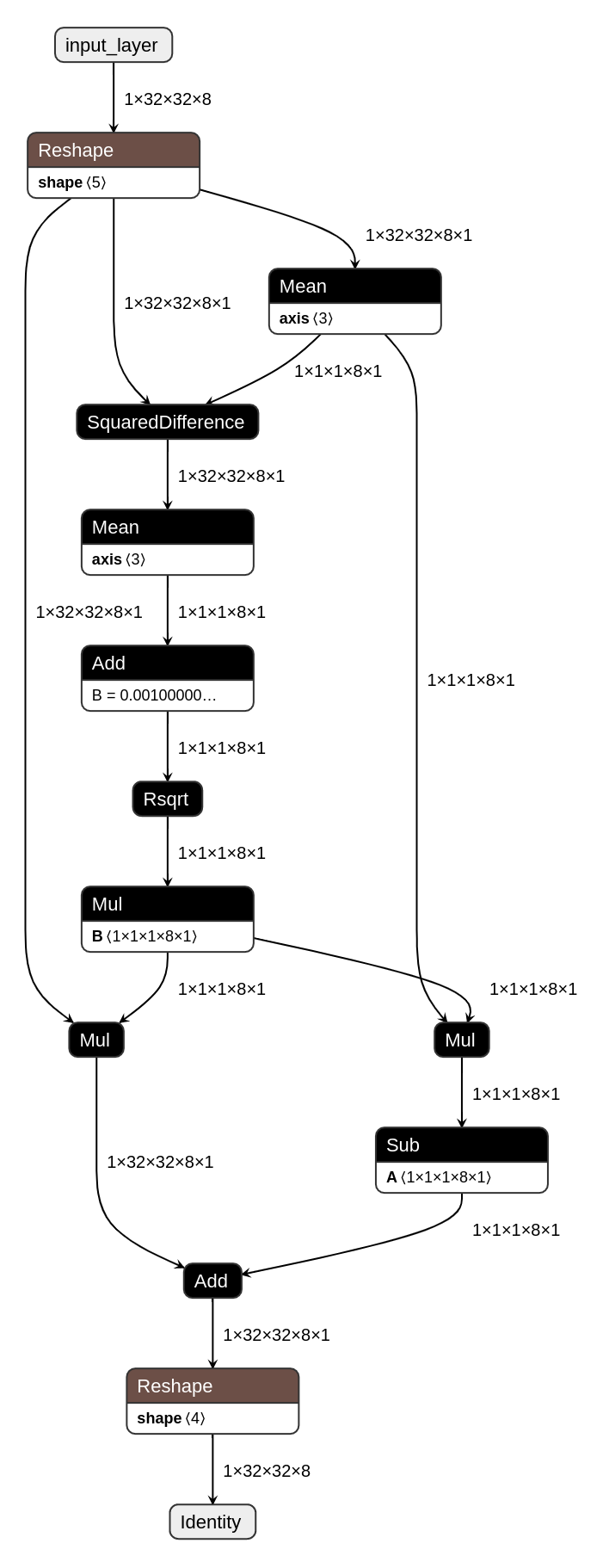
Latest TensorFlow produces a bit different network
- link to tflite recipe for this: Net_InstanceNorm_002
- with python script https://github.com/Samsung/ONE/issues/1741#issuecomment-637188577
Task
We also need to fuse Net_InstanceNorm_002 into CircleInstanceNorm IR
- Implement in
FuseInstanceNormPass.cppfile
How to check if works
- dredd test for this should pass with this change
diff --git a/compiler/circle2circle-dredd-recipe-test/test.lst b/compiler/circle2circle-dredd-recipe-test/test.lst
index c236a8e..9038119 100644
--- a/compiler/circle2circle-dredd-recipe-test/test.lst
+++ b/compiler/circle2circle-dredd-recipe-test/test.lst
@@ -8,5 +8,5 @@
 # resolve_customop_batchmatmul

 Add(Net_InstanceNorm_001 PASS fuse_instnorm)
-# Add(Net_InstanceNorm_002 PASS fuse_instnorm)
+Add(Net_InstanceNorm_002 PASS fuse_instnorm)
 Add(BatchMatMulV2_000 PASS resolve_customop_batchmatmul)
dredd rule for this: - Net_InstanceNorm_002/test.rule
 seanshpark
All 13 comments
@seanshpark
Did you start this task?
SRR can help you with this, if you want =)
 binarman
on 9 Jun 2020
binarman
on 9 Jun 2020
Did you start this task?
Nope :)
SRR can help you with this, if you want =)
This is my wish :)
seanshpark
on 9 Jun 2020
Example for InstanceNorm.
import tensorflow as tf
import tensorflow_addons as tfa
from tensorflow.keras import layers

print(tfa.__version__)
print(tf.__version__)

model = tf.keras.Sequential()

model.add(tf.keras.layers.Input(shape=(32,32,8), name="input_layer"))
model.add(tfa.layers.InstanceNormalization(center=True,scale=True,
                                           beta_initializer="random_uniform",
                                           gamma_initializer="random_uniform"))

converter = tf.lite.TFLiteConverter.from_keras_model(model)
converter.allow_custom_ops = True
tflite_model = converter.convert()
tflite_file = './instance_norm.tflite'
open(tflite_file, "wb").write(tflite_model)
0.10.0
2.2.0
 d-krylov
on 11 Jun 2020
d-krylov
on 11 Jun 2020
tflite2circle instance_norm.tflite InstanceNorm.circle
circledump InstanceNorm.circle
Model version: 0
 # sub graphs: 1

Operator Codes: [order] OpCodeName (OpCode Enum)
[0] RESHAPE (code: 22, version: 1)
[1] MEAN (code: 40, version: 1)
[2] SQUARED_DIFFERENCE (code: 99, version: 1)
[3] ADD (code: 0, version: 1)
[4] RSQRT (code: 76, version: 1)
[5] MUL (code: 18, version: 1)
[6] SUB (code: 41, version: 1)

Buffers: B(index) (length) values, if any
B(0) (0)
B(1) (0)
B(2) (20) 0x1 00 00 00 0x20 00 00 00 0x20 00 00 00 0x8 00 00 00 ...
B(3) (16) 0x1 00 00 00 0x20 00 00 00 0x20 00 00 00 0x8 00 00 00 ...
B(4) (32) 0x60 0x4c 0xd4 0x3a 0x67 0x8a 0x44 0x3d 0xaa 0x6e 0x2c 0xbd 0xce 0xcf 0xfd 0x3c ...
B(5) (32) 0xc0 0x7b 0xe 0xbd 0x18 0xc4 0x21 0x3c 0xc0 0x7f 0x15 0xbc 0x80 0xc9 0x52 0x3a ...
B(6) (4) 0x6f 0x12 0x83 0x3a
B(7) (12) 0x1 00 00 00 0x2 00 00 00 0x4 00 00 00 ...
B(8) (0)
B(9) (0)
B(10) (0)
B(11) (0)
B(12) (0)
B(13) (0)
B(14) (0)
B(15) (0)
B(16) (0)
B(17) (0)
B(18) (0)
B(19) (0)
B(20) (16) 0x31 0x2e 0x31 0x33 0x2e 0x31 00 00 00 00 00 00 00 00 00 00 ...

-------------------------------------------------------------------
Sub-Graph: #0 main

Data Format:
CHANNEL_LAST (NHWC for 2d, NDHWC for 3d data)

Operands: T(subgraph index : tensor index) TYPE (shape) (shape_signature) B(buffer index) OperandName
T(0:0) FLOAT32 (1, 32, 32, 8) B(1) input_layer
T(0:1) INT32 (5) B(2) sequential/instance_normalization/stack
T(0:2) INT32 (4) B(3) sequential/instance_normalization/Shape
T(0:3) FLOAT32 (1, 1, 1, 8, 1) B(4) sequential/instance_normalization/Reshape_1
T(0:4) FLOAT32 (1, 1, 1, 8, 1) B(5) sequential/instance_normalization/Reshape_2
T(0:5) FLOAT32 () B(6) sequential/instance_normalization/batchnorm/add/y
T(0:6) INT32 (3) B(7) sequential/instance_normalization/moments/variance/reduction_indices
T(0:7) FLOAT32 (1, 32, 32, 8, 1) B(8) sequential/instance_normalization/Reshape
T(0:8) FLOAT32 (1, 1, 1, 8, 1) B(9) sequential/instance_normalization/moments/mean
T(0:9) FLOAT32 (1, 32, 32, 8, 1) B(10) sequential/instance_normalization/moments/SquaredDifference
T(0:10) FLOAT32 (1, 1, 1, 8, 1) B(11) sequential/instance_normalization/moments/variance
T(0:11) FLOAT32 (1, 1, 1, 8, 1) B(12) sequential/instance_normalization/batchnorm/add
T(0:12) FLOAT32 (1, 1, 1, 8, 1) B(13) sequential/instance_normalization/batchnorm/Rsqrt
T(0:13) FLOAT32 (1, 1, 1, 8, 1) B(14) sequential/instance_normalization/batchnorm/mul
T(0:14) FLOAT32 (1, 32, 32, 8, 1) B(15) sequential/instance_normalization/batchnorm/mul_1
T(0:15) FLOAT32 (1, 1, 1, 8, 1) B(16) sequential/instance_normalization/batchnorm/mul_2
T(0:16) FLOAT32 (1, 1, 1, 8, 1) B(17) sequential/instance_normalization/batchnorm/sub
T(0:17) FLOAT32 (1, 32, 32, 8, 1) B(18) sequential/instance_normalization/batchnorm/add_1
T(0:18) FLOAT32 (1, 32, 32, 8) B(19) Identity

Operators: O(subgraph index : operator index) OpCodeName
    Option(values) ... <-- depending on OpCode
    I T(tensor index) OperandName <-- as input
    O T(tensor index) OperandName <-- as output
O(0:0) RESHAPE
    I T(0:0) input_layer
    I T(0:1) sequential/instance_normalization/stack
    O T(0:7) sequential/instance_normalization/Reshape
O(0:1) MEAN
    I T(0:7) sequential/instance_normalization/Reshape
    I T(0:6) sequential/instance_normalization/moments/variance/reduction_indices
    O T(0:8) sequential/instance_normalization/moments/mean
O(0:2) SQUARED_DIFFERENCE
    I T(0:7) sequential/instance_normalization/Reshape
    I T(0:8) sequential/instance_normalization/moments/mean
    O T(0:9) sequential/instance_normalization/moments/SquaredDifference
O(0:3) MEAN
    I T(0:9) sequential/instance_normalization/moments/SquaredDifference
    I T(0:6) sequential/instance_normalization/moments/variance/reduction_indices
    O T(0:10) sequential/instance_normalization/moments/variance
O(0:4) ADD
    Activation(NONE)
    I T(0:10) sequential/instance_normalization/moments/variance
    I T(0:5) sequential/instance_normalization/batchnorm/add/y
    O T(0:11) sequential/instance_normalization/batchnorm/add
O(0:5) RSQRT
    I T(0:11) sequential/instance_normalization/batchnorm/add
    O T(0:12) sequential/instance_normalization/batchnorm/Rsqrt
O(0:6) MUL
    Activation(NONE)
    I T(0:12) sequential/instance_normalization/batchnorm/Rsqrt
    I T(0:3) sequential/instance_normalization/Reshape_1
    O T(0:13) sequential/instance_normalization/batchnorm/mul
O(0:7) MUL
    Activation(NONE)
    I T(0:7) sequential/instance_normalization/Reshape
    I T(0:13) sequential/instance_normalization/batchnorm/mul
    O T(0:14) sequential/instance_normalization/batchnorm/mul_1
O(0:8) MUL
    Activation(NONE)
    I T(0:8) sequential/instance_normalization/moments/mean
    I T(0:13) sequential/instance_normalization/batchnorm/mul
    O T(0:15) sequential/instance_normalization/batchnorm/mul_2
O(0:9) SUB
    Activation(NONE)
    I T(0:4) sequential/instance_normalization/Reshape_2
    I T(0:15) sequential/instance_normalization/batchnorm/mul_2
    O T(0:16) sequential/instance_normalization/batchnorm/sub
O(0:10) ADD
    Activation(NONE)
    I T(0:14) sequential/instance_normalization/batchnorm/mul_1
    I T(0:16) sequential/instance_normalization/batchnorm/sub
    O T(0:17) sequential/instance_normalization/batchnorm/add_1
O(0:11) RESHAPE
    I T(0:17) sequential/instance_normalization/batchnorm/add_1
    I T(0:2) sequential/instance_normalization/Shape
    O T(0:18) Identity

Inputs/Outputs: I(input)/O(output) T(tensor index) OperandName
I T(0:0) input_layer
O T(0:18) Identity
For recipe:
tflchef/tools/reverse/tflchef-reverse instance_norm.tflite test.recipe
@d-krylov , Is the network same as link to tflite recipe for this: Net_InstanceNorm_001 (the one in the main comment) ?
If not, we need to register another one that you made :)
seanshpark
on 11 Jun 2020
It coincides with Net_InstanceNorm_002. I make pass for this. And I write my actions as a reminder for myself.
d-krylov
on 12 Jun 2020
@seanshpark, resolve my doubts, please.
Net_InstanceNorm_001 have tensor shape {1, 8, 6, 12} as input. And fillers for beta and gamma.
Perhaps, Net_InstanceNorm_002 should have shape with rank=4 as input and fillers for beta and gamma?
d-krylov
on 15 Jun 2020
Net_InstanceNorm_001 have tensor shape {1, 8, 6, 12} as input.
I think we can revise Net_InstanceNorm_002 to have same input shape as Net_InstanceNorm_001
seanshpark
on 15 Jun 2020
@d-krylov , if you had some shape problem with export, please refer #2423.
this fixes new created nodes in Pass not having shape informaton when exported.
seanshpark
on 18 Jun 2020
Draft #2449
seanshpark
on 24 Jun 2020
Related PRs:
- [x] tflite recipe #2872
- [x] luci pass #2871
binarman
on 9 Jul 2020
Done. Thank you!!!
seanshpark
on 22 Jul 2020
Related issues
 mhs4670go
·
4Comments
mhs4670go
·
4Comments
 periannath
·
3Comments
periannath
·
3Comments
 jinevening
·
3Comments
jinevening
·
3Comments
 ragmani
·
4Comments
periannath
·
3Comments
ragmani
·
4Comments
periannath
·
3Comments