Obspy: EVRESP ERROR when using tr.remove_response
Hello,
I get this error message using obspy 'tr.remove_response()' command:
EVRESP ERROR (... [File:
check_channel; required decimation blockette for IIR or FIR filter missing,
skipping to next response now
* ValueError: check_channel: Illegal RESP format
This happens only when I use the permanent stations from the DK network archived at GEOFON where I have also downloaded the StationXML file from.
The GEOFON team assume an obspy bug....
I am using Python 2.7.6 and obspy 1.1.0
I appreciate your help.
 Permian
All 21 comments
Can you post a small reproducible example that also acquires the data from a web service?
 krischer
on 26 Apr 2018
krischer
on 26 Apr 2018
from obspy import UTCDateTime, Stream, read_inventory
from obspy.clients.fdsn import Client
client = Client("GFZ")
pre_filter = [0.005, 0.008, 2, 4]
t0 = UTCDateTime(2015,5,5,10,0,0)
t1 = UTCDateTime(2015,5,5,11,0,0)
bulk = [("DK", "COP", "*", "BHZ", t0, t1),
("DK", "BSD", "*", "BHZ", t0, t1),
("DK", "MUD", "*", "BHZ", t0, t1)]
inv = client.get_stations_bulk(bulk, level="response")
st = Stream()
st += client.get_waveforms("DK", "COP", "*", "BHZ", t0, t1)
st.attach_response(inv)
st.remove_response(output='VEL', pre_filt=pre_filter, taper_fraction=0.005)
This stage is causing the problem:
435 <Stage number="9">
436 <PolesZeros resourceId="ResponsePAZ#20170829123231.311077.14" name="GFZ:DK1980:HDR24_iirpaz_1">
437 <InputUnits>
438 <Name>COUNTS</Name>
439 </InputUnits>
440 <OutputUnits>
441 <Name>COUNTS</Name>
442 </OutputUnits>
443 <PzTransferFunctionType>DIGITAL (Z-TRANSFORM)</PzTransferFunctionType>
444 <NormalizationFactor>0.999969</NormalizationFactor>
445 <NormalizationFrequency>1</NormalizationFrequency>
446 <Zero number="1">
447 <Real>1</Real>
448 <Imaginary>0</Imaginary>
449 </Zero>
450 <Pole number="0">
451 <Real>0.99937</Real>
452 <Imaginary>0</Imaginary>
453 </Pole>
454 </PolesZeros>
455 <StageGain>
456 <Value>1</Value>
457 <Frequency>1</Frequency>
458 </StageGain>
459 </Stage>
 megies
on 26 Apr 2018
megies
on 26 Apr 2018
Seems like an IIR decimation stage and for PolesZeros the required decimation attributes are not present (and generally unsupported by the StationXML schema). The GFZ webservices also omits these values in the SC3ML output, despite having support for it after verison 0.10.
We can raise a warning instead of throwing but that's about it? I think the decimation attributes are needed.
@andres-h can share some wisdom maybe.
 Jollyfant
on 26 Apr 2018
Jollyfant
on 26 Apr 2018
I have contacted Andres before. He has written to me: "stage 9 of DK stations is a digital IIR filter (poles&zeros). There is no decimation and decimation blockette is not required by the FDSN standard"
Permian
on 26 Apr 2018
Yeah, it's not required by the metadata schema but EVRESP needs them or it throws that error. One thing we could do when the decimation blockette it is missing is add a bogus one with a factor of 1 internally when reading inventories.
E.g. pushing this in your code makes it pass:
for net in inv:
for sta in net:
for cha in sta:
cha.response.response_stages[8].decimation_factor = 1
cha.response.response_stages[8].decimation_delay = 0.0
cha.response.response_stages[8].decimation_correction = 0.0
cha.response.response_stages[8].decimation_offset = 0
cha.response.response_stages[8].decimation_input_sample_rate = cha.response.response_stages[9].decimation_input_sample_rate
Thoughts?
Jollyfant
on 26 Apr 2018
Nice catch about the decimation stuff @Jollyfant!
when the decimation blockette it is missing is add a bogus one with a factor of 1 internally when reading inventories
Maybe only do it during the evalresp call? In general we should not automagically change user data I think..
megies
on 26 Apr 2018
From my point of view that should be an acceptable solution.
However, now I get warning:
WARNING (norm_resp): computed and reported sensitivities differ by more than 5 percent.
Execution continuing.
Permian
on 26 Apr 2018
Seems like an IIR decimation stage and for PolesZeros the required decimation attributes are not present (and generally unsupported by the StationXML schema)
All response stages can have the decimation attributes - see the ResponseStageType in the schema.
Maybe only do it during the evalresp call? In general we should not automagically change user data I think..
I'll give it a shot. I'm a bit surprised we did not encounter this any earlier given the massive amount of testing we did for the responses.
krischer
on 26 Apr 2018
Lion, me too. I have requested many data from various networks and clients. This is the only case where the error was encountered.
Permian
on 26 Apr 2018
From my point of view that should be an acceptable solution.
However, now I get warning:
WARNING (norm_resp): computed and reported sensitivities differ by more than 5 percent.
Execution continuing.
That is (hopefully) an unrelated problem. evalresp internally calculates the total sensitivity by just multiplying the sensitivities of all stages. It then compares this to the total sensitivity written in the file and raises this warning if it differs too much (but it always uses the computed one). Usually this is no cause to worry if you deconvolve the whole response. Just to be sure: Do you have a chance to compare the response ObsPy computes (e.g. inv.plot_reponse(0.001)) with a reference solution for these stations?
krischer
on 26 Apr 2018
Well, I have compared the response with evalresp from the rdseed package (so it is not really a reference solution I guess). I have requested the RESP file using:
from obspy.clients.iris import Client
client.resp("DK",`` "BSD", "*", "BHZ", dt, filename='RESP.DK.BSD.BHZ.seed')
However, there is this discrepancy for station BSD of network DK where the sensitivity warning also occurs.
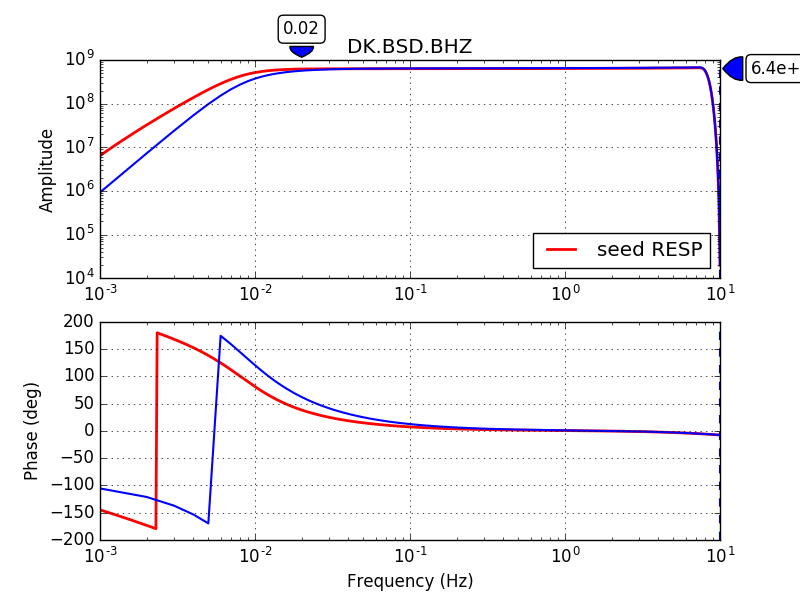
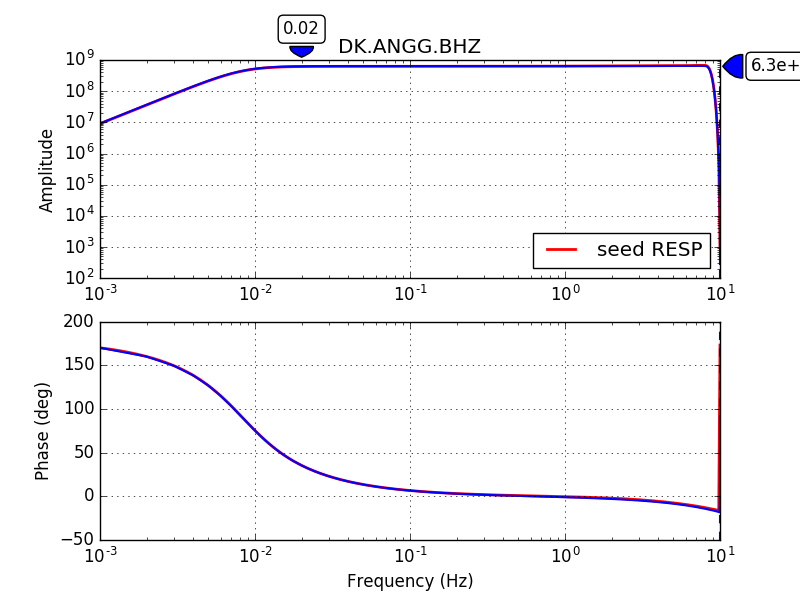
Station ANGG does not show any mismatch.
Permian
on 3 May 2018
Hmm- yea something is odd here - can you post the code you used to generate the figures? I don't really fully understand what is plotted there.
krischer
on 3 May 2018
from obspy import UTCDateTime, Stream, read_inventory
import matplotlib.pyplot as plt
import os, sys
import numpy as np
netw = 'DK'
stat = 'BSD'
chn = 'BHZ'
## try to request a RESP seed file for DK data
## see http://www.eas.slu.edu/eqc/eqc_cps/TUTORIAL/RESPONSE/index.html for a tutorial
## using gsac and evalsresp for removing the instrument response
from obspy.clients.iris import Client
client = Client()
dt = UTCDateTime("2015-05-05T06:30:00.000")
data = client.resp(netw, stat, "*", chn, dt, filename='RESP.%s.%s.%s.seed' % (netw, stat, chn))
## creates AMP.xxx and PHASE.xxx response files using rdseed package
os.system("evalresp %s %s 2015 125 0.001 10 500 -u 'vel' -f RESP.%s.%s.%s.seed" % (stat, chn, netw, stat, chn))
## load amplitude response from seed RESP file
amp_resp = np.genfromtxt('AMP.%s.%s..%s' % (netw, stat, chn))
phs_resp = np.genfromtxt('PHASE.%s.%s..%s' % (netw, stat, chn))
## create figure with two axis to overlay with the obspy response plot
fig = plt.figure()
ax1 = fig.add_subplot(211)
ax2 = fig.add_subplot(212, sharex=ax1)
## plot the seed RESP amplitude response
ax1.loglog(amp_resp[:,0], amp_resp[:,1], 'r', linewidth=2, label='seed RESP')
ax1.grid()
ax1.set_ylabel('Amplitude')
ax2.grid()
ax2.semilogx(phs_resp[:,0], phs_resp[:,1], 'r', linewidth=2, label='seed RESP')
ax2.set_ylabel('Phase (deg)')
ax2.set_xlabel('Frequency (Hz)')
ax1.legend(loc=4)
ax1.set_title('%s.%s.%s' % (netw, stat, chn))
## request the response from GFZ as inventory file
from obspy.clients.fdsn import Client
client = Client("GFZ")
pre_filter = [0.005, 0.008, 2, 4]
t0 = UTCDateTime(2015,5,5,10,0,0)
t1 = UTCDateTime(2015,5,5,11,0,0)
bulk = [(netw, stat, "*", chn, t0, t1)]
inv = client.get_stations_bulk(bulk, level="response")
for net in inv:
for sta in net:
for cha in sta:
cha.response.response_stages[8].decimation_factor = 1
cha.response.response_stages[8].decimation_delay = 0.0
cha.response.response_stages[8].decimation_correction = 0.0
cha.response.response_stages[8].decimation_offset = 0
cha.response.response_stages[8].decimation_input_sample_rate = cha.response.response_stages[9].decimation_input_sample_rate
## plot the obspy inventory response for each channel
## see https://docs.obspy.org/_modules/obspy/core/inventory/response.html#Response.plot
cha.plot(min_freq=0.001, output="VEL", plot_degrees=True, label='obspy', axes=(ax1, ax2))
st = Stream()
st += client.get_waveforms(netw, stat, "*", "BHZ", t0, t1)
st.attach_response(inv)
st.remove_response(output='VEL', pre_filt=pre_filter, taper_fraction=0.005)
OMG - after a 2 hours debug session I was about to doubt my sanity. Turns out that the StationXML and the RESP files are actually not identical. I'm not sure which one is at fault here, but the RESP file has an extra 9 after the comma, e.g. +9.99937E-01 instead of <Real>0.99937</Real> in XML file...
I'm not sure how anyone is supposed to notice that. And I am honestly a bit surprised how incredibly sensitive this particular response is to changes in the poles. Maybe one should try to find a more stable set of paz for this stage if possible?
@Permian Will you contact the GFZ and tell them about it?
Applying this diff to the RESP files results in equal response curves:
696c696
< B053F15-18     0  +9.99937E-01  +0.00000E+00  +0.00000E+00  +0.00000E+00
---
> B053F15-18     0  +9.9937E-01  +0.00000E+00  +0.00000E+00  +0.00000E+00
930c930
OMG - after a 2 hours debug session I was about to doubt my sanity. Turns out that the StationXML and the RESP files are actually not identical. I'm not sure which one is at fault here, but the RESP file has an extra 9 after the comma, e.g. +9.99937E-01 instead of
0.99937 in XML file...
Blasted! I burned some time on this too, and came to the same discrepancy.
However, I think that the error is in the XML for station BSD. Unless it is a tailored response, the xml matches up better with (EDIT: ANGG is a Q330, not a HDR24) the NRL:
nexus lines are nominal from the NRL
altered is the xml downloaded per your method with the decimation fields added
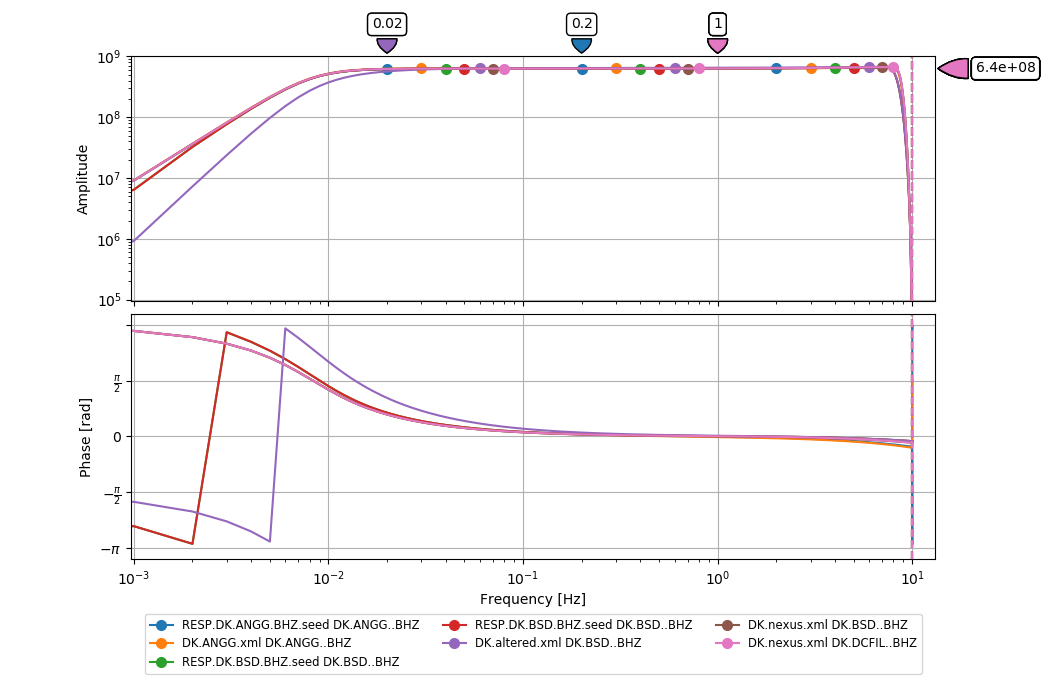
 dsentinel
on 3 May 2018
dsentinel
on 3 May 2018
Yes, this is a significant discrepancy in the long-period range.
I have contacted the GEOFON guys.
Permian
on 4 May 2018
Thanks everyone! And especially @dsentinel for your detective work. Together with #2128 I consider this issue resolved from our side.
krischer
on 4 May 2018
I found a similar mistake in a station in Africa from IRIS. AF.MONG
 gaoyajian
on 14 Sep 2018
gaoyajian
on 14 Sep 2018
I found a similar mistake in a station in Africa from IRIS. AF.MONG
Report it to IRIS, they will know who to contact about it.
megies
on 14 Sep 2018
I found a similar mistake in a station in Africa from IRIS. AF.MONG
Report it to IRIS, they will know who to contact about it.
yes
gaoyajian
on 14 Sep 2018
Related issues
 d-chambers
·
6Comments
d-chambers
·
6Comments
 FadelI
·
3Comments
FadelI
·
3Comments
 bgoutorbe
·
10Comments
bgoutorbe
·
10Comments
 richardDreo
·
8Comments
richardDreo
·
8Comments
 frodo4fingers
·
6Comments
frodo4fingers
·
6Comments
Most helpful comment
OMG - after a 2 hours debug session I was about to doubt my sanity. Turns out that the StationXML and the RESP files are actually not identical. I'm not sure which one is at fault here, but the RESP file has an extra 9 after the comma, e.g.
+9.99937E-01instead of<Real>0.99937</Real>in XML file...I'm not sure how anyone is supposed to notice that. And I am honestly a bit surprised how incredibly sensitive this particular response is to changes in the poles. Maybe one should try to find a more stable set of paz for this stage if possible?
@Permian Will you contact the GFZ and tell them about it?
Applying this diff to the RESP files results in equal response curves: