Nswag: Does not support API key authentication
Download NSwagStudio (latest stable)
Put in this Swagger 2.0 specification:
https://api.cloudmersive.com/convert/docs/v1/swagger
- Note that it does require API Keys to work:
https://api.cloudmersive.com/convert/docs/index
Expected: Outputs C# client that will work with API Key
Observed: Does not contain any code for API keys
 Cloudmersive
All 8 comments
Any update on this?
Cloudmersive
on 13 May 2018
Because authentication differs in many scenarios, you have to implement this yourself... e.g. use the InjectHttpClient option and set the api key header on the injected http client or use a base class (ClientBaseClass) and set the header in the CreateHttpRequestMessageAsync method (UseHttpRequestMessageCreationMethod) and which is retrieved by a config object (ConfigurationClass)
 RicoSuter
on 14 May 2018
RicoSuter
on 14 May 2018
But the whole point of Swagger is to standardize how this works - specifically API Key Authentication. It is completely standardized.
Cloudmersive
on 20 May 2018
I would also love to see some authentication code generation support. Not for every possible case, but API key and basic authentication would be very nice.
I have played around with the code and I’m close get something working. Would an PR be accepted if I completed this? I will need some help to get the necessary security properties available in the liquid templates. I have done parts of this, but it’s needs some improvement :-)
 pekspro
on 26 Jan 2019
pekspro
on 26 Jan 2019
Its already quite easy to implement that with a ConfigurationClass, BaseClass and an http message creation method on the base class... how would your generated code look like? Do you have a sample? It should be opt-in with a setting if we add that..
RicoSuter
on 26 Jan 2019
I totally agree this should be a setting. I have done that before, it was quite easy as a remember it :-)
If we have a crazy case where both apiKey and basic authentication is accepted like this:
  "apikeytest": {
    "type": "apiKey",
    "description": "TEST_DESCRIPTION",
    "name": "TEST_HEADER",
    "in": "header"
  },
  "basicauthtest": {
    "type": "http",
    "scheme": "basic",
    "in": "header"
  }
Then I would like to generate code like this:
    private string AuthenticationHeaderName = null;
    private string AuthenticationHeaderValue = null;

    public SetupAuthenticationWithApiKey(string apikey)
    {
        AuthenticationHeaderName = "TEST_HEADER";
        AuthenticationHeaderValue = apiKey;
    }

    public SetupAuthenticationWithBasicAuthentication(string username, string password)
    {
        AuthenticationHeaderName = "Authorization";
        AuthenticationHeaderValue = System.Convert.ToBase64String(System.Text.Encoding.GetEncoding("ISO-8859-1").GetBytes(username + ":" + password));
    }

    public ClearAuthentication()
    {
        AuthenticationHeaderName = null;
        AuthenticationHeaderValue = null;
    }

    private void AddAutentication(System.Net.Http.HttpRequestMessage request)
    {
        if(!string.IsNullOrWhitespace(AuthenticationHeaderName) && !string.IsNullOrWhitespace(AuthenticationHeaderValue))
        {
            request.Headers.Add(AuthenticationHeaderName, AuthenticationHeaderValue);
        }
    }
Also, in each method that is using some kind of authentication AddAutentication will be called just before PrepareRequest(client_, request_, urlBuilder_);.
I think that’s it. As I mentioned earlier, I need some advice how to expose some security settings to the Liquid-files. Accept from that it’s quite straightforward I think. Let me know what you think.
pekspro
on 31 Jan 2019
Can't you set a base class, enable UseHttpRequestMessageCreationMethod and do that in this just method in the base class (maybe also define a configuration class to inject configs etc.)?
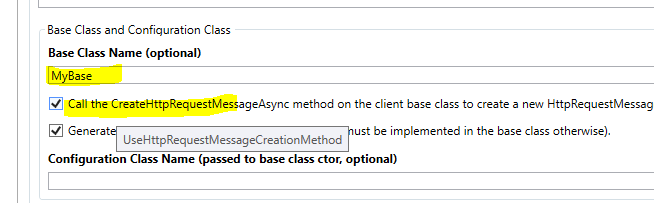
This whole auth code is always user specific and thus I'm a little hesitant to add it to NSwag directly...
RicoSuter
on 14 Feb 2019
Hi @RicoSuter, I agree about the authentication support, its well documented on swagger specification. i.e.
https://swagger.io/docs/specification/authentication/oauth2/
 yiyoMX
on 3 Jun 2019
yiyoMX
on 3 Jun 2019
Related issues
 RawsomeGH
·
4Comments
RawsomeGH
·
4Comments
 blackbaud-GavinNicol
·
3Comments
blackbaud-GavinNicol
·
3Comments
 Rui90
·
4Comments
Rui90
·
4Comments
 slimjack
·
3Comments
slimjack
·
3Comments
 p0wertiger
·
3Comments
p0wertiger
·
3Comments
Most helpful comment
But the whole point of Swagger is to standardize how this works - specifically API Key Authentication. It is completely standardized.