Nodemon: Child process not receiving SIGTERM
nodemon -v: 1.13.2node -v: 8.7.0 (nvm: 0.33.5)- Operating system/terminal environment: Ubuntu 16.04.3 / 4.4.0-104-generic / bash
- Command you ran: nodemon test.js
Hi,
thanks for your work on nodemon!
Expected behaviour
The child process should receive SIGTERM and/or trigger the process.on exit event. Code that relies on these events is not triggered otherwise - e.g. killing child processes that it spawned itself.
Actual behaviour
Does not send SIGTERM or triggers process on exit event
Steps to reproduce
Create file test.js
process.on('SIGTERM', () => {
  console.log('SIGTERM');
});
process.on('exit', () => {
  console.log('exit');
});

function loop () {
  console.log('looping');
  setTimeout(loop, 1000);
}
loop();
Run it nodemon test.js
Make a change in the file
node: v8.7.0
nodemon: 1.13.2
command: /home/user/.nvm/versions/node/v8.7.0/bin/node /home/user/.nvm/versions/node/v8.7.0/bin/nodemon test.js --dump
cwd: /home/user/Code/test
OS: linux x64
--------------
{ run: false,
  system: { cwd: '/home/user/Code/test' },
  required: false,
  dirs: [ '/home/user/Code/test' ],
  timeout: 1000,
  options:
   { dump: true,
     ignore:
      [ '.git',
        '.nyc_output',
        '.sass-cache',
        'bower_components',
        'coverage',
        'node_modules',
        re: /\.git|\.nyc_output|\.sass\-cache|bower_components|coverage|node_modules/ ],
     watch: [ '*.*', re: /.*\..*/ ],
     ignoreRoot:
      [ '.git',
        '.nyc_output',
        '.sass-cache',
        'bower_components',
        'coverage',
        'node_modules' ],
     restartable: 'rs',
     colours: true,
     execMap: { py: 'python', rb: 'ruby' },
     stdin: true,
     runOnChangeOnly: false,
     verbose: false,
     signal: 'SIGUSR2',
     stdout: true,
     watchOptions: {},
     execOptions:
      { script: 'test.js',
        exec: 'node',
        args: [],
        scriptPosition: 0,
        nodeArgs: undefined,
        execArgs: [],
        ext: 'js,json',
        env: {} },
     monitor:
      [ '*.*',
        '!.git',
        '!.nyc_output',
        '!.sass-cache',
        '!bower_components',
        '!coverage',
        '!node_modules' ] },
  load: [Function],
  reset: [Function: reset],
  lastStarted: 0,
  loaded: [],
  watchInterval: null,
  signal: 'SIGUSR2',
  command:
   { raw: { executable: 'node', args: [ 'test.js' ] },
     string: 'node test.js' } }
One workaround for cleaning up child processes of the child that get not killed is using the nodemon.json (see full doc with nodemon --help config)
{
  "events": {
    "restart": "pkill -f partial/path/to/child/of/child"
  }
}
 stoically
All 9 comments
After a bit of digging I found that it's not possible to trigger the process on exit event using a signal.
Also, it's possible to configure nodemon to send the SIGTERM signal by putting
{
  "signal": "SIGTERM"
}
into the nodemon.json - although that won't help with code that relies on the process on exit event, obviously.
I would suggest to send SIGTERM by default too though. Unless I miss something that would make that a problem?
stoically
on 16 Dec 2017
I ran test.js using node, and ctrl+c to stop it, and there's also no exit notification:
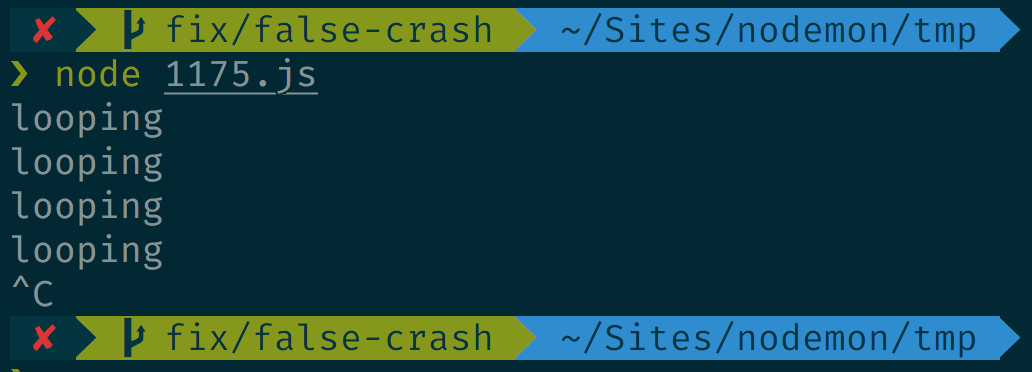
Nodemon uses a signal that's least used to kill the child process, but you if you want to use SIGTERM you can (either through config or the CLI). I don't think this is a bug, and I think you've got a solution for what you're after. 👍
 remy
on 16 Dec 2017
remy
on 16 Dec 2017
Just to clarify what's actually the problem: under some circumstances child processes stay alive after the "file change restart" triggers. The child processes die when doing a ctrl+c tho. I couldn't reproduce with a simple nodejs child - in this case it works just fine, but in case you want to reproduce it yourself:
Disclaimer: granax downloads and starts Tor
npm install granax
test.js:
const granax = require('granax');
const tor = granax();
tor.process.stdout.once('data', (data) => {
  console.log(data.toString());
})

const { exec } = require('child_process');
exec('ps aux|grep granax', (error, stdout, stderr) => {
  console.log(stdout);
});

function loop () {
  console.log('looping');
  setTimeout(loop, 5000);
}
loop();
Now if you make a changes in the test.js, you'll see the tor processes stacking up. If you hit ctrl+c it kills all processes.
stoically
on 16 Dec 2017
Can you retest with the latest nodemon release - there's been a slew of recent fixes I've released, and one in particular is for linux environments.
remy
on 16 Dec 2017
I've tested with the latest 1.13.3
stoically
on 16 Dec 2017
Okay, so I can see what's going on here.
- Nodemon spawns a process (node) which is restarted when code changes.
- This particular example code spawns a new process under the node process (tor.real)
- When a file change is detected, nodemon sends a SIGUSR2 to the full process group (individually)
- USR2 is normally good enough to kill a process, but tor.real will ignore the signal, so it remains running
Here's the tor.real process ignoring the SIGUSR2 signal (in all likelihood, it's using the signal for something else):
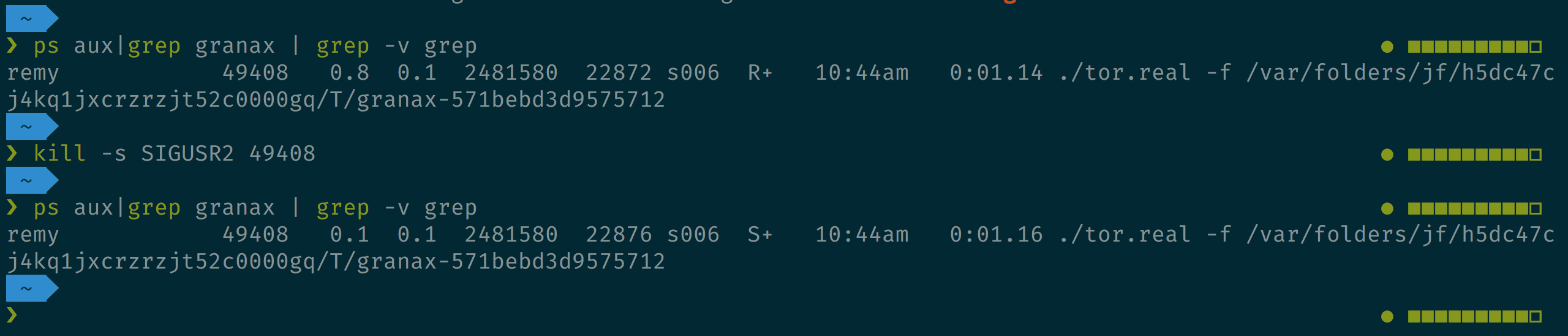
Solution: run with nodemon --signal SIGTERM (or SIGINT seems also work for tor.real).
The reason nodemon uses SIGUSR2 is so that the nodemon logic _knows_ that the restart was triggered by nodemon. Honestly, I can't remember exactly what it's SIGUSR2 instead of SIGTERM - the project is well over 7 years old so I'm a little hazy over the original decision.
I'll add this to the docs either way.
remy
on 16 Dec 2017
Thanks for looking into it. Can confirm that it works with node --signal SIGTERM, cool!
Just for my understanding: is there a reason you don't send SIGTERM per default to the childs? After a little research it seems that USR2 is defined as "user defined signal" - so it could mean everything depending on the process (e.g. unicorn reexecutes the binary). SIGTERM/INT on the other hand is defined as quickly shutting down the process - wouldn't it make sense to make that the default?
stoically
on 16 Dec 2017
Yeah, like I said, there was a reason, but it was such a long time ago the thought through justification escapes me.
I'd like to look at this more, but I don't want to dig in too deep this weekend (should be with my kids). I have a gut feeling that a SIGTERM could be worth swapping to, but I've not thought through the full impact.
remy
on 16 Dec 2017
Alright, yeah, somehow I missed the part explaining the why, sorry. Thanks for your time so far and a nice weekend to you and your kids! :)
stoically
on 16 Dec 2017
Related issues
 endquote
·
4Comments
endquote
·
4Comments
 robboerman
·
3Comments
robboerman
·
3Comments
 ehmicky
·
4Comments
remy
·
5Comments
ehmicky
·
4Comments
remy
·
5Comments
 dimsmol
·
4Comments
dimsmol
·
4Comments
Most helpful comment
Okay, so I can see what's going on here.
Here's the tor.real process ignoring the SIGUSR2 signal (in all likelihood, it's using the signal for something else):
Solution: run with
nodemon --signal SIGTERM(orSIGINTseems also work for tor.real).The reason nodemon uses SIGUSR2 is so that the nodemon logic _knows_ that the restart was triggered by nodemon. Honestly, I can't remember exactly what it's SIGUSR2 instead of SIGTERM - the project is well over 7 years old so I'm a little hazy over the original decision.
I'll add this to the docs either way.