Node: url.parse() port instead of hostname
- Version: 6.9.2
- Platform: macOS Sierra
- Subsystem: url module
url.parse('localhost:8081').hostname
outputs:
"8081"
 onury
onury
All 18 comments
Hi @onury ,
i think that it's not properly a bug because you have to pass the protocol on input at parse function
url.parse('http://localhost:8081').hostname
The url module follow the RFC 3986, RFC 1808, RFC 2396 and in parse function the first element is considered as protocol part of the url see: https://github.com/nodejs/node/blob/master/lib/url.js#L206
So maybe what we need is a check if the url is right to be parsed or not.
 NickNaso
on 16 Jun 2017
NickNaso
on 16 Jun 2017
@NickNaso I took a look on the implementation of the function, and url.parse will break the first part before a ':' as a protocol:
url.parse('a:b').protocol
returns
'a:'
So it's not checking for a pattern like 'http://' or any of the like, as it expects a protocol to be always present.
 aaneto
on 16 Jun 2017
aaneto
on 16 Jun 2017
@aaneto The protocol doesn't have to be http, and in fact even malformed URLs without the double slash like http:localhost:8081 are allowed by browsers, etc.
Users are generally encouraged to use the newer and more standard-compliant WHATWG URL parser that's in Node.js v7.0.0+, which will parse the string in the following fashion:
> new url.URL('localhost:8081')
URL {
  href: 'localhost:8081',
  origin: 'null',
  protocol: 'localhost:',
  username: '',
  password: '',
  host: '',
  hostname: '',
  port: '',
  pathname: '8081',
  search: '',
  searchParams: URLSearchParams {},
  hash: '' }
Closing, as the logic behind url.parse's choice has been explained and a better alternative is posed.
 TimothyGu
on 16 Jun 2017
TimothyGu
on 16 Jun 2017
Then you cannot trust url.parse() unless it's 100% strict URL.
You should always validate the URL passed to url.parse() before parsing. And fill in the missing protocol..
- RFC standards may require the protocol portion but conventions and browsers do not.
These are all considered valid:localhost:8081,www.foo.com,domain.com/path, etc.. url.parse()shouldn't check for:but://for protocol portion.- also a URL starting with
//should returnnullfor protocol. - it's better that it doesn't force existing valid protocols such as
http,ftp..
It should allow any psuedo protocol. i.e. this is valid:twitter://
url.parse('cannot.trust/url')
{"protocol":"cannot.trust:","slashes":null,"auth":null,"host":"80","port":null,"hostname":"80","hash":null,"search":null,"query":null,"pathname":"/url/parse","path":"/url/parse","href":"cannot.trust:80/url/parse"}
host and hostname are both parsed as 80 👍
protocol is considered cannot.trust but href is cannot.trust:80/url/parse so it puts port after protocol... but then again port is null.
This forces me to write my own parser ..
onury
on 16 Jun 2017
You should always validate the URL passed to
url.parse()before parsing. And fill in missing the missing protocol..
RFC standards may require the protocol portion but conventions and browsers do not.
These are all considered valid:localhost:8081,www.foo.com,domain.com/path, etc..
Browsers are different, in that they have a "base URL" (specifically, the URL of the current document) to fall back on. E.g. when a browser sees domain.com/path in the href attribute of an a element, given the current document uses https scheme, it automatically uses the base URL's scheme https; and if it is http, it uses http instead.
Node.js is different. There isn't a document.baseURI for Node.js, and as such we force the user to supply their own base through either url.resolve or new URL(input, base).
(And also, try using <a href="localhost:8080">link</a> in a browser. It will not go to http://localhost:8080/, but instead localhost:8080 where localhost is the scheme/protocol.)
url.parse()shouldn't check for:but://for protocol portion.
This would make it impossible to parse, among others, magnet links.
also a URL starting with
//should returnnullfor protocol.
We already do:
> url.parse('//foo/bar')
Url {
  protocol: null,
  slashes: null,
  auth: null,
  host: null,
  port: null,
  hostname: null,
  hash: null,
  search: null,
  query: null,
  pathname: '//foo/bar',
  path: '//foo/bar',
  href: '//foo/bar' }
it's better that it doesn't force existing valid protocols such as
http,ftp..
It should allow any psuedo protocol. i.e. this is valid:twitter://
We already support non-standard protocol in both parsers.
> url.parse('twitter://')
Url {
  protocol: 'twitter:',
  slashes: true,
  auth: null,
  host: '',
  port: null,
  hostname: '',
  hash: null,
  search: null,
  query: null,
  pathname: null,
  path: null,
  href: 'twitter://' }
> new url.URL('twitter://')
URL {
  href: 'twitter://',
  origin: 'null',
  protocol: 'twitter:',
  username: '',
  password: '',
  host: '',
  hostname: '',
  port: '',
  pathname: '',
  search: '',
  searchParams: URLSearchParams {},
  hash: '' }
(also reopening...)
TimothyGu
on 16 Jun 2017
Thanks. I was suggesting that it's good that it allows psuedo protocols.
For URLs like localhost:8081, when I say convention; it's when you enter this in an address bar of a browser. It does go to http://localhost:8081. So it doesn't consider localhost as the protocol. But I'm not suggesting that url.parse() should do the same. It shouldn't set http as default. But rather, parse it as null.
onury
on 16 Jun 2017
@onury Which version are you using? On v8.1.2 it does parse the protocol as null:
> url.parse('cannot.trust/url')
Url {
  protocol: null,
  slashes: null,
  auth: null,
  host: null,
  port: null,
  hostname: null,
  hash: null,
  search: null,
  query: null,
  pathname: 'cannot.trust/url',
  path: 'cannot.trust/url',
  href: 'cannot.trust/url' }
EDIT: so does v6.11.0 and v4.8.3
 joyeecheung
on 16 Jun 2017
joyeecheung
on 16 Jun 2017
Hi guys,
i tested url.parse('localhost:8081') over Node.js version 7.10.0 and 8.1.2 and the result is always the same:
> var p = url.parse('localhost:8081')
undefined
> p
Url {
  protocol: 'localhost:',
  slashes: null,
  auth: null,
  host: '8081',
  port: null,
  hostname: '8081',
  hash: null,
  search: null,
  query: null,
  pathname: null,
  path: null,
  href: 'localhost:8081' }
>
I try this specific case also on the browser with the same result in both Firefox and Chrome

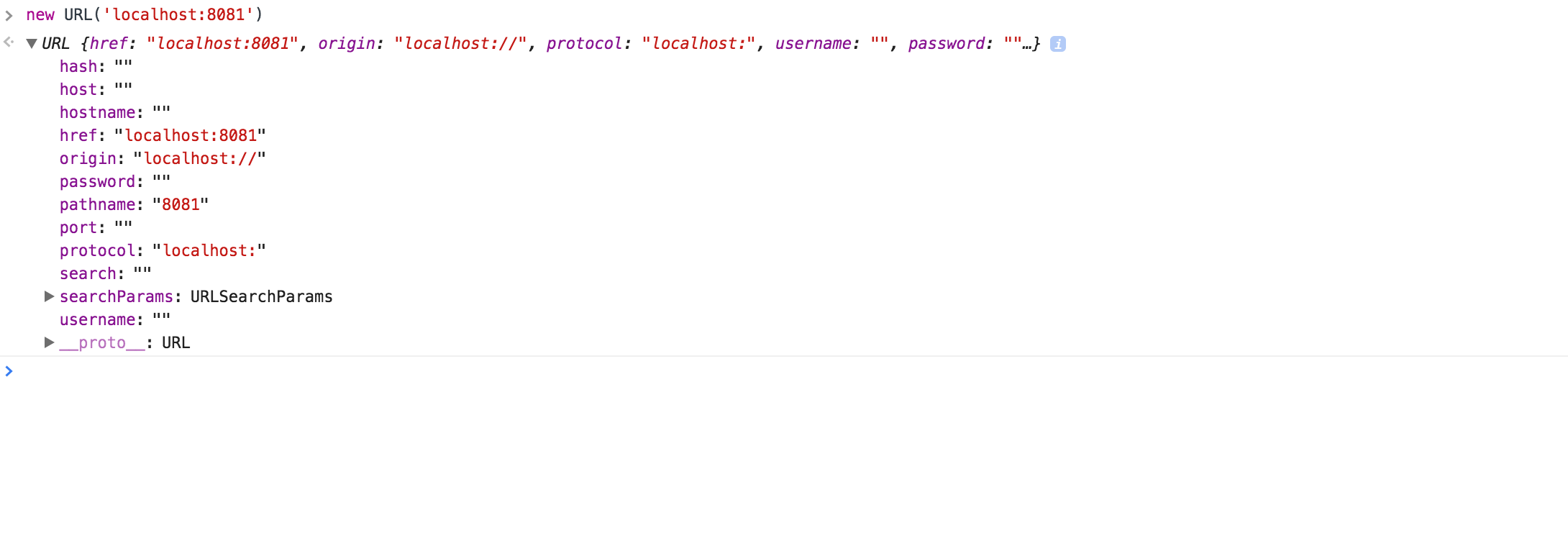
It's my opinion that the method parse should has only the responsability to parse the url and not to validate it.
NickNaso
on 16 Jun 2017
@joyeecheung v6.9.2
@NickNaso I agree, it shouldn't validate. but parse..
onury
on 16 Jun 2017
@NickNaso I agree, it shouldn't validate. but parse..
@onury Do you suggest it should be documented as a Note on "known behaviour"?
 refack
on 16 Jun 2017
refack
on 16 Jun 2017
@refack Documenting this should be good and avoid mistake and reinforce what parse really do
NickNaso
on 16 Jun 2017
@refack, @NickNaso,
At least...
But I'd insist this is not the correct behaviour.
It'd be more logical to determine if the string includes a protocol or not by simply checking for :// not :.
One argument above for this is that; URLs without the double slash like http:localhost:8081 are allowed by browsers. Well, localhost:8081 is also allowed and treated as http://localhost:8081 by browsers.
url.parse('http:localhost:8081') parses http: as protocol but hostname as null..
{"protocol":"http:","slashes":null,"auth":null,"host":null,"port":null,"hostname":null,"hash":null,"search":null,"query":null,"pathname":"localhost:8081","path":"localhost:8081","href":"http:localhost:8081"}
Conforming to RFCs but does it really? I believe protocol:hostname is not a valid format..
Which spec says path/name can come right after protocol?
url.parse() should know better.
onury
on 16 Jun 2017
@onury @NickNaso We have implemented WHATWG URL (URL in browsers) in Node.js, and url.parse() is more like a legacy API better left alone for compatibility reasons. If you do want the same kind of behavior as in the browsers, maybe just use new url.URL() instead? (although in this case I would consider the new URL() behavior rather than the type-in-the-address-bar behavior as "how browsers treat this URL").
Also the weird thing is...on my Mac:
> process.version
'v6.9.2'
> url.parse('cannot.trust/url')
Url {
  protocol: null,
  slashes: null,
  auth: null,
  host: null,
  port: null,
  hostname: null,
  hash: null,
  search: null,
  query: null,
  pathname: 'cannot.trust/url',
  path: 'cannot.trust/url',
  href: 'cannot.trust/url' }
@onury
Well,
localhost:8081is also allowed and treated ashttp://localhost:8081by browsers.
Only in address bars, which has a human audience, not a machine audience. Any pathways for URL parsing that has a machine audience -- including new URL and <a> -- parse localhost: as the protocol part.
TimothyGu
on 16 Jun 2017
I believe
protocol:hostnameis not a valid format..
Agreed, but protocol:pathname is valid. Which is exactly how url.parse interprets http:localhost:8081.
Which spec says path/name can come right after protocol?
https://tools.ietf.org/html/rfc3986#section-3
The hier-part production has four branches, three of which do not have //.
TimothyGu
on 16 Jun 2017
url.parse() is behaving correctly in this case. There is no bug here. localhost:8181 a syntactically valid URL string with localhost: as the protocol and 8181 as the path. If this intention is to parse as an http:// URL, then the http:// protocol needs to be specified explicitly: url.parse('http://localhost:8181'), otherwise, the url.parse() implementation will have no way of knowing what the user's intent is. Browsers can safely assume user intent and assume that the user meant http:// because of the nature of what a Browser does. The more generic url.parse() cannot make such assumptions, nor should it.
http:localhost:8181 is not a valid absolute URL string. It will be parsed as a relative URL, meaning that the localhost:8181 is assumed to be part of the path segment. However, because users have commonly made this mistake, the WHATWG URL standard has accounted for it and opted to be lenient.
The following each represent correct behavior per the relevant standards, even tho they differ in result. The difference is that new url.URL() conforms to the WHATWG standard, while url.parse() conforms to the IETF RFC.
> new url.URL('http:localhost:8181')
URL {
  href: 'http://localhost:8181/',
  origin: 'http://localhost:8181',
  protocol: 'http:',
  username: '',
  password: '',
  host: 'localhost:8181',
  hostname: 'localhost',
  port: '8181',
  pathname: '/',
  search: '',
  searchParams: URLSearchParams {},
  hash: '' }
> url.parse('http:localhost:8181')
Url {
  protocol: 'http:',
  slashes: null,
  auth: null,
  host: null,
  port: null,
  hostname: null,
  hash: null,
  search: null,
  query: null,
  pathname: 'localhost:8181',
  path: 'localhost:8181',
  href: 'http:localhost:8181' }
>
The following is also correct per each of the relevant standards:
> new url.URL('localhost:8181')
URL {
  href: 'localhost:8181',
  origin: 'null',
  protocol: 'localhost:',
  username: '',
  password: '',
  host: '',
  hostname: '',
  port: '',
  pathname: '8181',
  search: '',
  searchParams: URLSearchParams {},
  hash: '' }
> url.parse('localhost:8181')
Url {
  protocol: 'localhost:',
  slashes: null,
  auth: null,
  host: '8181',
  port: null,
  hostname: '8181',
  hash: null,
  search: null,
  query: null,
  pathname: null,
  path: null,
  href: 'localhost:8181' }
>
Even in the browser, when using the URL API, you will get exactly the same results as when using the WHATWG URL API in Node.js.
There is no bug here. I recommend closing.
 jasnell
on 16 Jun 2017
jasnell
on 16 Jun 2017
@TimothyGu, @jasnell, @joyeecheung
Fair enough.. Thanks.
onury
on 16 Jun 2017
Very frustrating and confusing behavior. You can't even parse elementary host:port URL. Seems the simplest replacement for this purpose is new URL('nodejs.org:1234', 'foo://'); It will work with protocol-including URLs as well: new URL('bar://nodejs.org:1234', 'foo://');
URL {
  href: 'bar://nodejs.org:1234',
  origin: 'null',
  protocol: 'bar:',
  username: '',
  password: '',
  host: 'nodejs.org:1234',
  hostname: 'nodejs.org',
  port: '1234',
  pathname: '',
  search: '',
  searchParams: URLSearchParams {},
  hash: '' }
 Antonius-S
on 5 Jul 2019
Antonius-S
on 5 Jul 2019
Related issues
 fanjunzhi
·
3Comments
fanjunzhi
·
3Comments
 willnwhite
·
3Comments
willnwhite
·
3Comments
 addaleax
·
3Comments
addaleax
·
3Comments
 stevenvachon
·
3Comments
stevenvachon
·
3Comments
 jmichae3
·
3Comments
jmichae3
·
3Comments
Most helpful comment
Then you cannot trust
url.parse()unless it's 100% strict URL.You should always validate the URL passed to
url.parse()before parsing. And fill in the missing protocol..These are all considered valid:
localhost:8081,www.foo.com,domain.com/path, etc..url.parse()shouldn't check for:but://for protocol portion.//should returnnullfor protocol.http,ftp..It should allow any psuedo protocol. i.e. this is valid:
twitter://hostandhostnameare both parsed as80👍protocolis consideredcannot.trustbuthrefiscannot.trust:80/url/parseso it puts port after protocol... but then againportisnull.This forces me to write my own parser ..