Nim: [strformat] Update the documentation to state that the precision field works only for floats
The strformat documentation says (emphasis mine):
The 'precision' is a decimal number indicating how many digits should be displayed after the decimal point in a floating point conversion. For non-numeric types the field indicates the maximum field size - in other words, how many characters will be used from the field content. The precision is ignored for integer conversions.
The _.precision_ field seems to do nothing for strings as seen in this example:
import strformat
let str = "abc"
echo fmt">7.1 :: {str:>7.1}"
echo fmt" 7.1 :: {str:7.1}"
echo fmt" 7.2 :: {str:7.2}"
echo fmt" 7.3 :: {str:7.3}"
Output:
>7.1 ::     abc
 7.1 :: abc
 7.2 :: abc
 7.3 :: abc
I think that the implementation behavior is the Right Thing(TM), which @data-man would also agree. So can be documentation be fixed to mention that the .precision is only effective for floats?
PS: Thank you @skilchen for quickly coming up with that PR. Hopefully doing this doc change would be much simpler.
 kaushalmodi
All 13 comments
I don't agree with @data-man. It is useful to be able to limit the number of characters of a string in the formatted output e.g. to produce columns of fixed size in a simple textual report. IMHO the documentation is better than the current implementation. So i make another attempt to fix the implementation in #7941
 skilchen
on 1 Jun 2018
skilchen
on 1 Jun 2018
It is useful to be able to limit the number of characters of a string in the formatted output e.g. to produce columns of fixed size in a simple textual report.
Hmm, that's a valid point, not that I have needed to do that, but it's a valid use case. One might say that you could slice a string as foo[0 .. 7]. But letting the fmt formatter deal with such table prettification cases looks cleaner.
kaushalmodi
on 1 Jun 2018
I think that precision for strings should raise an exception.
Or for strings should be this documentation:
[[fill]align][sign][#][0][minimumwidth][.maximumwidth][type]
Maybe another symbol instead of a dot.
 data-man
on 1 Jun 2018
data-man
on 1 Jun 2018
Again: i disagree with @data-man.
In strformat Nim clearly tries to mimic python's f-strings. So it is desirable to have similar behavior.
In all printf-inspired string-formatting implementations (and there are really many of them) the precision field for strings always means the maximum number of characters to output. And afaik all of them use the dot to separate precision from width. I don't understand why one should raise an exception in this case. IMHO your proposed documentation is wrong (7.3s means a maximum of 3 characters within a field of 7 characters) and the relevant current documentation is clear enough:
The 'precision' is a decimal number indicating how many digits should be displayed
after the decimal point in a floating point conversion. For non-numeric types the
field indicates the maximum field size - in other words, how many characters will
be used from the field content. The precision is ignored for integer conversions.
Btw. except in the case of the g conversion the precision field has always the meaning of "number of digits/characters" and is not related to the pretty sophisticated concepts of precision or significance as used in engineering disciplines.
From an evolutionary point of view, the printf-inspiration is the winner in programming language implementations (hopefully avoiding the dangers of format string attacks). Probably only very few people do miss something like common-lisp's incredibly powerful format. Although it would be a nice exercise for the lovers of metaprogramming, to try to reimplement common-lisp's format function and loop macro in Nim. However a more useful use of available spare time for people with talents in metaprogramming would be to copy elixir's excellent unicode support to Nim. But i digress ...
skilchen
on 2 Jun 2018
This issue can be closed after #7941 has been merged.
Thanks to @Varriount for taking care of my PR's!
skilchen
on 5 Jun 2018
Thank you!
For future, you can have an issue auto-close on PR merge if you have a string like "Fixes URL_OF_THE_ISSUE" in the commit message.
"Fixes #ISSUE_NUMBER" also works, but that makes accessing the issue thread from terminal i.e. not browser a pain.
kaushalmodi
on 5 Jun 2018
"Fixes #ISSUE_NUMBER" also works, but that makes accessing the issue thread from terminal i.e. not browser a pain.
We always use #ISSUE_NUMBER and I don't know a terminal that cannot deal with '#'. (Nor do I want to know.)
 Araq
on 6 Jun 2018
Araq
on 6 Jun 2018
I don't know a terminal that cannot deal with '#'
I meant to say that if you are in a terminal (not a browser), you need to type the whole path to the issue manually. If the entire link is in the commit message, you can copy/paste it in the browser.
The concern is not about a terminal "handling" a # or not.
kaushalmodi
on 6 Jun 2018
Putting the full issue link also helps if for whatever reason this repo is moved to a non-GitHub repo.. the "#ISSUE_NUMBER" won't work there.. you are just handcuffing yourself more with GitHub by using those shortcuts..
kaushalmodi
on 6 Jun 2018
@kaushalmodi but what's wrong with this? It doesn't make sense to make "#ISSUE_NUMBER" work on non-GitHub repo because no one is planning to switch from GitHub anytime soon.
 Yardanico
on 6 Jun 2018
Yardanico
on 6 Jun 2018
@Yardanico The "switching from Github" was a side note. The main point about accessibility from a non-browser env still stands.
I access all git repos (github/lab/savannah/etc) from my editor (Emacs/Magit).. it looks like this:
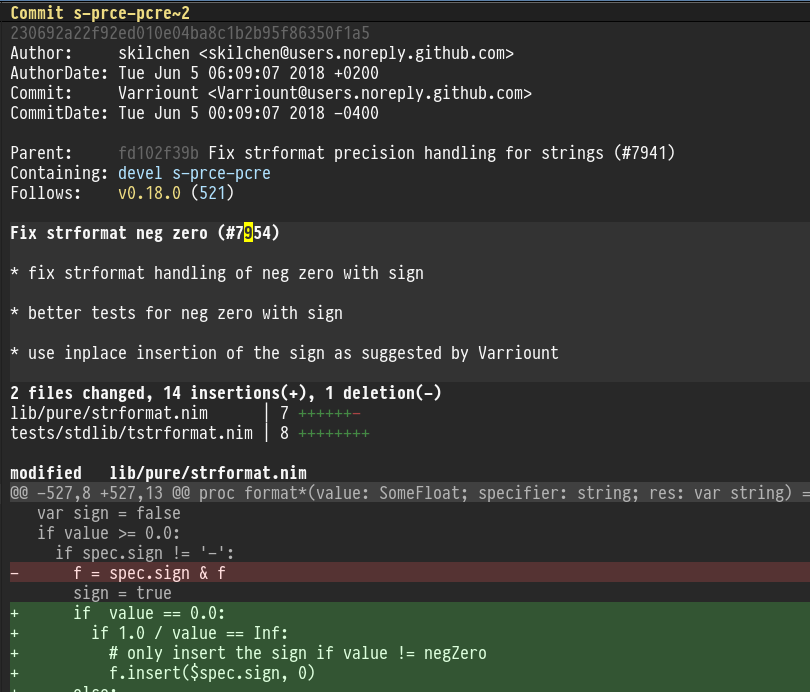
It would look the same even if you were not using Emacs, and were looking at git logs in the terminal (as Magit is just a wrapper around CLI git).
If the #7954 in that screenshot were a URL, I could have quickly jumped to that URL in my browser (Emacs can detect URL under point). As it is just "#number", I need to switch to a browser, navigate to the issues for Nim, and type that number.
So in summary, this is just a convenience request for us terminal users who don't always access repos via github.com in a browser.
kaushalmodi
on 6 Jun 2018
Well, maybe it should be another way - magit should implement support for these URLs? :)
Yardanico
on 6 Jun 2018
The above applies to Vim/terminal users too (I just happen to use Magit).
That said, I might just add little Elisp to my config to infer the issue URL from "#NNNN". :)
kaushalmodi
on 6 Jun 2018
Related issues
 alaviss
·
3Comments
alaviss
·
3Comments
 Vindaar
·
3Comments
Vindaar
·
3Comments
 teroz
·
3Comments
teroz
·
3Comments
 hlaaftana
·
3Comments
hlaaftana
·
3Comments
 timotheecour
·
3Comments
timotheecour
·
3Comments
Most helpful comment
Again: i disagree with @data-man.
In strformat Nim clearly tries to mimic python's f-strings. So it is desirable to have similar behavior.
In all printf-inspired string-formatting implementations (and there are really many of them) the precision field for strings always means the maximum number of characters to output. And afaik all of them use the dot to separate precision from width. I don't understand why one should raise an exception in this case. IMHO your proposed documentation is wrong (
7.3smeans a maximum of 3 characters within a field of 7 characters) and the relevant current documentation is clear enough:Btw. except in the case of the
gconversion the precision field has always the meaning of "number of digits/characters" and is not related to the pretty sophisticated concepts ofprecisionorsignificanceas used in engineering disciplines.From an evolutionary point of view, the printf-inspiration is the winner in programming language implementations (hopefully avoiding the dangers of format string attacks). Probably only very few people do miss something like common-lisp's incredibly powerful format. Although it would be a nice exercise for the lovers of metaprogramming, to try to reimplement common-lisp's format function and loop macro in Nim. However a more useful use of available spare time for people with talents in metaprogramming would be to copy elixir's excellent unicode support to Nim. But i digress ...