Nextjs-auth0: The code quality of the examples is low
Describe the problem you'd like to have solved
There's IMO a number of flaws in the examples:
- It's possible to accidentally use the global user from 'fetchUser' so that you log in others inadvertently (API2)
- You're printing internal errors on failure
- You use the error handler to set the status code, when IRL the status code might already have been set by the auth0 lib; causing an exception that crashes the server because headers already have been sent
- The components' files are not properly capitalised (e.g.
Layout.jsx) and it would be nice, had they been TypeScript, and it ought to bewithAuth.jsxnotwith-auth.jsx(niggles only) - E.g.
login-redirect.jsxonly redirects client-side, not server-side, potentially breaking the back button - In e.g.
with-auth.jsxyou do aif (!ctx.req) {instead of the more commonif (typeof window !== 'undefined') {— because this is basically just a check if we're running in the browser, so it should clearly be written as such - In
with-authyou overwrite any/all getInitialProp values that pages might have - It's not a well written HoC; instead of returning
div > InnerComponent, it should return a wrapper around what it received — and Layout should absolutely not require you to pass two generic propertiesloadinganduser - You should split up
user.jsinto its different parts - NextJS now includes a
fetchglobal, so you can remove theisomorphic-unfetchimport - Never compare to
undefinedin JS, since it's a valid variable name; souserState === undefinedis buggy and should betypeof userState === 'undefined' - The exported
UserProvideris in fact NOT a user provider; it's some sort of wrapper around it - You have extra
isMountedchecks when you don't need to - There's no way to force a user refresh; once set globally in the app, it's there forever
- The pattern with
import config from './config'is just strange and completely needless since the indirection doesn't add expressive power
Describe the ideal solution
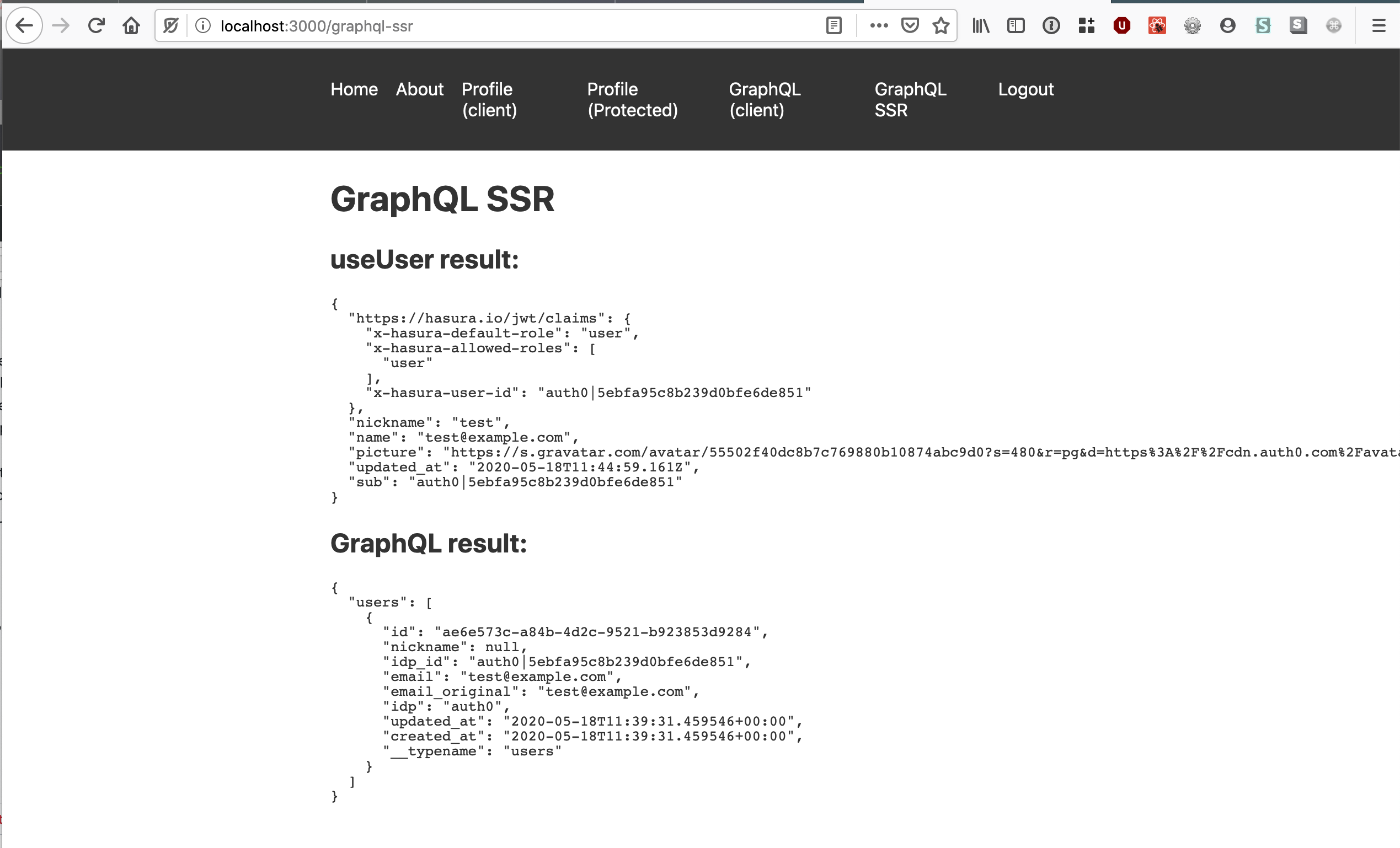
Fixing all the above. I've done it for now, I can file a PR; but that includes TypeScript typings for everything; looks like this:
Alternatives and current work-arounds
There are some not-so-nice bugs in there.
Question
Would you accept a PR that fixes this but turns it into TypeScript?
 haf
haf
All 7 comments
I would also like to add, that by adding all environment variables to the next.config.js they will get included in the client bundle, potentially exposing critical information.
Environment variables only needed server-side do not (and should not) need to be included in next.config.js
 BjoernRave
on 18 May 2020
BjoernRave
on 18 May 2020
Additional point: Due to restrictions on the number of lambdas when next is hosted on Vercel
The four auth0 apis could be collapsed into one relative path file such as: api/auth/[...path].tsx, with path switching built into the one api file. Turning 4 lambdas into 1, which might help smaller projects keep under the limit on lambdas
- See: https://nextjs.org/docs/api-routes/dynamic-api-routes#catch-all-api-routes
 james-ff
on 18 May 2020
james-ff
on 18 May 2020
@BjoernRave Are you sure? https://nextjs.org/docs/api-reference/next.config.js/introduction says:
next.config.jsis a regular Node.js module, not a JSON file. It gets used by the Next.js server and build phases, and it's not included in the browser build.
Thie sample also seems to use next.config.js.
haf
on 18 May 2020
I believe in Next.js 9.4 the need to declare environment variables in next.config.js is removed (at least for browser accessible environment variables):
https://nextjs.org/blog/next-9-4#new-environment-variables-support
james-ff
on 18 May 2020
If you read the section in the blog of 9.4. it at least seems like having the env vars in next.config.js exposes them in the browser bundle: https://nextjs.org/blog/next-9-4#new-environment-variables-support
First, you can now prefix the environment variable with NEXT_PUBLIC_ to expose an environment variable to the browser. When that environment variable is used it will then be inlined into the browser JavaScript bundle.
You no longer have to add a next.config.js and add the env key to expose these variables.
BjoernRave
on 19 May 2020
@haf , it would be awesome if you could file a PR, im quite new to javascript world and learning by reading examples, would love to see your fixups :)
 MrShish
on 20 May 2020
MrShish
on 20 May 2020
Hi @haf, please check out the updated samples in the new v1.0.0-beta.0 release.
 Widcket
on 15 Jan 2021
Widcket
on 15 Jan 2021
Related issues
 RyanPayso13
·
4Comments
RyanPayso13
·
4Comments
 synoptase
·
6Comments
synoptase
·
6Comments
 jvorcak
·
4Comments
jvorcak
·
4Comments
 aorsten
·
6Comments
aorsten
·
6Comments
 lkbr
·
4Comments
lkbr
·
4Comments
Most helpful comment
I would also like to add, that by adding all environment variables to the
next.config.jsthey will get included in the client bundle, potentially exposing critical information.Environment variables only needed server-side do not (and should not) need to be included in
next.config.js