Next.js: Ability to not apply source maps to stack traces
Feature request
While applying the sourcemaps to stack traces may be useful in development, when you're trying to debug stack traces in production and re-applying the sourcemaps it does not work as they've been rewritten.
We track exceptions with Sentry and upload our application sourcemaps via their release management tool (mainly for server side sourcemaps). However, all the errors that reach the _error page have been rewritten, so we don't get the correct mappings. See below:
Without automatic sourcemaps / Original error (Expected 👍)
Stack traces point to our original bundle file line numbers and columns, sourcemap is then applied and source is shown correctly:

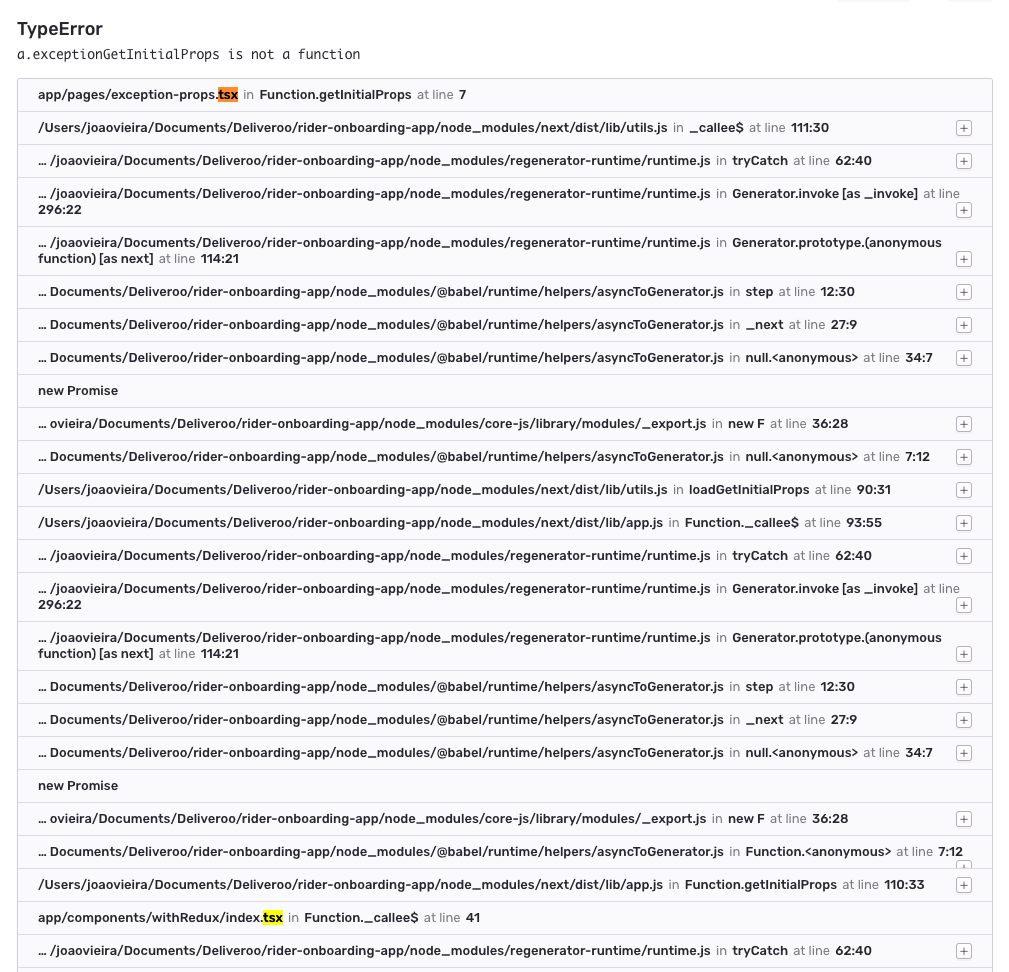
With automatic sourcemaps (Actual 👎)
Stack traces point to files that don't exist. Even though the line numbers map correctly to the original source, we don't have it anymore to find the problem.
Describe the solution you'd like
Could we disable this automatically in production builds (both client and server) or at least have an option to disable it? Or alternatively, apply the sourcemaps just before rendering in the ErrorDebug page, while sending the real error to Error.getInitialProps so we can capture it correctly. Also, when it bubbles to the window, having the real url would point to the file in the dev console source, instead of non-existent/malformed file path that 404s at the moment.
I've seen that the @canary version has rewritten all of this. Are sourcemaps still gonna be applied in the next major version?
Describe alternatives you've considered
Capturing the exception ourselves to get the original stack trace (e.g. wrapping hoisted getInitialProps in _app), but this does not capture all the possible exceptions and is not centralized.
Is there any alternative right now to get the original error?
 joaovieira
All 6 comments
We no longer rewrite stacktraces on latest canary, we only render rewritten stacktraces in dev with react-error-overlay.
 timneutkens
on 4 Aug 2018
timneutkens
on 4 Aug 2018
@joaovieira How do you upload application sourcemaps to Sentry so that Sentry will recognize .ts files?
 Utwo
on 29 Aug 2018
Utwo
on 29 Aug 2018
same question with u @Utwo
 pmjhonwang
on 13 Sep 2018
pmjhonwang
on 13 Sep 2018
@Utwo @pmjhonwang I simply use the Sentry CLI (https://docs.sentry.io/clients/javascript/sourcemaps/#upload-sourcemaps-with-cli), though there are other ways. Just make sure you're generating sourcemaps on your build (e.g. with withSourcemaps) and you may need to play with the CLI a bit to get the --url-prefix right.
joaovieira
on 14 Sep 2018
Thanks, I've solved it like this:
sentry-cli releases files ${TAG} upload-sourcemaps --url-prefix=~/_next/static  ./.next/static
sentry-cli releases files ${TAG} upload-sourcemaps \
   --url-prefix=~/_next/\"$(cat ./.next/BUILD_ID)\"/page \
   ./.next/server/bundles/pages"
Ah, now I understand where the problem was. Yeah, I next export everything into a folder (which I deploy to a CDN) and upload everything from there. This also runs from a docker container after deploy, so there's only one version of the app in there. No need to find BUILD_ID, etc.
joaovieira
on 14 Sep 2018
Related issues
 YarivGilad
·
3Comments
YarivGilad
·
3Comments
 ghost
·
3Comments
YarivGilad
·
3Comments
ghost
·
3Comments
YarivGilad
·
3Comments
 kenji4569
·
3Comments
kenji4569
·
3Comments
 jesselee34
·
3Comments
jesselee34
·
3Comments