Next.js: minimal next.js bundle 185kb gzipped
Bug report
Describe the bug
Thanks for the great library, we have been very glad to use it.
My bug report is that In the FAQ it says "a small next.js bundle is around 65kb gzipped". I've been doing some performance auditing today and I'm curious if I'm doing something wrong or not, because with React, ReactDOM and Next.js in a hello world app I'm seeing a 185kb main.js file.
Is there a minification step I need to include? Should the example be updated with this? main.js seems to be gzipped from looking at the headers and trying to compress it with compression and seeing no difference.
I'm using a custom server from the example to reproduce this, and typescript, although that shouldn't make a difference.
To Reproduce
Using the custom server typescript example:
yarn create next-app --example custom-server-typescript custom-server-typescript-app
npm run build
npm run start
navigate to localhost:3000 in Firefox, go to network tab and look at mainjs:

Expected behavior
Bundle size should be less than 65kb as this is a hello world app with an unrealistically small number of extra dependencies / code
Screenshots
System information
    "next": "^6.0.3",
    "react": "^16.4.0",
    "react-dom": "^16.4.0",
Thanks!
 realalexhomer
All 13 comments
Wanted to add that i just used npx create-next-app --example hello-world with the same result, so its not related to the custom server or any of the packages in the typescript example
realalexhomer
on 8 Jun 2018
Sounds like it's not a production bundle, you're seeing the size of HMR, sourcemaps, etc... My main.js goes from 1.2MB -> 305kB.
 NathanielHill
on 8 Jun 2018
NathanielHill
on 8 Jun 2018
Hmm thanks glad to hear that. So i guess my question would be how can i avoid getting that stuff in my build? I would have thought next build and next start would not include sourcemaps and HMR?
FWIW I set my env variables to NODE_ENV=production and still got the 185kb bundle
realalexhomer
on 8 Jun 2018
I suspect you are not doing this properly in server.js:
const next = require('next')
const dev = process.env.NODE_ENV !== 'production'
const app = next({ dir: '.', dev })
https://github.com/zeit/next.js/blob/a411b3550887e12145ea07bbcca60b170ca243fd/server/index.js#L30
NathanielHill
on 8 Jun 2018
it's "65kb gzziped". You need to enable compression on express server (or proxy server like nginx).
 rashidul0405
on 8 Jun 2018
rashidul0405
on 8 Jun 2018
So to clear this up. Next.js's server doesn't implement gzip, as a reverse proxy like nginx is usually better suited to handle gzip/brotli. As you can see here: https://hello-world-jfzvyxevhz.zeit.sh/ with brotli/gzip enabled by default on our now.sh hosting platform. the commons bundle is 62.3KB, the pages are 4.5KB and 1.6KB.
This is done without any modifications:
yarn create next-app --example hello-world hello-world-appcd hello-world-appnow
Also to clear up confusion between the commands:
nextornext dev- dev servernext build- build for productionnext start- start for production
When using a custom server the dev flag acts as a switch between development and production server.
 timneutkens
on 8 Jun 2018
timneutkens
on 8 Jun 2018
Fun fact, the faq item mentioning a 65kb bundle size was added here: https://github.com/zeit/next.js/pull/444 at the beginning of the project, and hasn't been updated since.
timneutkens
on 8 Jun 2018
Chiming in, for me a fresh install of next with only one line in a single page comes to 185kb uncompressed main bundle, compressing down to 61kb on L6 compression (default level for the compression() module).
Said bundle will take ~200ms to unzip, parse and execute on a low-end phone (~5 years old), at a cost of ~1.2 seconds to download for a total cost of 1.4 seconds. On desktop on an average connection the entirety of download, parse, execute will be <200ms.
FYI.
 codinronan
on 21 Jun 2018
codinronan
on 21 Jun 2018
@codinronan Wow, you're even more conservative than me if you use 50kb/s dialup as your mobile speed assumption! :rofl:
NathanielHill
on 22 Jun 2018
@NathanielHill hehe, that's for 2nd- and 3rd world connection speeds, which for one of my clients is relevant, for another it is not. Even still, for the US company, we aim for <200kb (minzipped) of JS to be delivered in the first page load. The main.js bundle blows up really, really fast.
Inside the US you can assume ~5mbps which gets you pretty good times on a mid-level, ~2 year old phone.
I'm starting a new project that WILL be aimed at people outside the US so I am cognizant that most of them are on much slower connections and am aiming at < 130kb initial JS. Still, Next is very competitive in the size of its initial bundle.
codinronan
on 22 Jun 2018
I'm also in a "2nd" world market, so well aware of the issues. 90%+ is strictly mobile, Luckily internet and mobile infrastructure is quite advanced here for the region, and we recently got a Cloudflare PoP :+1:
I find latency to be the biggest killer for such connections and so reducing total network requests required for first paint is also critical. HTTP/2 will help, but you're also running into limitations of TCP design at this level. Interesting reading: https://tylercipriani.com/blog/2016/09/25/the-14kb-in-the-tcp-initial-window/
Zeit is pretty good for small bundle sizes :tada:
NathanielHill
on 22 Jun 2018
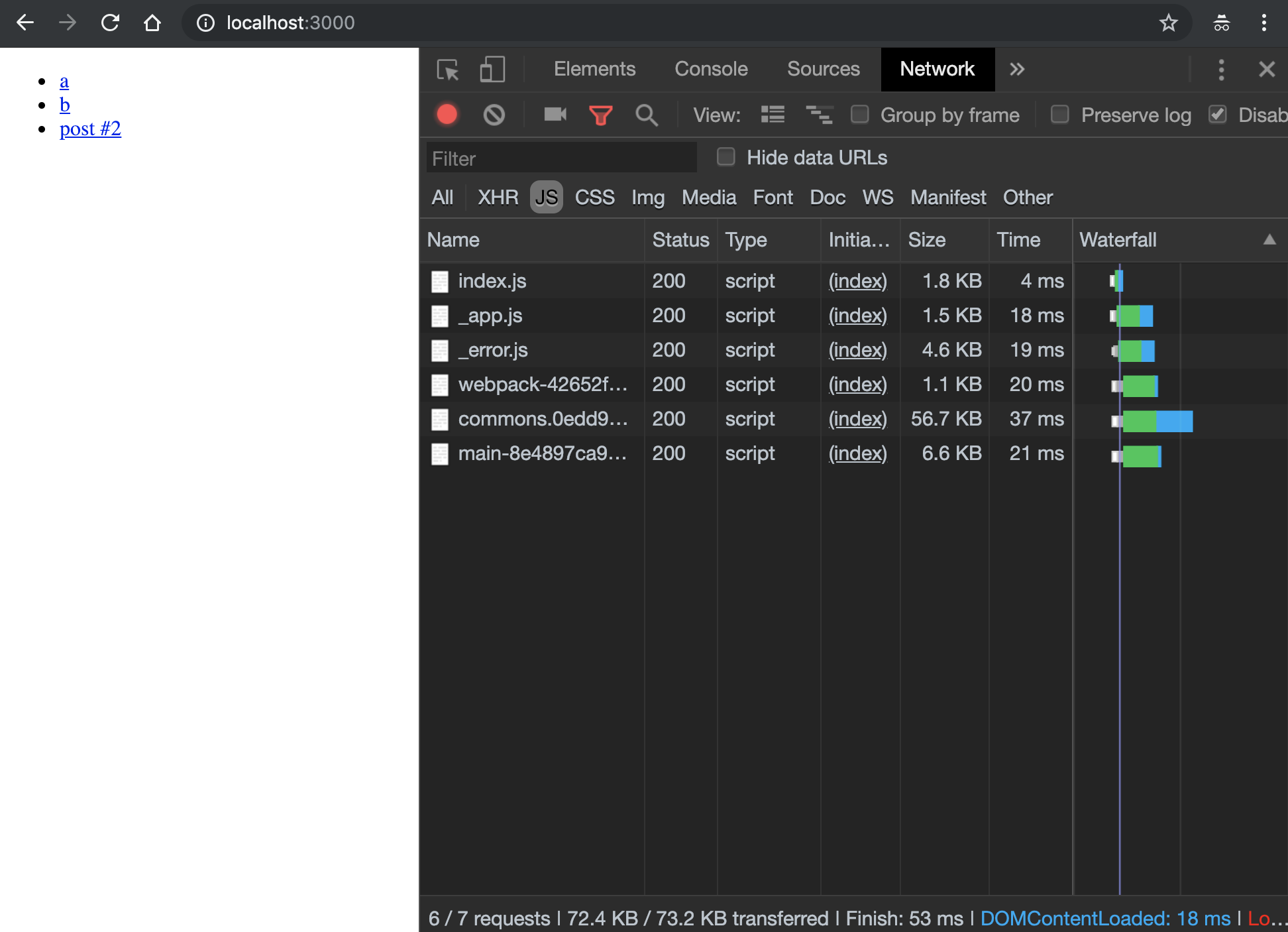
I also tried the production build with compression express middleware. These are the results I got with the latest next.js version
 piyushchauhan2011
on 16 Jan 2019
piyushchauhan2011
on 16 Jan 2019
@piyushchauhan2011 If you're using react and react-dom, you're looking at about ~35kb baseline. So those results aren't that surprising. If you're not using any weird edge-cases in the React API, consider preact to reduce bundle size.
NathanielHill
on 16 Jan 2019
Related issues
 jesselee34
·
3Comments
jesselee34
·
3Comments
 YarivGilad
·
3Comments
YarivGilad
·
3Comments
 wagerfield
·
3Comments
wagerfield
·
3Comments
 pie6k
·
3Comments
pie6k
·
3Comments
 havefive
·
3Comments
havefive
·
3Comments
Most helpful comment
Chiming in, for me a fresh install of next with only one line in a single page comes to 185kb uncompressed main bundle, compressing down to 61kb on L6 compression (default level for the compression() module).
Said bundle will take ~200ms to unzip, parse and execute on a low-end phone (~5 years old), at a cost of ~1.2 seconds to download for a total cost of 1.4 seconds. On desktop on an average connection the entirety of download, parse, execute will be <200ms.
FYI.