Next-auth: Link to custom sign in provider
Your question
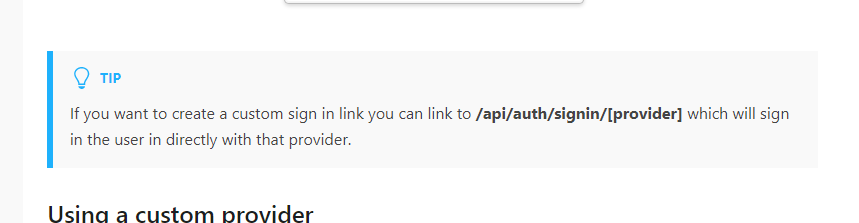
Is this feature still available? It currently seems to goes to the list of providers
What are you trying to do
Link to auth0 custom sign in provider /api/auth/signin/auth0 to sign user in directly
https://next-auth.js.org/configuration/providers
- [x] Found the documentation helpful
- [ ] Found documentation but was incomplete
- [ ] Could not find relevant documentation
- [x] Found the example project helpful
- [ ] Did not find the example project helpful
 simonbbyrne
All 3 comments
Ah! Good spot, thanks for asking about that. I think we probably need to update that section.
Until version 3.x an HTTP GET request to the URL could initiate a sign in journey, this made it easy to create custom sign in buttons.
To prevent an of XSS attack initiating signing in a user who had previous signed in, but then signed out again using something like a targeted iFrame on another site, these routes now require an HTTP POST request with CSRF forgery.
Some other sites use a GET request to start the journey, and it's not an inherent vector for doing something malicious (depending on how they use some other OAuth options in the flow), but is not ideal, as would allow a user to sign back in without their express consent, so was changed to not support this and to instead to display a list of the configured providers as fallback behaviour (so as not to be too onerous for people upgrading from 2.x).
So that it is still easy to create custom sign in buttons, the provider ID can be passed to the signIn() button.
e.g.signIn('google'), signIn('twitter') , signIn('auth0') (etc)
…which handles getting the CSRF token and submitting a POST request automatically so initiates the flow without an intermediate page.
 iaincollins
on 14 Aug 2020
iaincollins
on 14 Aug 2020
Thank you for the quick response Iain. I understand now why it was removed.
My plan is to use Auth0 provider for all my authentication needs. I'm currently redirecting in to /api/auth/signin/auth0 when the session is unavailable. I attempted to trigger the auth0 flow .
export const getServerSideProps: GetServerSideProps = async (context) => {
  const session = await getSession(context);
  if (!session || !session.user) {
    context.res.writeHead(302, {
      Location: '/api/auth/signin/auth0',
    });
    context.res.end();
    return;
  }

  return { props: {} };
};
In this case, should I create a custom signin page and call signIn('auth0') when we mount to initiate the flow?
simonbbyrne
on 14 Aug 2020
Ah yes, that seems like a good approach!
This is a good argument for NextAuth providing a better way of optionally redirecting folks who are not signed in.
iaincollins
on 14 Aug 2020
Related issues
 ryanditjia
·
3Comments
ryanditjia
·
3Comments
 ghoshnirmalya
·
3Comments
ghoshnirmalya
·
3Comments
 eatrocks
·
3Comments
eatrocks
·
3Comments
 barbara-lea
·
3Comments
barbara-lea
·
3Comments
 alephart
·
3Comments
alephart
·
3Comments
Most helpful comment
Thank you for the quick response Iain. I understand now why it was removed.
My plan is to use Auth0 provider for all my authentication needs. I'm currently redirecting in to
/api/auth/signin/auth0when the session is unavailable. I attempted to trigger the auth0 flow .In this case, should I create a custom signin page and call
signIn('auth0')when we mount to initiate the flow?